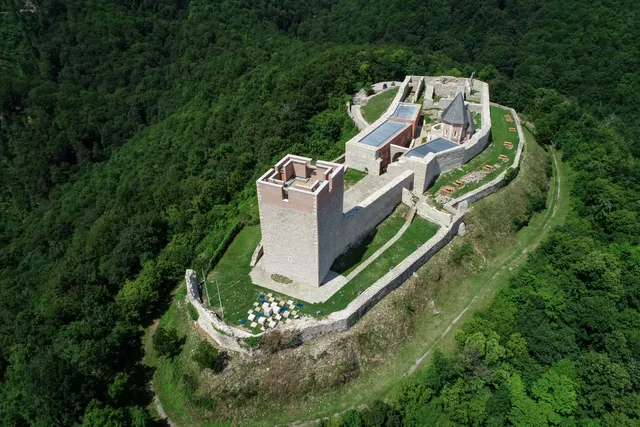
On the southern slope of Medvednica, at the top of the hill Mali Plazur, nests a picturesque medieval castle which has been watching over Zagreb for eight centuries.
It was built in 1254, after the catastrophic invasion of Tartars who had raided and devastated this area, burning and razing to the ground the two settlements now included in Zagreb: the burgherās Gradec and the bishopās Kaptol. Although built in order to protect the burghers, the bishop and the ecclesiastical treasure, castle Medvedgrad commanded such a perfect strategic site that it was perpetually in the centre of proprietary and political turmoil. In its history it changed many lords, either winning or losing it through marriage, purchase and sale, intrigue or even plotting. Even though magnificently fortified and always ready for battle, Medvedgrad was never attacked. On the contrary, the lords of Medvedgrad often filled their coffers and storehouses by plundering neighboring villages, and sometimes even, either by political or armed force, reached after Zagreb itself. The most notorious of them were the counts of Celje, who in the mid-15th century terrorized the town to such extent that many townspeople of Gradec had to flee from their homes. Even today the scary stories about the countess Barbara of Celje ā the ill famed Black Queen ā circulate about the villages at the foot of the mountain.
Medvedgrad was abandoned in 1590, after the fortress was devastated by a terrible earthquake, and its last lords moved to their much more modern and comfortable manor in Å estine.
Since then the castle at the top of the hill has been left to decay. It was visited only by adventurers and treasure hunters, searching for the treasure which, according to lore, was hidden there by the Black Queen.
The systematic archaeological research had started only in 1979, and since then the walls have been conserved and some parts of this best preserved Croatian medieval castle have been reconstructed. Thus from the ruins emerged again the octagonal chapel of St. Philip and Jacob, the south defensive tower, the residential palace and some other parts of the ancient fortress.
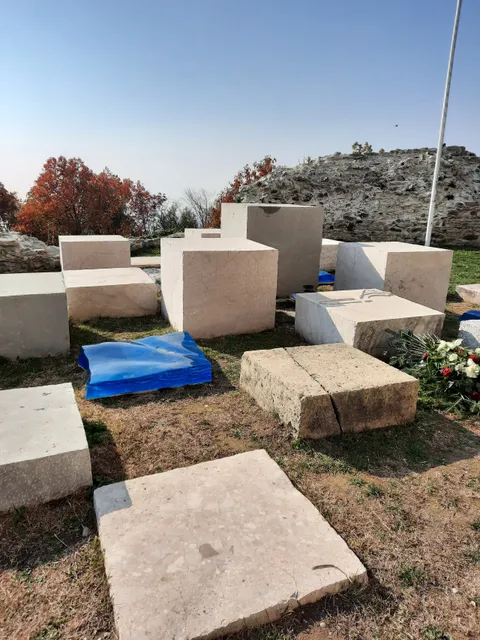
In 1994 a monument named the Homeland Altar, work of sculptor Kuzma KovaÄiÄ, was erected under the southern tower, burning an eternal flame in the honor of all Croatian heroes.
Nowdays the visitors of Medvedgrad can explore this ancient castle on their own or with a guide, and elucidate the ādarkā Middle Ages. They can find a souvenir of their visit in our little souvenir shop in the Great Palace.
In the near future the construction of a visitor centre is being planned, which will bring a new life to this picturesque medieval castle on...
Ā Ā Ā Read moreMedvedgrad was the first castle ruin Iāve ever visited, and it left a good impression. While itās not a huge complex, the views, atmosphere, and history make it worth the trip ā and entry is only 8 euros, which is very fair.
š° The Fortress: Itās a small, well-preserved medieval structure with scenic views over the city and forest. Thereās a chapel, outer walls, towers, and a few indoor areas. We explored it in about 1 hour and 30 minutes at a slow and calm pace.
š Accessibility: Thereās no public transportation directly to Medvedgrad. The nearest bus stop is about 2 km downhill, and the walk back up would have been too much for my friend, who has foot problems. Thatās why we chose a taxi, which was absolutely the right call. I wish there were a shuttle or dedicated access ā but considering the narrow road, I understand why buses donāt go all the way.
š Taxi story: We arranged for the driver to return after our visit. He came back as promised and even helped us figure out why we couldnāt access the Police Museum (reservation required), then took us to our next stops (zoo/intercity). He was very kind, and we gave him 50 euros total as a thank-you ā he deserved it.
š„ Crowds: We arrived at opening time and had the place almost to ourselves. Only when we were leaving did a group of school kids show up. It was very quiet and peaceful ā perfect for photography and relaxing exploration.
š· Overall experience:
Very calm and not too touristy
Beautiful nature surrounding the castle
Worth a visit if you want something scenic and not overwhelming
Took about 1.5 hours to enjoy everything
Very fair price at only 8ā¬
ā Final verdict: If you're in Zagreb and want a small, historical site with great views and peaceful surroundings, Medvedgrad is a great choice ā just be sure to arrange transport in advance if you donāt want a steep...
Ā Ā Ā Read moreMedvedgrad (593 m) je tipiÄan srednjovjekovni zamak koji se lijepo mogao vidjeti iz Zagreba sve do 1957, kada se jedne noÄi sruÅ”ila južna braniÄ-kula podlegavÅ”i zubu vremena. Bio je okružen dvostrukim prstenom debelih obrambenih zidova i s dvije braniÄ-kule, sjevernom i južnom. U kule se ulazilo kroz vrata na prvom katu. U gradu su bile dvije stambene palaÄe i nekoliko gospodarskih zgrada. Najvrednijom graÄevinom smatra se oktogonalna kapelica Sv. Filipa i Jakova, s kamenim uglovima, rozetama i 3 m visokim romaniÄkim portalom (posve je obnovljena). Sjeverno od nje bila je u kamenu Å”kriljevcu cisterna za vodu 5x4 m, dublja od 4 m. U grad se ulazilo sa sjevera kroz uzak ljevkast prolaz izmeÄu unutraÅ”njeg i vanjskog zida. Medvedgrad su sagradili 'sredstvima Crkve i za Crkvu' zagrebaÄki biskup Filip i zagrebaÄki Kaptol u razdoblju od 1249. do 1254. g. Äesto je mijenjao vlasnike. Gospodari su mu bili, osim kraljeva i zagrebaÄkih biskupa, kanonik Torusti, BaboniÄi, grofovi Celjski, braÄa Weyspriach, Stjepan Frankopan, Juraj BrandenburÅ”ki, Ivan KarloviÄ, grofovi Zrinski i Gregorijanci. Za Gregorijanaca grad je 1590. toliko oÅ”teÄen potresom da je morao biti napuÅ”ten, te se veÄ 1642. spominje kao ruÅ”evina. God. 1979. zapoÄela su istraživanja, konzervacija zidova i rekonstrukcija pojedinih dijelova. Do 1990. istraženi su prostori najstarijeg dijela, a rekonstruirana je i južna kula. Na Dan državnosti 30.5.1994. Medvedgrad je postao mjesto odavanja poÄasti svim hrvatskim junacima i hrvatskoj suverenosti. Toga je dana predsjednik dr. Franjo TuÄman otkrio pod južnom kulom Oltar hrvatske domovine, djelo kipara Kuzme KovaÄiÄa. Taj spomenik tvore velike kamene kocke razliÄitih vrsta kamena i veliÄina, s isklesanim hrvatskim motivima iz vremena kneza Branimira, velikim križem i stihovima hrvatske himne, posložene u hrvatski grb. (Izvor: Poljak, Željko, "Hrvatske planine: planinarsko-turistiÄki vodiÄ", 2. dopunjeno izdanje, Golden Marketing, Zagreb, 1998.)
Od Å estina do Medvedgrada biciklom oko 35 minuta....
Ā Ā Ā Read more