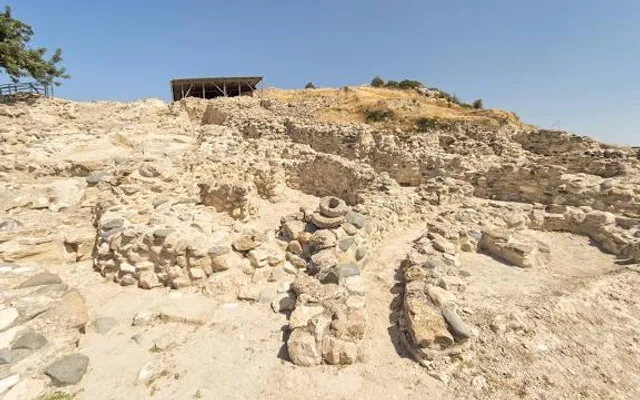
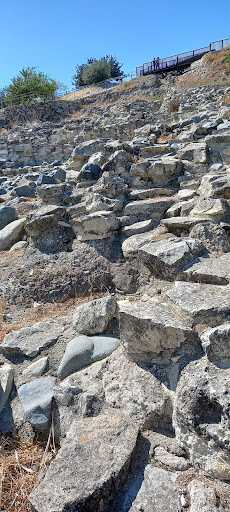
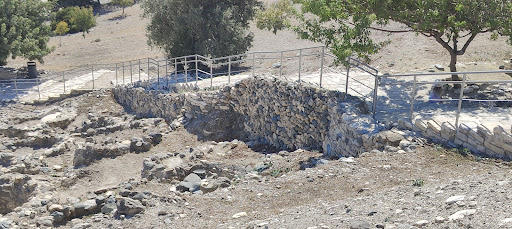
This place it was on my wishlist for years and today I decided to make the trip there and I'm wasn't at all disappointed. The site it has the original hut houses on the top of the hill and a small site at the bottom of the hill with reconstructed for visitors to see how were originally and how people lived back 100.000 years ago. The Neolithic village is a UNESCO site and after walking around it I could see why. I have taken the route up to the hill and I could see clearly the settlement how it was years ago, but there are also a lot of details to read so you get to understand the findings. I have walked the whole route and walking through the nature path could see where the Maroni river was passing and why it was important to build the village there in the first place. Also walking the nature path you get to see all the beauty of Spring with wild flowers everywhere. Most of the finds from the settlement are in the Larnaca Archaeological museum which I have visited a few hours before I made my way to Choirokitia which by combining the 2 together I could visually see how they lived and survived by. The entrance fee is 2.50 euros which it wasn't bad for spending nearly two hours walking on the site. There are toilet facilities which there were clean but not a cafe. The site is open from 8.30 to 17.00 in the Winter months and from 8.30 to 19.00 in the Summer. There is not wheelchair access to the site, but they can just visit the reconstructed huts. Also the Department of Antiquities can issue special entry cards for 1, 3 or 7 days at a reduced price and also a pensioners special entry card. For more information you can visit...
Read moreEs sieht dort wirklich schön aus,sehr viele Ausgrabungsstellen,viele Ruinen-ich denke mal aus Sandstein und mehr...Hier eine Info von dem Aetokremnos:
Aetokremnos (griech.: Adlerklippe[1]) ist ein Abri bei Limassol an der Südküste Zyperns, der 40 m über dem Meeresspiegel liegt.
Abri von Aetokremnos, 1960
Auf ca. 40 m² Fläche wurden in vier Schichten (die dritte ist steril) zahlreiche Knochen von Hippopotamus minor (ein verzwergter Vertreter des Flusspferdes) sowie etwa tausend Flintartefakte gefunden. Damit war Aetokremnos lange Zeit der einzige Fundplatz auf der Insel, der einer vorneolithischen und damit einer Jäger-und-Sammler-Kultur angehörte. Mit Roudia (7,2 ± 1,3 bis 12,8 ± 1,6 ka) kam ein zweiter Fundplatz aus dieser Epoche hinzu, der wohl noch älter ist.[2]
Zu den Flusspferdknochen kamen Knochen von etwa drei Individuen der Art Palaeoloxodon cypriotes, eine ebenfalls verzwergte Elefantenform, sowie Überreste von Fischen und Vögeln, vier Knochen von Damwild, 13 von Schweinen. Das Lager wurde auf etwa 9825 v. Chr. datiert.[3]
Zunächst nahm man an, damit den Beleg gefunden zu haben, dass die Jäger die Flusspferde wie die übrigen Vertreter der Megafauna ausgerottet hätten. Doch wiesen die Knochen keine Schnittspuren aufwiesen, hingegen 30 % von ihnen Brandspuren. Außerdem zeigte sich, dass 74 % der Knochen von Zwergflusspferden, 25 % von Fischen und Vögeln stammten, jedoch fanden sich nur Überreste von drei Elefanten. Die Flusspferde hingegen repräsentierten etwa 500 Individuen. Da sich die Zahl der Flusspferde von unten nach oben, also von den ältesten zu den jüngsten Schichten verminderte, zugleich der Anteil der anderen Tiere anstieg, folgerte Simmons, dass die übermäßig erfolgreichen Jäger gezwungen waren, nunmehr anderen Arten nachzustellen.
Die Anwesenheit von Schweinen überraschte insofern, als man geglaubt hatte, sie seien erst mit den ersten Siedlern des Neolithikums auf die Insel gekommen, also einer bäuerlichen Kultur. Sie waren neben Damwild die einzigen größeren Säugetiere auf der Insel.
Neben den genannten fanden sich Knochen von mindestens drei Schlangenarten, der Levanteotter (Macrovipera lebetina), der Pfeilnatter und der Zypern-Ringelnatter, (Natrix natrix cypriaca), einer heute bedrohten Unterart der Ringelnatter, sowie Überreste der Wechselkröte. Von den Knochen stammen 98,3 % von der Levanteotter.[4]
Inzwischen wurde durch einen Schädelfund bei Xylophágou im Südosten Zyperns der Nachweis erbracht, dass es auf Zypern eine zweite Elefantenart gab (Palaeoloxodon...
Read moreA well preserved archaeological site which is now a good tourist attraction. There is even a trail for hiking around it. I like the attention to detail that went into the reconstruction of the houses.
It gives you a rough idea how the Neolithic people of Cyprus lived. Giving is a fascinating glimpse of a primitive life. Very enlightening.
Well done to everyone involved.
The ticket was nice and cheap.
The only downside is that the information boards are not well presented or organised properly. Their information is written in Greek, English, and French, all over the place, it's a bit tricky to find the English translation for things. They could have kept them separate but that's a minor thing.
Overall a good place to visit for history and archaeology...
Read more