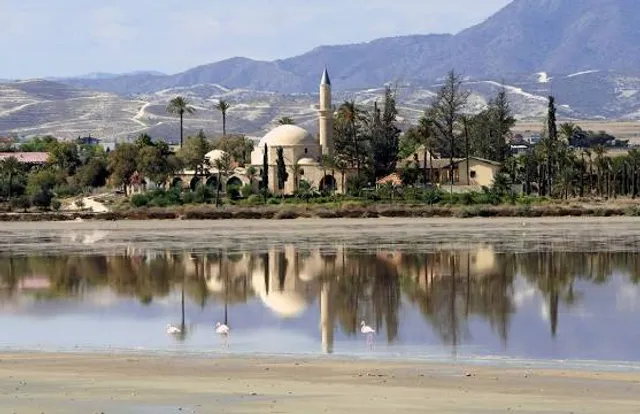
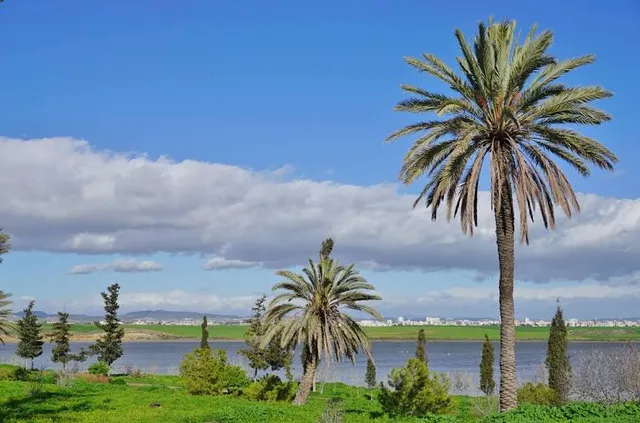
Ok the comment turned out really big so I cut it out into four sections as I have narrowed it out to the things that I really wanted to say: Important notice: Take precautions as there are lots of mosquitoes in the area and wear boots and closed shoes (definitely not sandals) if you intend to walk next to the bay of the salt lake as the area is also a biome for migratory birds, snakes and vipers (all protected from national nature authority). Useful information there is only one road to Halan Sultan Tekke and you have to turn left as soon as you exit the roundabout, so make sure you watch out and drive slowly otherwise you will have to go all the way to the next roundabout and then turn back. Additionally you can either pack directly at the parking lot you will see at your left side immediately after you have turned left, and the parking lot will also be at your left side. Then walk for two kilometres alongside the bay of the salt lake or you can keep driving (carefully as the road is really curvey) and park next to the monument. As a side note: from Halan Sultan Tekke you can walk directly through a stone path all the way to Larnaca salt bay and watch many migratory birds. This time of the year you can observe the flamingo flocks that come all the way from Africa and the Nile River. And a few words about the monument: Hala Sultan Tekke complex is composed of a mosque, mausoleum, minaret, cemetery, and living quarters for men and women. The term tekke (convent) applies to a building designed specifically for gatherings of a Sufi brotherhood, or tariqa, and may have referred to an earlier feature of the location. The present-day complex, open to all and not belonging to a single religious movement, lies in a serene setting on the shores of the Larnaca Salt Lake, which appears to be an important site also in prehistory. Hala Sultan Tekke is a listed...
Read moreHala Sultan Tekke, also known as the Mosque of Umm Haram, is a prominent Muslim holy site and historic landmark located on the west bank of Larnaca Salt Lake, in Larnaca, Cyprus. Here are some key details about this significant site:
Religious Significance: It is a mosque and tekke complex, which is a place of devotion and worship for Sufi orders. The site is particularly revered because it is associated with Umm Haram, the foster sister of the Prophet Muhammad’s mother, Aminah.
Historical Background: The area has been used as a cemetery since the second half of the second millennium B.C. The current complex includes a mosque, mausoleum, cemetery, and living quarters for men and women.
Architecture: The mosque features Ottoman architectural style with two domes and one minaret, reflecting the Islamic building traditions of the period.
Accessibility: The site is open to visitors with visiting hours typically from 08:30 to 19:30, allowing people to explore and appreciate its historical and spiritual context.
Hala Sultan Tekke is not only a place of great religious importance but also a part of the rich cultural heritage of Cyprus, offering insights into the island’s diverse history and the Islamic tradition. It’s a must-visit for those interested in religious history and architecture. If you’re planning a visit, it’s recommended to check the current opening hours and any visitor guidelines that may...
Read moreA beautiful drive up to this place.
Depending on the time of year you drive through a salt lake. In the summer months it’s practically dry but in the spring you may be lucky enough to see a flock of flamingos 🦩 thats right flamingos in Cyprus who would have thought. No need for an African Safari Holiday when its all here. M
As you come towards the end of the road there is the Hala Sultan Tekkesi.
During the second half of the second millennium B.C, the area of the Hala Sultan Tekke was used as a cemetery by the people who lived in an archaeological site known as Dromolaxia Vizatzia, a large Late Bronze Age town a few hundred metres to the West.
During the Ottoman administration of Cyprus, a mosque complex was built in stages around the tomb. The tomb was discovered in the 18th century by the dervish called Sheikh Hasan, who also built the first structure here. Dervish Hasan managed to convince the administrative and religious authorities of the site's sacred nature and with the permission he received, he built the shrine around the tomb in 1760 and had it decorated. The wooden fences around the tomb would have been built by the 19th-century Ottoman governor in Cyprus, Seyyid Elhac Mehmed Agha, which were replaced by fences in bronze and two doors by his successor Acem Ali Agha.
A nice...
Read more