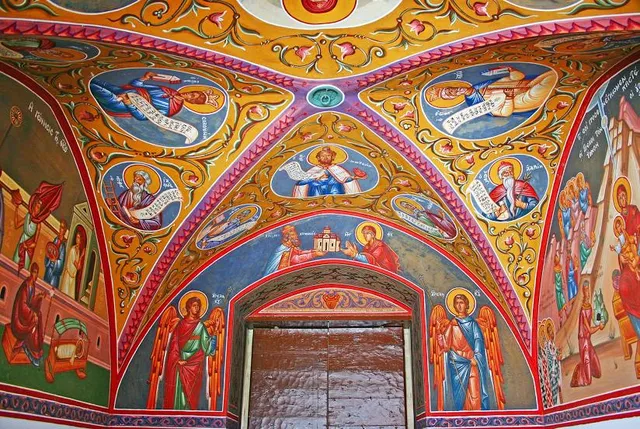
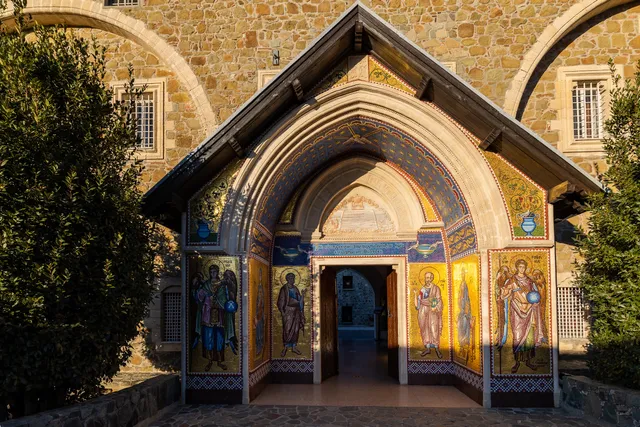
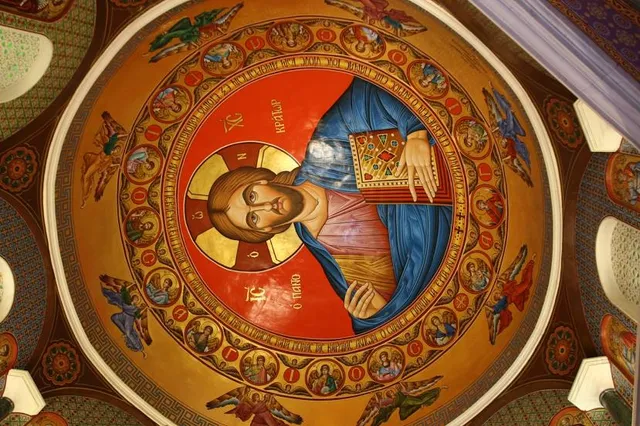
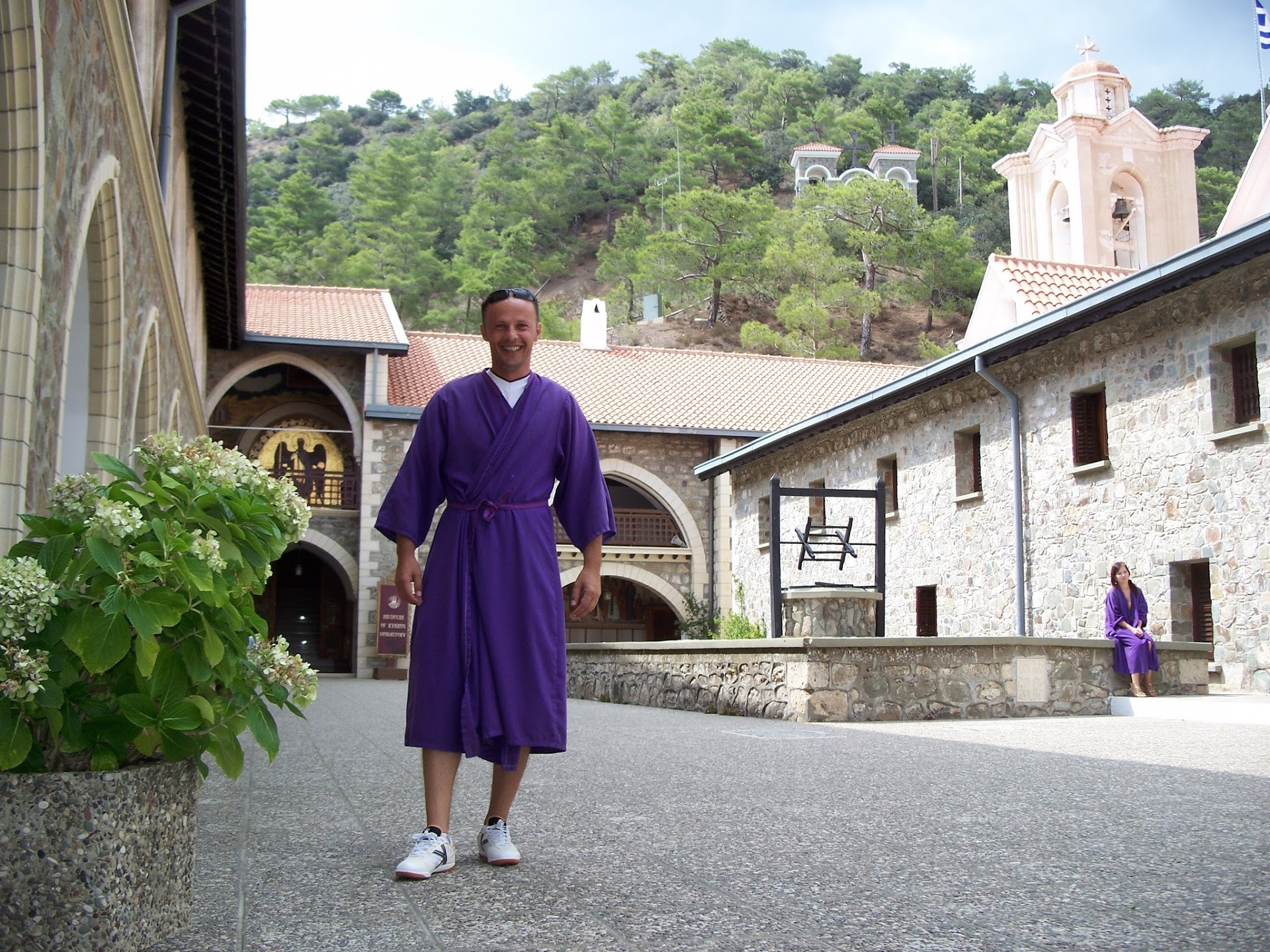
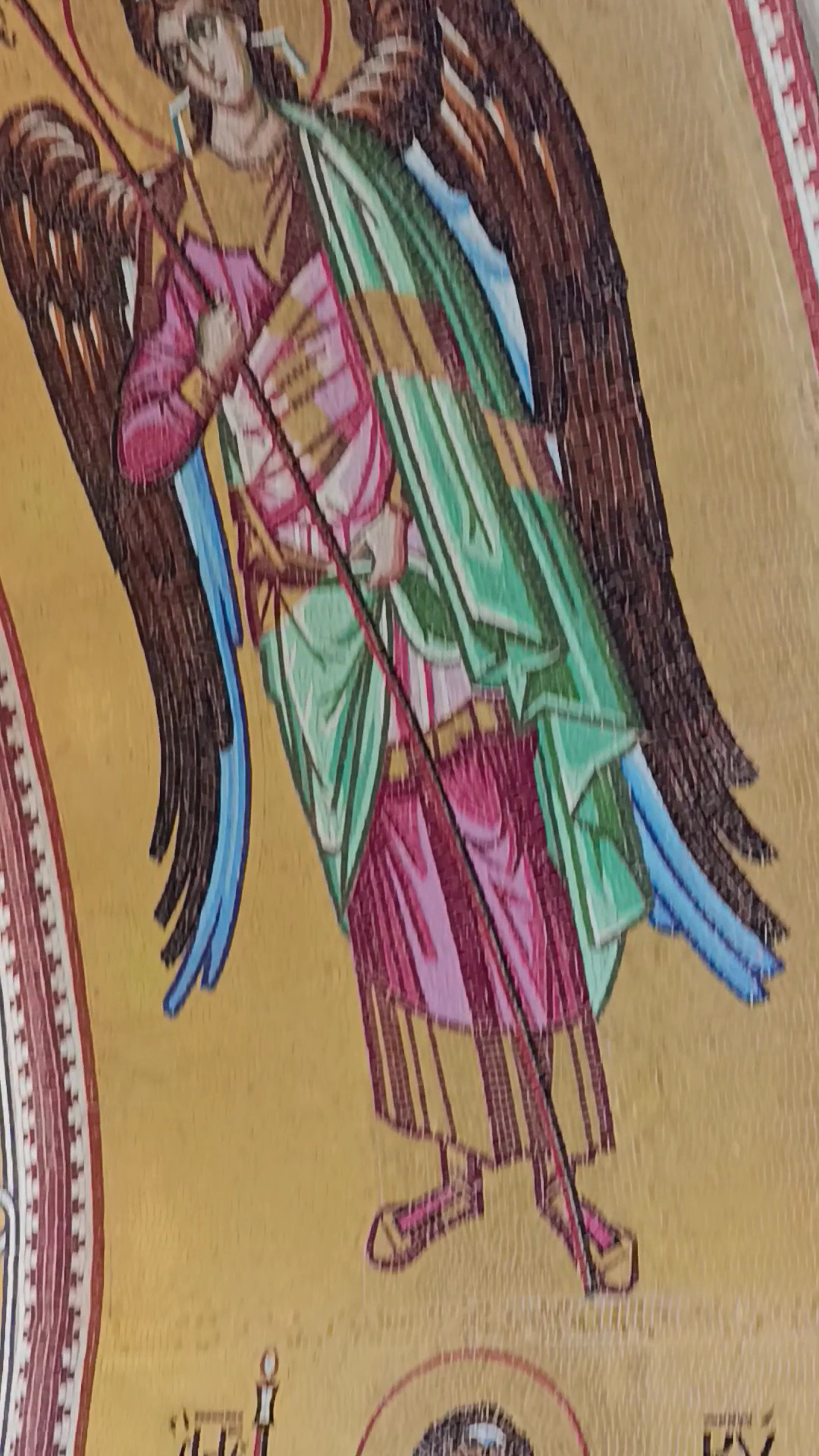
Very nice experience at Kikos monastery. When I eneterd inside it was surprise how they decorate thes church. Kykkos Monastery (or the Holy, Royal and Stavropegic Monastery of Kykkos) is located in the pinewoods of Troodos. From the time of its founding and to the present day, the monastery has been home to a miracle-working icon of the Virgin Mary, which according to a legend was created by the Apostle Luca himself, while the Virgin was still alive.
The icon is a gift from Alexios Komnenos – a Byzantine emperor, who also financed the construction of the monastery in the 11th century.
During its construction, a piece of the True Cross was placed under the foundation stone, which made the monastery stavropegic, meaning independent from the eparchy.
There are several theories behind the monastery’s name. One of them claims that a little bird had predicted its creation, singing: “Kikkos-kikkos will become a mountain monastery.” Another theory suggests that the word “kykkos” comes from the name of the local plant, called “kokkos.”
But how did the icon of the Virgin Mary, which used to belong to a Byzantine emperor, end up on the island? There is a legend, which claims that a hermit called Esaias used to live in a small cave at the site of the future monastery. One day Manuel Boutoumites, a Byzantine governor of the island, stumbled upon Esaias’ cell while hunting. Boutoumites had gotten lost and asked Esaias to show him the way. But the monk, who had taken an oath of silence, would not answer his questions. Boutoumites got angry and punished the monk.
Boutoumites forgot about the incident, but when he returned home he was struck by an unknown illness, which couldn’t be cured by any doctor. Boutoumites finally remembered the hermit and realized that he wanted to apologize to him for an undeserved punishment. Esaias forgave Boutoumites and began to pray for his health, which improved shortly thereafter. Boutoumites wanted to thank the old monk for his miraculous recovery, but the only thing that Esaias wanted was the icon of the Virgin, which was kept in the imperial palace at Constantinople.
Boutoumites and Esaias traveled together to Constantinople. There the monk cured the emperor’s sick daughter and performed several other miracles, which had impressed the ruler enough to convince him to part with his beloved icon. This is how the icon made its...
Read moreKykkos Monastery is truly an awe-inspiring destination, a magnificent testament to Orthodox faith and a must-visit for anyone traveling to Cyprus. Nestled high in the Troodos Mountains, it offers not just spiritual solace but also breathtaking vistas that stretch across the island's rugged beauty. From the moment you begin your ascent through the winding mountain roads, the journey to Kykkos Monastery is an experience in itself. As you reach its elevated position, said to be on one of the highest peaks, the air becomes crisp and the panoramic views are nothing short of spectacular. It's a truly amazing and breathtaking setting that instantly connects you with the serene and powerful presence of nature. For anyone with an appreciation for Orthodox Christianity, Kykkos Monastery is iconic. It is one of the wealthiest and most significant monasteries in Cyprus, renowned throughout the Orthodox world. Stepping inside, you are immediately enveloped in a rich tapestry of history, art, and devotion. The monastery is famed for its incredible collection of icons, particularly the miraculous icon of Panagia Eleousa (the "All-Merciful" Mother of God), which is believed to have been painted by St. Luke the Evangelist himself. While the main icon is traditionally veiled out of reverence, the sheer number and intricate beauty of the other icons, frescoes, and mosaics adorning the monastery's walls and chapels are simply stunning. The gilded woodwork and vibrant religious artwork create an atmosphere of profound spirituality and artistic grandeur. Beyond the main monastery, a short drive or walk uphill leads to the "Throni of Panagia," where a large statue of the Virgin Mary stands, and the tomb of Archbishop Makarios III, Cyprus's first president, who began his ecclesiastical career here. This spot offers even more expansive views and a deeper sense of the monastery's historical and cultural significance. Kykos Monastery is more than just a religious site; it's a cultural treasure that encapsulates the heart and soul of Cyprus. The sense of peace, the historical depth, and the sheer beauty of its location make it an unforgettable experience. Whether you are a devout follower, an art enthusiast, or simply seeking a place of profound beauty and tranquility, Kykkos Monastery will leave you with a lasting impression. It is...
Read moreKykkos Monastery: A Spiritual Oasis in the Troodos Mountains of Cyprus
Nestled high in the Troodos Mountains of Cyprus, the Kykkos Monastery stands as a testament to faith, history, and Byzantine art. This holy sanctuary, dedicated to the Virgin Mary, offers visitors a glimpse into the island’s rich religious heritage. Let us explore the mystical allure of Kykkos:
Founding and Legacy:
Founded around the end of the 11th century by the Byzantine emperor Alexios I Komnenos, Kykkos Monastery has endured centuries of trials and triumphs.
Its location at an altitude of 1318 meters on the northwest face of Troödos Mountains provides both spiritual elevation and breathtaking views.
Icon of the Virgin Mary:
The monastery houses one of the three icons attributed to Agios Loukas (Apostle Luke) the Evangelist.
This miraculous icon, believed to have been painted by St. Luke himself, draws pilgrims seeking solace and healing.
Architectural Splendor:
Kykkos Monastery showcases Byzantine architectural style. Its imposing walls, frescoes, and domes evoke a sense of reverence.
The main church, adorned with intricate mosaics and golden icons, invites contemplation.
Spiritual Connection:
As you step into the monastery, the scent of incense and the soft chanting of monks envelop you.
Light a candle, offer a prayer, and feel the weight of centuries of devotion.
Archbishop Makarios III:
The first President of Cyprus, Archbishop Makarios III, began his ecclesiastical career as a monk at Kykkos in 1926.
His love for the place endured throughout his life, and he requested to be buried there after his death in 1977.
Tomb of Archbishop Makarios III:
Located 3 kilometers west of Kykkos Monastery, the tomb of Archbishop Makarios III remains a popular visitor destination.
Pilgrims pay homage to the man who shaped Cyprus’ modern history.
Zivania and Religious Fairs:
Kykkos Monastery produces Zivania, a traditional Cypriot spirit.
The monastery hosts religious fairs, drawing crowds seeking blessings and community.
In summary, Kykkos Monastery transcends time—it’s a place where ancient icons meet modern pilgrims, where silence speaks louder than words. 🌟🏛️🇨🇾
For more information, visit Kykkos Monastery on Wikipedia or explore its hallowed halls in person. Happy...
Read more