Positioned around 70 kilometers east of Prague, Kutná Hora houses some of the most beautiful architecture in the whole of Bohemia. Today, Kutná Hora displays a sedate and impressive vision of Czech culture and tradition, hence its UNESCO World Heritage Site status.
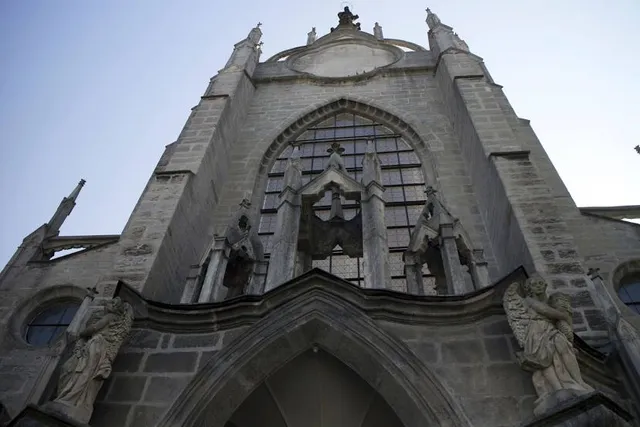
But amid its Baroque-style buildings and medieval churches, lies an attraction that's definitely not for the faint-hearted traveler. Take a short walk through the narrow streets of the small suburb of Sedlec and you'll reach a quaint yet eerie chapel. And while the Church All Saints seems rather unassuming from the outside, lurking underneath is an enthralling tale of mystery and death, with bones of over 40,000 have been gathered here....
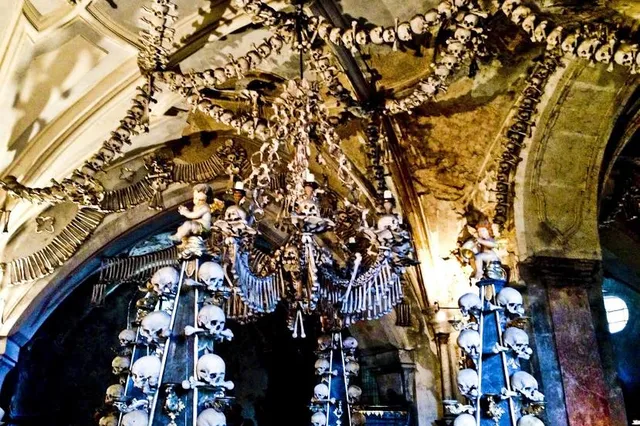
The interior of the cemetery church, otherwise known as the Chapel of Skulls, was entirely made of bone. You can see crosses, inscriptions and altars from elements of the human skeleton. The huge chandelier and the Schwarzenberg family crest depicting a raven pecking at the severed head a special impression on those entering it. Two large bone chalices, four baroque bone candelabras, six enormous bone pyramids, two bone monstrances, a family crest in bone, and skull candle holders. Festively looping chains of bone are hung throughout like crepe paper at a birthday party...
The church has a long history, beginning in the 13th century when the Abbot of the Sedlec Monastery (Abbot Henry) brought a handful of earth back from a journey to the Grave of the Lord in Jerusalem. He scattered this “holy soil” across the Sedlec cemetery, securing its place as one of the most desired burial sites for people all over Bohemia and the surrounding countries. Everyone, even victims of the plague epidemic that broke out in this area in the fourteenth century, as well as those killed during the Hussite wars and the Thirty Years' War, wanted to be buried in that handful of the Holy Land, but it simply wasn’t enough room for everyone to rest in peace. This changed in the nineteenth century, when with the consent of the church authorities known at that time sculptor and carpenter František Rint, in 1870, was employed for the task of artistically arranging the thousands of bones, created from them elements of the interior design of the church.
You can try an one-hour train ride from Prague, then just walk to the church from the Kutná Hora train station in about ten minutes.
Opening hours: Daily 09:00 – 18:00 (closed on December 24) Ossuary Admission: Child, Student, Senior, Disabled 60 CZK (2.77 USD) – Adult 90...
Read moreIn 1278, Henry, the abbot of the Cistercian monastery in Sedlec, was sent to the Holy Land by King Otakar II of Bohemia. He returned with a small amount of earth he had removed from Golgotha and sprinkled it over the abbey cemetery. The word of this pious act soon spread and the cemetery in Sedlec became a desirable burial site throughout Central Europe.
In the mid 14th century, during the Black Death, and after the Hussite Wars in the early 15th century, many thousands were buried in the abbey cemetery, so it had to be greatly enlarged.
Around 1400, a Gothic church was built in the center of the cemetery with a vaulted upper level and a lower chapel to be used as an ossuary for the mass graves unearthed during construction, or simply slated for demolition to make room for new burials.
After 1511, the task of exhuming skeletons and stacking their bones in the chapel was given to a half-blind monk of the order.
Between 1703 and 1710, a new entrance was constructed to support the front wall, which was leaning outward, and the upper chapel was rebuilt. This work, in the Czech Baroque style, was designed by Jan Santini Aichel.
In 1870, František Rint, a woodcarver, was employed by the Schwarzenberg family to put the bone heaps into order, yielding a macabre result. The signature of Rint, also executed in bone, appears on the wall near the entrance...
Read moreWhat a stunning display of devotion. This has been on my bucket list for years. I'd suggest NOT going with a tour group if this is something on you bucket list. While it's pretty small but there is so much to see and being rushed through (25ish minutes when the tour stated was supposed to be 60 minutes) I am not sure that is need 60 minutes because of the size but being able to really investigate the bone structures would have been nice. Especially since you aren't allowed to take pictures. I totally understand that restriction out of respect for the dead so no complaints about that. I bought a lot of postcards , magnets, a shirt and a pair of socks to support this incredible place. I overheard the Ossuary's tour guide explaining how they were deconstructing larger pyramids to build a more supportive structure so the weight of the upper layers of skulls and bones wouldn't damage the bottom layers. They had completed one pyramid so you could see how it looks after restoration was completed. It was meticulous and so glad to see the family that owns it is interested in preserving it for the future.
Just wish I'd had more time to really take it all in and absorb the details. Again this is not the fault of the Ossuary. I'd 1000% recommend to anyone interested. I'll definitely return if we make it...
Read more