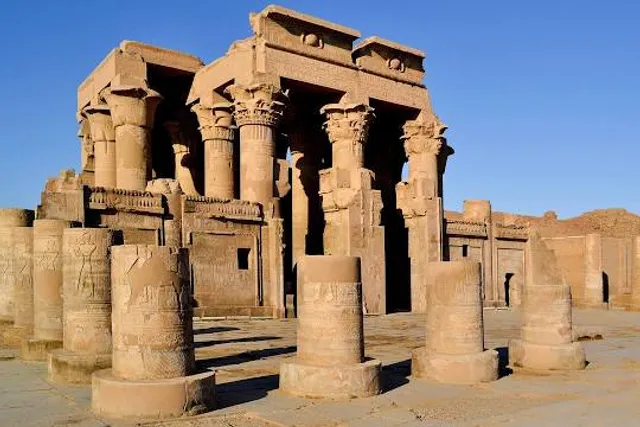
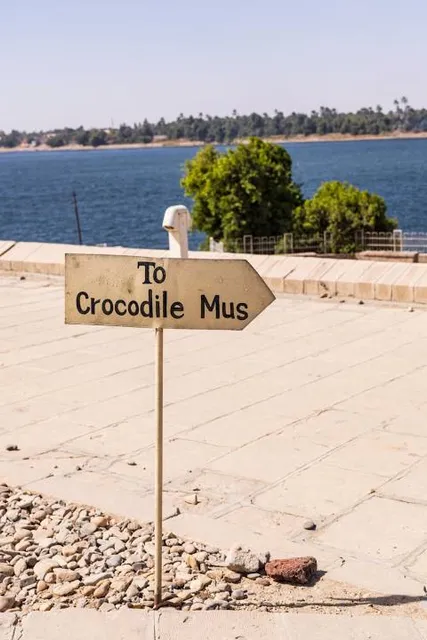
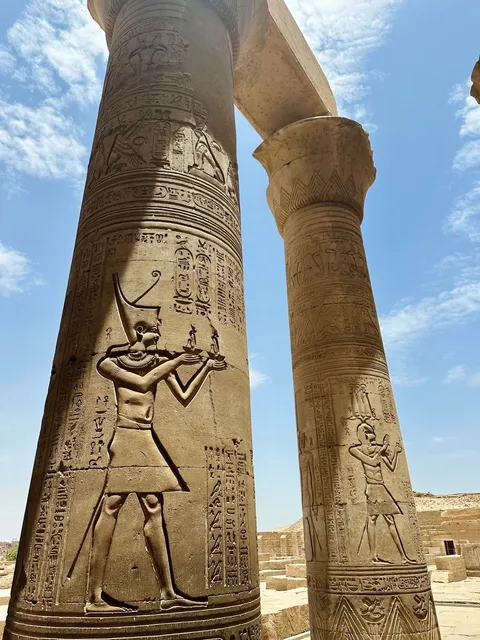
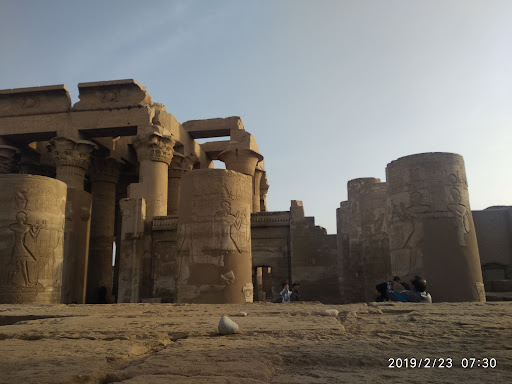
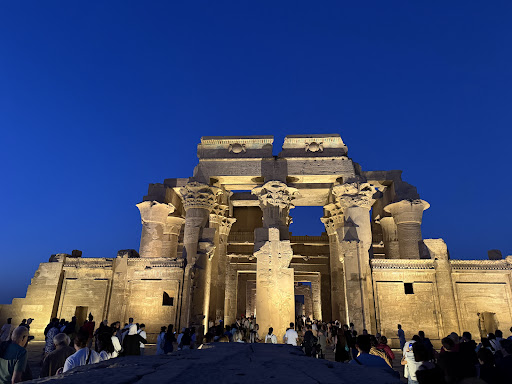
KOM OMBO TEMPLE. Temples at Kom Ombo were constructed for two sets of gods. Crocodile God Sobek along with Hathor and Khonsu. Which formed the southern part. Northern part which was dedicated to Falcon God Haroeris along with Goddess Tasenetnofret and God Panebtawy. Over period of time most of the temples were destroyed by Nile, earthquakes and builders who came at later periods and removed stones to construct newer buildings. Some damage was also caused by Christians who used these temples as church. Crocodile God Sobek's temple, the southern portion was in relatively better condition with even the roof of some passages and rooms still intact. This portion was cleared and restored by a french man in 1813 . Today this is the only portion where walls, roof and pillars are In a better state. Here Hieroglyphics are also in better state. Rest of the temple area though cleared of rubble, is full of ruins. Remains of bottom 5-10 feet of huge columns gives one an idea of the hugeness and the beauty of the original Temples in their hey days. At one point, in broken wall the guide pointed out how tapered cedar wood blocks were used to hold the building blocks together.(see photo). The layout follows that of other Egyptian temples of those era. There is wall enclosed courtyard. Next a vestibule. Followed by hypo style hall. And lastly the sanctuary. Side rooms for storage and use of priests. The passage roof, even after almost 2500 years later, still has coloured paintings of flying vultures in comparatively very good condition. The walls and pillars are all full of Hieroglyphics and bass reliefs. Many of them in good condition but many of them chiseled out deliberately by later Christians and many destroyed simply due to natural calamities and adding Without the guide it is not possible for us to know meaning of these Hieroglyphics and bass reliefs. Even the best of guides may not explain the meaning of all the reliefs as it is not possible to do so in and any reasonable time frame. Some of the relief panels explained to us by our guide were, Faint colours around royal symbol are still visible on the summit blocks.(see photo), Goddess of Upper Egypt and Lower Egypt declaring the King as sovereign of Upper AND Lower Egypt with a crown with symbol of Upper and Lower Egypt (see photo), King wearing double crown of Upper and Lower Egypt Making offering to various Gods(see photo), Lunar Calendar as followed by ancient Greek/ Roman / Egyptian of that period, Three seasons in a year. Floods, Harvest and Dry(see photo), Lady giving birth to a child. Romans had devised a chair, some thing like a commode of today. Seated lady delivered the baby. Shown in extreme right. On the left breast feeding the child (see photo), Surgical tools of that period.(see photo). Broken portion where only lower portion is left shows King offering surgical tools to God.(see photo). And On the left surgical tools of that period being offered to God by King. On the right is one of the prescription in .heriolygraphic writing(see photo). CROCODILE MUSEUM. After Kom Ombo Temple we went and saw museum. Photography is not allowed in side. There are lots crocodile mummies. On display are many exhibits related to crocodile God and it's worship. A very interesting exhibit contains large numbers of fossilised crocodile eggs showing growing crocodile foetus in varying stages of growth. After the returned to...
Read moreThe Kom Ombo Temple in Egypt is a double Temple codedicated to the crocodile deity Sobek and Falcon headed Haroeris. This has generated the architecture of a symmetrical design in the Kom Ombo Temple. Temple construction commenced under Ptolemy VI and continued thru to Ptolemy VIII and Temple was added to under the Romans. We arrived at the temple steps by the River Nile cruise originating at Aswan and held up stream for many hours due to uncertain weather conditions disrupting inland river navigation. We arrived on a cloudy late evening on the steps and entered the temple.The cabin attendant on our Nilde Jewel ship entertained us by making a Crocodile of bath towels for our grandson a picture is enclosed which is well executed and skillful work. There is available a tremendous literature on the temple with detailed pictures but in the limited time we had in the temple precincts would like to stress on the three path breaking exhibits in the temple namely
The small town of Kom Ombo is situated on the East side of the Nile, 45 kilometers to the North of the city of Aswan, about 800 kilometers to the South of Cairo, the capital of Egypt.The word "Kom" in Arabic means the small hill and the word "Ombo", in the Hieroglyphic ancient Egyptian language means the gold. Therefore, the word Kom Ombo, as a whole, means the hill of the gold. The Temple of Kom Ombo is an unusual double temple in the town of Kom Ombo in Aswan Governorate, Upper Egypt. It was constructed during the Ptolemaic dynasty, 180–47 BC. Some additions to it were later made during the Roman period. The building is unique because its 'double' design meant that there were courts, halls, sanctuaries and rooms duplicated for two sets of gods. The southern half of the temple was dedicated to the crocodile god Sobek, god of fertility and creator of the world with Hathor and Khonsu. Meanwhile, the northern part of the temple was dedicated to the falcon god Haroeris, also known as Horus the Elder, along "with Tasenetnofret (the Good Sister, a special form of Hathor or Tefnet/Tefnut and Panebtawy (Lord of the Two Lands). The temple is atypical because everything is perfectly symmetrical along the main axis.They believed that as a totem animal, and object of worship, it would not attack them. Captive crocodiles were kept within the temple and many mummified crocodiles have been found in cemeteries, some of which can be seen in the temple sanctuary today. Much of the temple has been destroyed by the Nile, earthquakes, and later builders who used its stones for other projects. Some of the reliefs inside were defaced by Copts who once used the temple as a church. All the temples buildings in the southern part of the plateau were cleared of debris and restored by Jacques de Morgan in 1893.The Temple of Kom Ombo, which we view today and was built during the Greco Roman period, was constructed on the ruins of a much older temple which was called "Ber Sobek" or the house of the god Sobek.
The Ptolemies have constructed the Temple of Kom Ombo for the worship of two gods, Sobek; the Crocodile god, and Horus, the falcon god. This is why the complex mainly consists of two parallel temples with all the traditional components of such ancient Egyptian religious structures are present in...
Read more