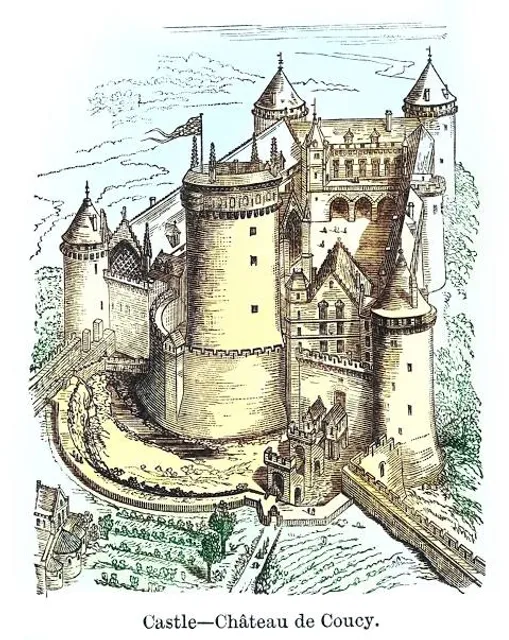
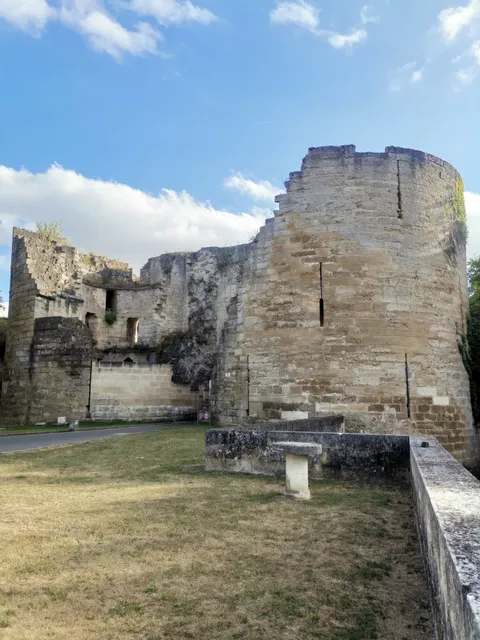
The Château de Coucy is a French castle in the commune of Coucy-le-Château-Auffrique, in Picardy, built in the 13th century and renovated by Eugène Viollet-le-Duc in the 19th century. In April 1917, the German army dynamited the keep and the four towers using 28 tons of explosives to prevent their use by enemy artillery spotters as the Germans fell back in the region. During its heyday, it was famous for the size of its central tower and the pride of its lords, who adopted the staunchly independent rhyme: roi ne suis, ne prince ne duc ne comte aussi; Je suis le sire de Coucy ("I am not king, nor prince nor duke nor count; I am the Lord of Coucy").
The castle was constructed in the 1220s by Enguerrand III, Lord of Coucy. The castle proper occupies the tip of a bluff or falaise. It forms an irregular trapezoid of 92 x 35 x 50 x 80 m. At the four corners are cylindrical towers 20 m in diameter (originally 40 m in height). Between two towers on the line of approach was the massive donjon (keep). The donjon was the largest in Europe, measuring 35 meters wide and 55 meters tall. The smaller towers surrounding the court were as big as the donjons being built at that time by the French monarchy. The rest of the bluff is covered by the lower court of the castle, and the small town. Coucy was occupied in September 1914 by German troops during World War I. It became a military outpost and was frequented by German dignitaries, including Emperor Wilhelm II himself. In March 1917 the retreating German army, on order of General Erich Ludendorff, destroyed the keep and the 4 towers. It is not known whether this act had some military purpose or was merely an act of wanton destruction. The destruction caused so much public outrage that in April 1917 the ruins were declared "a memorial to barbarity". War reparations were used to clear the towers and to consolidate the walls but the ruins of the keep were left in place.
One of its lords, Enguerrand VII (1340–1397) is the subject of historian Barbara Tuchman's study of the fourteenth century, A Distant Mirror. It also features extensively in British author Anthony Price's 1982 crime/espionage novel The Old Vengeful. Château de Coucy has been listed as a monument historique by the French Ministry of Culture since 1862, and is managed by the Centre des...
Read moreAmazing place. Steeped in history and with a rich past. Our expectations were low because from the drive up to it, it looked like a crumbling ruin. In reality it’s a stunning site, with many areas restored carefully to make visiting these areas very exciting. I loved that even as a ruin, I found graffiti on some stones from WWI right back to 1799. I bet there is some even older to give an indication of people being at this Chateaux since 920. In fact the whole town is walled and protected by towers and makes for a fascinating visit. There are some cramped and tight spiral steps to get up some of the towers and a lot of the ground is uneven in places so accessibility would be an issue. There is a proper reception area with souvenirs and they accept payment by cash and card. We spent 1.5 hours there and were really blown away by the size and quality of the site. Would...
Read moreSize matters! At least that is what Enguerrand III the Great, also known as Enguerrand the Builder, must have thought when he began renovating the castle in 1223. After seven years of construction, a 54-meter-high and over 30-meter-high tower stands here, making it the largest keep in Europe. And it will stay that way until the German troops blow up the keep in 1917. The size and strength of the keep is evident from the fact that they needed 28 tons (!) Of explosives to blow up this structure. The meters of thick foundations still impress the visitor of this remarkable ruin with its...
Read more