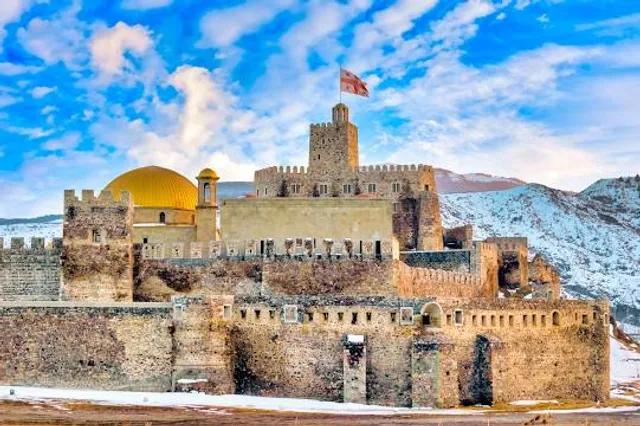
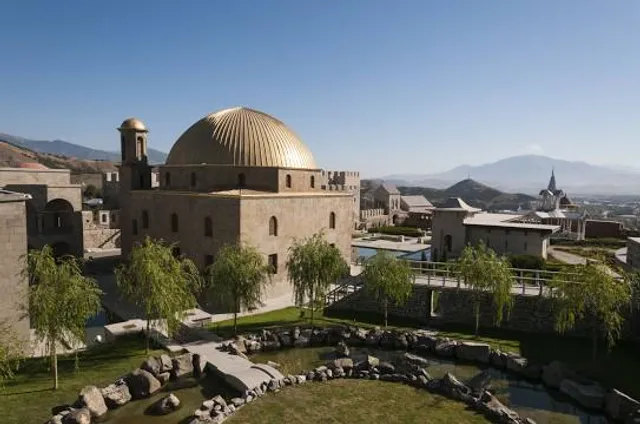
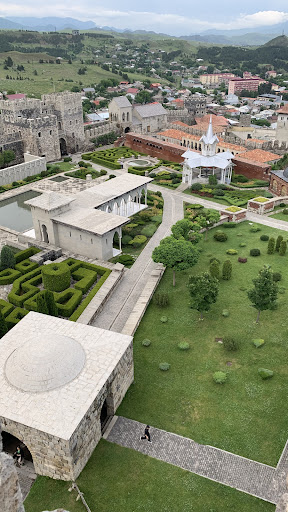
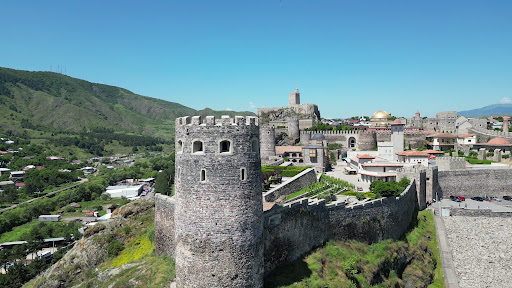
A classic tourist trap. The Akhaltsikhe Castle is a relatively large complex of buildings pretending to be a piece of history, whereas in fact there is very little of the original structure left to see. Rather than being an object which aims to exhibit Georgian heritage, it is structured as a commercial enterprise which aims solely to generate as much revenue as a “trapped” tourist will bare.
Walking into the complex as a foreign tourist you immediately feel used - a Georgian citizen pays 7 GEL, whereas a foreign tourist has the privilege of paying 18 GEL. Many countries have laws against charging tourists more than local people, while in Georgia the Ministry of Tourism formalized the practice … but I digress.
The 18 GEL buys you access to the castle, but not the museum. That’s additional 15 GEL or so. I did not get to see it, because it was closed during regular castle hours.
There is no guidance whatsoever on how to explore the castle. A map of the castle is available for 2GEL - sadly, while it clearly labels the souvenir shop, it misses many if not most of the castle features. The features which are labelled, are just that: no description of function or historical context.
There is no information at all about anything as you randomly walk around. Nothing at all. Most of the structures you walk on appear brand new, and you have a distinct feeling that they have nothing to do with history. You are treated to some “artistic rendering” of what may have been.
This castle has been, so far, my most disappointing experience in Georgia, and I would recommend avoiding it, even if it happens to be on your...
Read moreAccording to the Georgian Chronicles the city was established in the 9th century by Guaram Mampali, son of the King of Tao. At the end of the 12th century Lomsia turned into a real city with the new name Akhal-tsikhe (New Fortress), which in addition to the fortress had a serious system of city-wide fortifications – high walls, guarded entrance gates and watch towers. From the 13th to the end of 14th centuries it was the capital city of Samtskhe-Saatabago, ruled by the Georgian princely (mtavari) family and a ruling dynasty of the Principality of Samtskhe, the House of Jaqeli.
In 1393 the city was attacked by the armies of Tamerlane. Despite the Turko-Mongol invasions, the fortress withstood and continued to thrive. After the Treaty of Constantinople in 1590, the whole territory of Samtskhe-Saatabago came under the rule of Ottoman Empire.
Metropolitan John writes in the late 18th century that "despite the fact that a large part of the population has been Islamized, there's still a functioning Orthodox church." After the Treaty of Georgievsk between the Kingdom of Kartli and the Russian Empire was signed, the question of the fate of Akhaltsikhe arose. The first attempt to take the fortress in 1810 failed. However, Prince Paskevich successfully stormed the fortress 18 years later, in the great Battle of Akhaltsikhe. After the Treaty of Adrianople in 1829, the Ottomans yielded this part of Akhaltsikhe Region.
The fortress and its adjacent buildings were extensively rebuilt and renovated in 2011–2012 in order to attract more...
Read moreAkhaltsikhe (Rabati) Castle, located in southern Georgia, is a magnificent fortress complex that beautifully combines history, culture, and architecture. With origins dating back to the 9th century, the castle has undergone significant transformations over the centuries, blending medieval, Ottoman, and Georgian styles into a unique and captivating landmark.
The sprawling complex features stone fortifications, towers, and courtyards, along with beautifully restored structures such as a mosque, a minaret, a church, and a synagogue, reflecting the region’s diverse cultural heritage. The castle also houses a museum that showcases artifacts, manuscripts, and historical exhibits, offering insights into Georgia's rich past.
Rabati Castle’s elevated position provides stunning panoramic views of Akhaltsikhe and the surrounding landscape, making it a favorite spot for photography enthusiasts. The complex is especially enchanting at night when illuminated, creating a magical atmosphere that highlights its architectural grandeur.
The castle’s grounds include charming gardens, cafes, and shops selling local crafts and souvenirs, making it an excellent destination for families, history buffs, and casual travelers alike. Conveniently located near other attractions such as Vardzia and Borjomi, Rabati Castle is a must-visit destination that combines historical intrigue with modern comforts, leaving visitors inspired and in awe of Georgia’s...
Read more