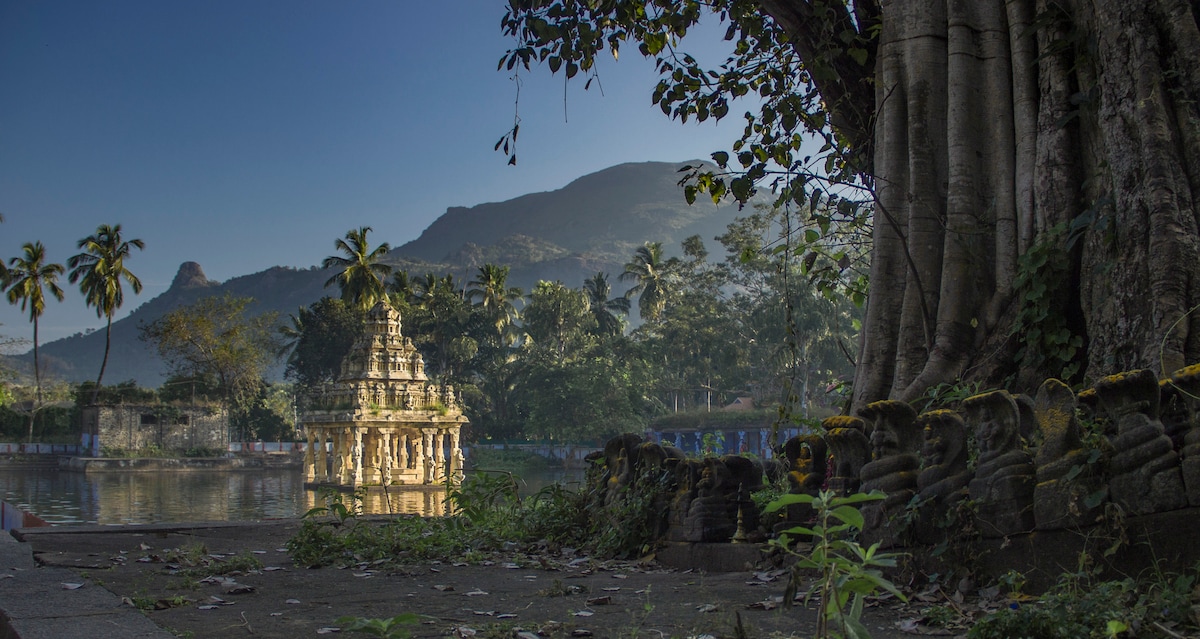
Suchindram Shree Thanumalayan Swamy Temple is located in , Suchindram, Tamil Nadu at a distance of 80 Kms from Tirunelveli and 6 km from Nagercoil and 13 kms from Kanyakumari.. It is one of the Abhimana Kshetrams in Vaishnavite traditions. It is also one of the 108 Shiva Temples revered by the Kerala Hindu culture, It is more than 2000 years old
Stanumalaya denotes Trimurtis; “Sthanu” represents Lord Shiva, “Mal” and “Ayan” represents Lord Vishnu and Lord Brahma. Therefore it is of great significance for both Shaivites and Vaishnavites It is one among very few temples in India where the Trinity [Brahma, Vishnu, and Shiva] is worshipped. The Trinity is worshipped here in the form of a huge Linga. It has 3 divisions, starting from Shiva at the top, Vishnu at the middle and Brahma at the bottom of the Linga respectively. Apart from the Trinity, Vigneswari (a feminine form of Vinayaga), Goddess Aram Valartha Nayaki, Indra Vinayaga, Kala Bhairava and Sakshi Ganapathy are also worshipped here.
As per Legend, Indra was cursed by Rishi Gauthama for his evil intentions on Rishi’s wife Ahalya and In order to free himself from the curse he visited Gnanaranya temple for performing "Ardhajama Pooja", or worship, at midnight every day and got relieved of the curse.The term "Suchi" in Suchindrum is believed to have derived from the Sanskrit meaning that stands for "purify"
As per another Legend, the trinities Brahma, Vishnu and Shiva wanted to make Anasuya's (wife of Rishi Atri) name eternal with their divine act. They came to the sage's hermitage as Brahmin mendicants. The Brahmins put forth a condition that they would accept food if she serves nude. With her power of chastity, she converted the three to small kids and served them food. The concorts of the Trinities Parvathi, Saraswathi and Lakshmi requested Anasuya to restore their husbands to their original form. Anasuya obliged immediately and the trinity blessed the couple for their devotion. The three emanated in the form of three Lingas and the place where the couple worshiped the trinity is believed to be the temple..
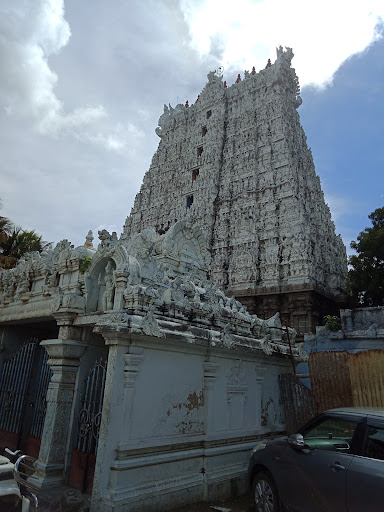
The temple is built with Kerala style and Tamilnadu style architecture. The temple complex covers around two acres with 134-foot-tall gopuram. On the outer prakaram, there are separate shrines for Cheravasal Sastha, Rama and Lord Muruga. There is an imposing monolithic image of Lord Anjaneya opposite to Lord Rama's Shrine. It is about 5.5 m high and is said to represent the Viswarupa of Hanuman as shown to Sita at Ashoka Vana in Lanka. On the northern corridor, there are four musical pillars cut out of single granite blocks.
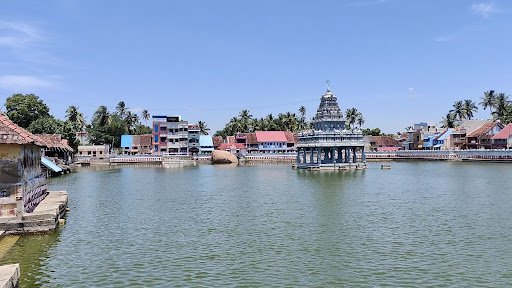
There are some 30 additional shrines, including those for Lord Vishnu, Sita-Rama, Kailasanathar, Pancha Pandavar, Natakasala, Kontai Adi, Subramania Swamy, and Garuda, along with Unjal, Dwaja, Chenbagaraman, Vasantha, and Alankara Mandapam. There is also a Gopura Vasal, Nandeeswar shring, Chitra sabai, and the great Hanuman murti, all encircled by a temple corridor. The Theertham here is the Prapancha tank.
The main Visnu shrine made of panchalokas (metals). To the right of it are the Sita-Rama deities, and across from them is the very tall Hanuman murti. .There rare female form of Vinayaka (Ganesha) here is known as Vigneshwari, or Vallabha Ganeshaani. Outside, there is an excellent collection of paintings found on the walls of the temple gopuram, The approximately 115 paintings on the seven tiers of the tower are 120 years old, drawn onto the limestone walls using herbal extracts.
As per Legend about Suchindram Temple is the age-old practice of Agnipariksha that was practiced here up until the 1860's, when it was forbidden by the government. This ritual was intended to test the sanctity of the Namboodri Brahmin.
The chariots of Sthanu-Mal-Ayan temple are very beautiful, and the center of attractice at the annual Car Festival here.
The temple timings : 4:30 am – 11:30 am and 5...
Read moreThe Suchindram temple offers a rare opportunity to worship the holy Trinity -- AND Hanuman. Set in an area of nearly four acres, the temple is a grand display of Dravidian temple art and architecture. The present temple was built in the 17th Century, though experts have identified 9th Century inscriptions there, perhaps proof of a more ancient lineage.
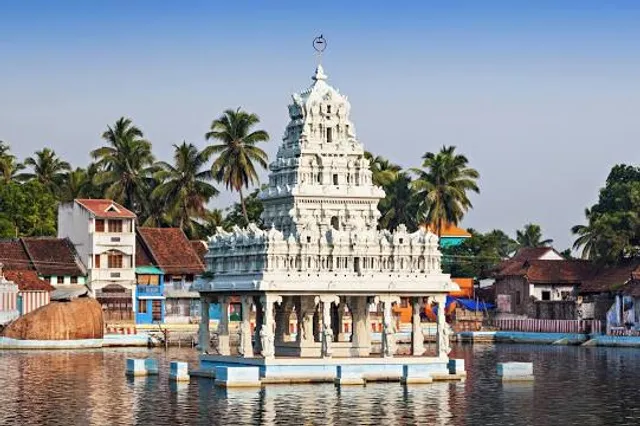
The temple amazes with its rare and unique architectural features. What welcomes the pilgrim is the imposing seven storeyed 134 feet tall white Gopuram replete with detailed carvings in the traditional Dravidian style of the grand temples. There is a 13 feet high and 10 feet wide idol of Nandi next to the Swayam Bhu Lingam, which is made of crushed seashells and lime mortar. Moving inside, another wonder that testifies to the expertise of the artisans of old awaits the visitor -- the four groups of 18 feet tall musical pillars carved out of monoliths. The pillars, when tapped, emits a variety of musically correct notes and this is a major attraction. Moving into the long corridor/hallway, one is staggered by the 1035 carved pillars lining the hallway. These are second perhaps only to those at the huge corridors of the Rameswaram temple. The Navagraha scuptures engraved on the ceiling of the temple mandapam are truly exquisite examples of the sculptor's art.
Though popularly called the Suchindram temple, it is known as the Thanumalayan or Sthanumalayan Temple -- 'S/Tthanu' is Lord Shiva, while 'Mal' and 'Ayan' refer to Lord Vishnu and Lord Brahma respectively. The Trimurthi Linga here represents Brahma at the base, while the middle part represents Vishnu, and the top part Shiva.
There are lores and legends connected with the temple, the more popular one being that of Indra, the chief of Gods, getting "cleansed" ("Suchi + Indra") of his misdemeanors while meditating in the Gnanaranya, a holy forest that included the present location of the temple, thanks to the blessings of Lord Shiva in the form of Dakshinamoorthy.
Another lore connects the "Swyam Bhu" lingam that sprouted here after Anasuya, wife of Athri Maharishi, was acknowledged as the most chaste and spiritually powerful among mortals by the Trimurtis and their consorts. The 'swayam bhu' lingam at the base of an ancient fossilized tree in front of the temple is still worshipped with piety upon entering the temple, and before one approaches the main Sanctum with the Trimurti Linga. This dual presence of the Trimurtis is thought to make the darshan at Suchindram temple particularly auspicious.
Apart from the Holy Trinity, Vigneswari (a unique feminine form of Vighneswara/Vinayaga), Goddess Aram Valartha Nayaki, Indra Vinayaga, Sakshi Ganapathy and Kala Bhairava are also worshipped as sub-deities here.
However, the fame of the temple chiefly lies with Hanuman, carved from a huge monolith, that towers above the worshipper at about 22 feet in a rare pose with the tail raised above the head.
The 10-day chariot festival held in December-January draws huge crowds of devotees. Another auspicious occasion is during Teppam festival celebrated during April-May. The temple timings are: Morning 4:30 am – 11:30 am, and evening 5:00 pm – 8:30 pm. To use the word awesome to describe the Suchindram temple would likely be an understatement. For the traveller and pilgrim, the temple ought to be in their bucket list, and it is more than likely a hurried first visit would soon lead onto another one less hurried and...
Read moreThe Thanumalayan Temple, also called Sthanumalayan Temple is an important Hindu temple located in Suchindram in the Kanyakumari district of Tamil Nadu, India.
The Thanumalayan Temple is of importance to both Shaivaite and Vaishnavite sects of Hinduism, as the name Stanumalaya denotes Trimurtis; "Stanu" means Siva; "Mal" means Vishnu; and the "Ayan" means Brahma
The temple is an architectural achievement, known for its quality of workmanship in stone. There are four musical pillars carved out of a single stone, and which stand at 18 feet (5.5 m) in height; these are an architectural and design highlight of the temple grounds. They are in the Alankara Mandapam area, and they emit the sounds of various musical notes when struck. There are an additional 1035 pillars with carvings in the area known as the dancing hall.
There is an Anjaneya, (or Hanuman), statue which stands at 22 feet (6.7 m) and is carved of a single granite block. It is one of the tallest statues of its type in India. It is also of historical interest that this statue was buried in the temple in 1740, fearing an attack by the Tipu Sultan and was subsequently forgotten. It was rediscovered in 1930, and subsequently restored for viewing by the then Devaswom Board Commissioner Rajya Seva Praveena Sri M.K. Neelankantha Iyer of Kottarathu Mathom, Moncompu.
There is also a Nandi statue, made of mortar and lime, which is 13 feet (4.0 m) tall and 21 feet (6.4 m) long, it is one of the biggest Nandi statues in India.
The religious significance of the temple stems from the fact that the main statue of linga represent Siva (Sthanu), Vishnu (maal) and Brahma (Ayan), (as well as giving the temple its name). The representation of the three central gods of Hinduism in one linga makes it unique in India. Anthropologically it may have stemmed from the fact that the main temple at Padmanabhapuram was Vaishnavite, and the Nanjil Pillais and other communities in Nagarcoil were primarily Shaivaites, because of the influences from Chola, Chera and Pandya kingdoms. One of the unique aspects of the temple is the presence of the gods across the length and breadth of the Hindu pantheon, from Rama and Krishna to Amman and kandan. The different Hindu sects from Vaishnavism, Shaivism, to more localised Tamil sects like amman, kandan are represented in the different idols of the temple.
The 10-day Car Festival celebrated in this temple during between December and January every year attracts crowds of thousands of people. Another festival known as Teppam is celebrated during between April and May every year. The Sanskrit work Sucindrastalamahatmya gives a full-fledged legendary account of the origin and development of...
Read more