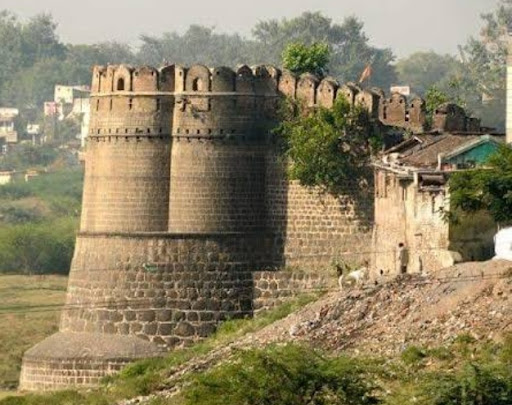
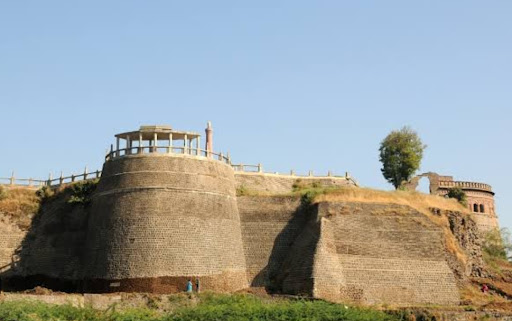
Akola Fort, also known as Asadgad or Korbandh Fort, is a historical fortification located in the city of Akola, Maharashtra, India. It's an important landmark in the Akola district, along with Narnala and Akot forts.
Here's a breakdown of its key aspects:
History:
Earliest Form: The fort's origins are debated, with some sources mentioning an earthen fort built by one Akol Singh around 780 AD to protect a village and the nearby Rajeshwar Temple from invaders.
Reconstruction and Renaming: It was significantly fortified and rebuilt in 1697 CE by Asad Khan during the reign of Mughal Emperor Aurangzeb. From Asad Khan, it acquired the name Asadgad. There are several inscriptions on the fort, including one on the Dahi Handa gate, confirming its construction date in 1697 CE during Aurangzeb's rule.
Later Events: In 1803, Arthur Wellesley (later the Duke of Wellington) camped here before the Battle of Argaon during the Second Anglo-Maratha War. The British Raj largely dismantled the fortress around 1870 to prevent future conflicts, as it was heavily fortified.
Modern Use: By 1910, the central part of the fort, known as the "hawakhana," was being used as a school.
Architecture and Features:
Construction: The fort was built using large granite stone blocks, lime glue paste, mud blocks, clay bricks, wood, and iron.
Simple Design: Akola Fort is notable for its lack of decorative embellishments, focusing on strength and functionality.
Inscriptions: Besides the Dahi Handa gate inscription, other inscriptions can be found on the Fateh Buruj bastion and the Eidgah, providing historical details.
Rajeshwar Temple: Within the fort complex, there is an ancient Rajeshwar Temple dedicated to Lord Shiva, which is an important pilgrimage site with a fascinating local legend associated with it. The temple is known for its intricate carvings.
Bridges: The fort also features two bridges: the Dagadi Pool (stone bridge) and the Lokhand Pool (iron bridge), the latter built during British rule.
Significance:
Strategic Location: Situated on the banks of the Morna River, the fort's strategic location provided natural defense and a vantage point to monitor the surroundings.
Historical Importance: It has witnessed centuries of history, serving various rulers and empires, including the Mughals and Marathas, and playing a role in significant battles.
Architectural Blend: Its design reflects a blend of Mughal and Rajput architectural styles.
Tourist Attraction: Today, Akola Fort is a prominent historical landmark and a popular tourist attraction, drawing history enthusiasts and architecture lovers. It offers panoramic views of the city and the Morna River from its top.
Visiting Information:
Location: Akola, Maharashtra, India. It's easily accessible within the city, approximately 5 km from Akola Junction railway station.
Timings: It is generally open to the public, with no entry fees.
Best Time to Visit: October to March, when the weather is pleasant for outdoor exploration.
Nearby Attractions: Other historical and spiritual sites in the Akola district include Balapur Fort, Narnala Fort, Raj Rajeshwar Temple, and the Gajanan Maharaj...
Read more"In its earliest form of mud made by one Akol Singh to protect the village . He saw a hare chasing a dog and considering this to be an auspicious sign, he built an earthen wall here to protect the village. Akola was fortified majorly in 1697 CE during the reign of Aurangzeb by Asad Khan from whom the fort took its name (Asadgad). In 1803, Arthur Wellesley camped here before proceeding to win the Battle of Argaon in the Second Anglo-Maratha War. The fortress was dismantled by the British Raj in about 1870."
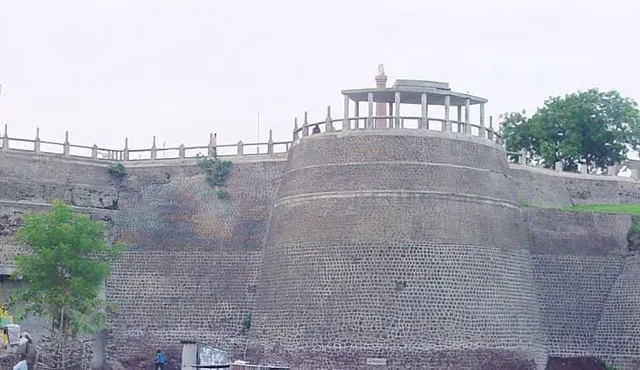
Being par of our histoy , it interested us , so we decided to visit . Our first glimpse of the fort was caved in Western wall of the fort .To go to the fort we were directed to a lane along the Northern wall of the fort.It was narrow ,stairs led up to the gate of the fort . Lane it self was quite bad and smelly as lot of garbage was thrown along the fort wall . Climb to the wall led us to the main gate . From this gate there was another North - South path & stairs going to city . We were told that it was the main approach road for the Fort . We could see a narrow approach path with lot of houses, from the looks of it, apparently residences of people in low/ medim income group.The approach path was encroached , three wheeler auto rickshaws were parked in the path , which was also being used to tether domestic animals. Both the approaches were big disappointment to say the least.Main gate had Azad Park ( Freedom Park) written . Reaching the top we could see that the fort , from what was remaining ,not so big . Actually for one standing structure in ruins there was nothing to see . The area was mostly being used by unemployed youths as place to while away time . There as a broken down fountain.There was a pillar monument with statue of Lion at the top , electricity pole without light fixtures , probably stolen . There was no sign of the so called " Azad Park ". For a historical monument The place looked totally neglected . The view from the fort of Akola city and the Morna river was good but closer look revealed heaps of garbage and totally polluted waters of Morna river, full of filth . It was big big disappointment . It reeked of total neglect and apathy of the administration . If ever there was an example of how NOT to maintain an historical monument Akola Fort or Asadgarh fort , as it is also called , is a classic example. Left the place with a heavy and saddened heart .If you are the type to say " I was there" risk it .Otherwise a visit is not recommended it will only...
Read moreIts earliest form of mud was made by one Akol Singh to protect the village. He saw a hare chasing a dog and considering this to be an auspicious sign, he built an earthen wall here to protect the village. Akola was heavily fortified in 1697 CE during the reign of Aurangzeb by Asad Khan, from whom the fort took its name (Asadgad). In 1803, Arthur Wellesley camped here before proceeding to win the Battle of Argaon in the Second Anglo-Maratha War. The fortress was dismantled by the British Raj in about 1870. It was reported in 1910 in a district gazetteer that the central part of the fort (the hawakhana) was used as a school. There are several inscriptions on the fort. An inscription on the Dahi handa gate gives its date of construction as 1114 AH (1697 CE)deepak, 'during the reign of emperor Aurangzeb when Nawab Asad Khan was minister.' Another on the Fateh Buruj bastion has no exact date. It too mentions the same minister but a different emperor (Shah Alam). One on the Eidgah contains texts and a statement that the building was finished by Khawja Abdul Latif in 1116 AH (1698 CE). On the Agarves gate an inscription in Marathi reads that Govind Appaji in 1843 CE constructed the fort. The latter statement contradicts all the other...
Read more