Whispers of Simplicity: A Journey Through Kirti Mandir
Kirti Mandir in Porbandar is not just a structure; it is a gateway to history, an intimate brush with the life of Mahatma Gandhi. As a writer, stepping into its quiet premises feels like flipping through pages of time. This ancestral home, where Mohandas Karamchand Gandhi was born on October 2, 1869, is an enduring symbol of simplicity, rootedness, and resilience—a reflection of the man himself.
The origins of the site date back to the 19th century. The Gandhi family, part of the Modh Bania community, resided here for generations. This home was not just a residence but a hub for community interactions, a place where the echoes of tradition blended with the whispers of change. Walking into Kirti Mandir, one cannot help but imagine the initial inhabitants bustling with life, unaware that a child born here would shape the destiny of millions.
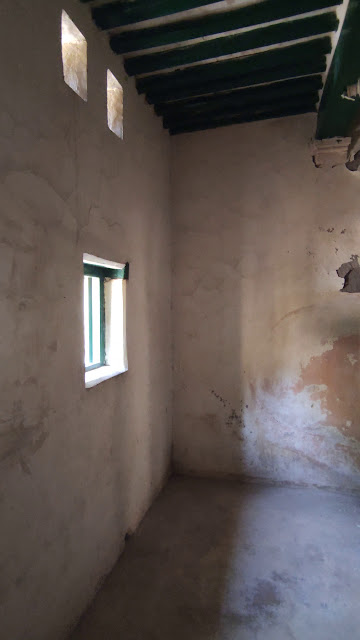
The structure is modest yet deeply evocative. Its labyrinthine rooms—small, whitewashed, and connected by narrow wooden staircases—tell stories of a bygone era. The room where Gandhi was born is simple, with a window that invites soft daylight. It feels untouched by time, as if still cradling the spirit of the young boy who would one day walk across continents, uniting people with the power of truth.
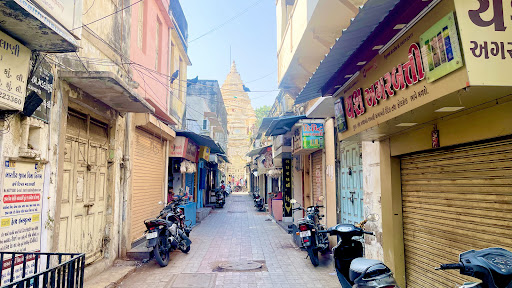
The surrounding neighborhood in Gandhi’s childhood days was a medley of bustling markets, narrow lanes, and the hum of everyday life. Porbandar, a coastal town, was alive with traders, fishermen, and artisans. Yet, amidst this lively chaos, Kirti Mandir stood serene, embodying the values of its residents. It was a home that taught its children discipline and empathy, values that Gandhi carried into his transformative work.
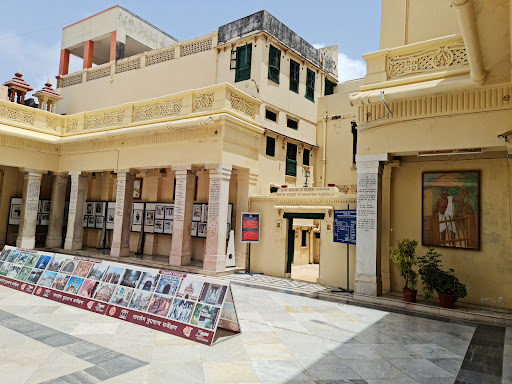
One striking trivia about Kirti Mandir is its deliberate preservation. Despite modern renovations to enhance the memorial, care has been taken to retain the essence of the original structure. The house is surrounded by a temple complex built in 1950, marking Gandhi’s legacy and showcasing relics of his life, including photographs and letters. The 79 lamps in the temple’s precinct symbolize the 79 years of his life—a poignant tribute to his journey.
Another lesser-known fact is that the construction of the temple was funded by donations from people across India, a collective offering from citizens who revered Gandhi. This unity in creating a memorial reflects the collective consciousness that Gandhi inspired during his lifetime. It’s also intriguing to learn how Kirti Mandir became a pilgrimage site not long after Gandhi’s passing. Visitors from around the globe continue to flock here, drawn by the aura of simplicity and the life lessons embedded in every corner.
As a writer, walking through Kirti Mandir stirs profound feelings. The air seems laden with stories, not only of Gandhi but also of his family, their struggles, and the societal backdrop of colonial India. There is a sense of humility in the understated grandeur of the place, a reminder that greatness often stems from the simplest of beginnings. You feel an intimate connection, as though you are not merely observing history but are a part of it, tracing footsteps that once resonated with purpose.
The house is not just a memorial; it’s a reminder of human potential. It leaves one reflecting on the power of perseverance, the strength in nonviolence, and the influence of a single life on the course of history. As you step out of Kirti Mandir, the salty breeze from the Arabian Sea greets you—a gentle reminder of the constancy of nature and the fleeting nature of life. Yet, it is places like this that anchor us, showing how fleeting lives can leave behind enduring legacies.
By Manav Kaushik
For more on Food and Beverages, follow: Foodfunda_net on...
Read moreKirti Mandir is a name carried by several important heritage landmarks across Gujarat, but two of the most notable are Kirti Mandir in Porbandar, the birthplace of Mahatma Gandhi, and Kirti Mandir in Vadodara, a memorial of the Gaekwad dynasty. Both sites are culturally and historically significant monuments representing Gujarat’s rich legacy of spirituality, leadership, and architectural elegance.
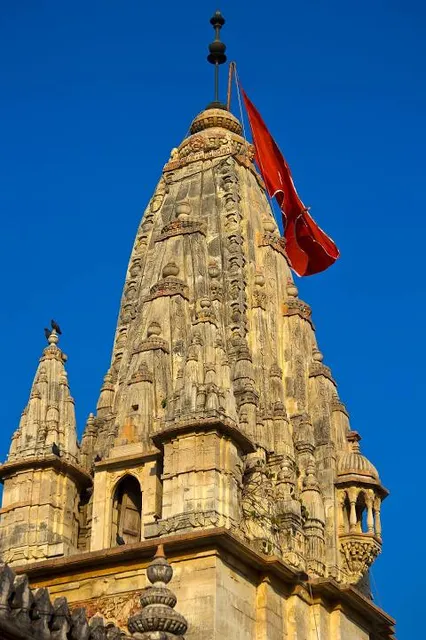
Kirti Mandir, Porbandar Located in the coastal city of Porbandar, Kirti Mandir is a memorial dedicated to Mohandas Karamchand Gandhi, India's Father of the Nation, and his wife Kasturba Gandhi. This temple is situated adjacent to Gandhi's ancestral home where he was born on October 2, 1869. Popularly known as the “Temple of Fame,” the building was constructed between 1947 and 1950 with the intention to honor the life and legacy of Mahatma Gandhi.
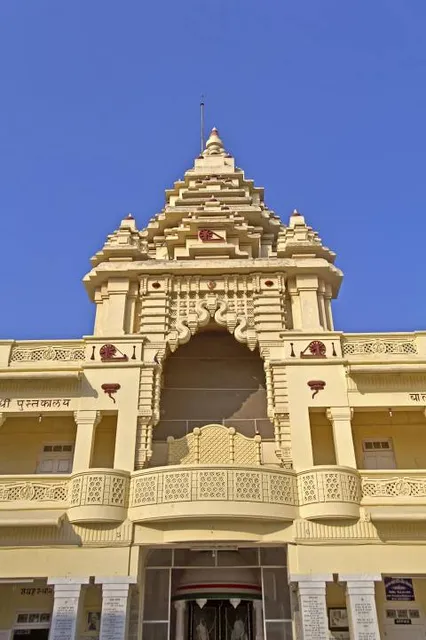
Kirti Mandir in Porbandar rises to a height of 79 feet in symbolic representation of Gandhi’s 79 years of life. Architecturally, it is an amalgamation of features borrowed from various religious traditions in India, including Hindu, Jain, Parsi temples, churches, and mosques, symbolizing peace, unity, and secularism—a reflection of Gandhi’s vision for the country.
Inside the temple, visitors find life-sized portraits of Gandhi and Kasturba wearing simple dhotis and shawls, emblematic of their humble lifestyle. The walls are adorned with quotes and the cherished ideals of ‘Satyagraha’ (Truth) and ‘Ahimsa’ (Non-violence) that defined Gandhi’s life. The temple complex also includes memorials dedicated to Mahadev Desai (Gandhi’s secretary) and Maganlal Gandhi (his cousin), and a museum exhibiting personal belongings, letters, and historical photographs.
The temple compound incorporates a Kasturba-Mahila Library which promotes the values of education and empowerment, just as Gandhi had advocated.
Kirti Mandir, Vadodara Kirti Mandir in Vadodara is a royal mausoleum built in 1936 to honor the Gaekwad dynasty, which ruled the Baroda State for nearly three centuries. This temple mainly serves as a cenotaph for the Gaekwads and stands as a stunning example of Gujarat’s blend of architectural styles, merging Hindu and Jain influences.
Designed by Sir Edward Lutyens and Baroda’s state architect V.R. Talwarkar, the building is shaped like an 'E’ and boasts exquisite domes, balconies, terraces, and a central shikhara approximately 35 meters high. The temple’s shikhara is richly decorated and symbolizes the sun, moon, and earth with a bronze map of undivided India, reflecting the Gaekwad rulers’ expansive vision.
Inside, the walls feature stunning murals by noted artists such as Nandalal Bose and Raja Ravi Varma, depicting epic scenes like the Gangavataran, the life of Meera, the battle of Mahabharata, and Natir Poojan (dance worship). The interiors are elaborately carved and marble-finished, offering visitors an immersive journey into royal history and cultural grandeur.
The temple also houses portraits, photos, weapons, and coins from the Gaekwad era. Adjacent to Kirti Mandir is the temple of Lord Dattatreya, where the royal family once prayed.
Significance and Visiting Experience Kirti Mandir, whether in Porbandar or Vadodara, stands as a symbol of Gujarat’s cultural pride and historical heritage. The Porbandar temple reflects Gandhi’s legacy of peace, unity, and non-violence, whereas the Vadodara monument highlights the artistic splendor and historical might of the Gaekwad dynasty.
Both temples are vital tourist destinations that offer rich educational insights, beautiful architecture, and a deep connection to Gujarat’s past. Visitors often admire the tranquil yet majestic ambiance, detailed murals and carvings, and the stories these monuments narrate of the region’s influential...
Read moreKirti Mandir Management Committee warmly welcomes you on this holy land of Mahatma Gandhi. This sacred place is segmented into two parts, one is where Mahatma Gandhiji was born and the other is ‘Kirti Mandir’ which is built in order to pay homage to the revered ‘Bapu’.
Birthplace
The great grandfather of Mahatma Gandhiji Shri Harjeevan Rahidas Gandhi had purchased this building in 1777 from Manabai Gangaji Mehta and it was later expanded up to third floor by the grandfather of Mahatma Gandhiji Shri Uttamchand Gandhi locally known as Shri Otta Gandhi. Mahatma Gandhiji’s father Shri Karamchand Gandhi was serving as Diwan in the Royal Court of Porbandar state. His mother was Putlibai, who was spiritual master and left lasting impression over the mind and heart of Mahatma Gandhiji. Mahatma Gandhiji was born on 2nd October 1869; Bhaadrapad krsnapaksh ashtami of Vikram samvat 1925, in the room highlighted with ‘swastik’ in the birthplace of Mahatma Gandhiji. The house is equipped with an underground water storage system built about 250-300 years ago. This water tank is about 10 feet deep, 15 feet long and 6 feet wide. The three storied house of Mahtma Gandhiji stands on the top of the water tank. There are 3-D portraits of the parents of Gandhiji. Mahatma Gandhiji went Rajkot for education at the age of seven. Mahatma Gandhiji was wedded in the same house to Kasturba at the age of thirteen. Archeological Survey of India maintains the birth place of Mahatma Gandhi.
Kirti Mandir
Upon the release of Mahatma Gandhiji from the house - arrest at Aga Khan Palace in 1944-45, Rajratna Sheth Shree Nanjibhai Kalidas Mehta urged him to stay for some time at Panchgini. During which Nanjibhai and his Highness of Porbandar Maharaja Natavarsinhji expressed the desire of people of Porbandar to construct a memorial at the birth place of Honourable Bapu. Mahatma Gandhiji gave consent to sell his house to Shree Nanjibhai Mehta and gave his power of attorney to Shree Maneklal Amrutlal Gandhi. After obtaining the birthplace of Bapu, Shree Nanjibhai constructed this wonderful monument the cost of Five Lakh rupees within two years and named it as Kirtimandir.
Architectural beauty of Kirti Mandir
The area of Kirtimandir is about 750 sq.m and it is decorated with wonderful art and carvings. Its height is 79 ft which represents 79 years life span of Mahatma Gandhiji (2.10.1869 to 30.1.1948). The 79 symbols of lamps are set on the top of the peak reflecting the lifelong endeavor of Mahatma Gandhiji to eradicate slavery, superstitions, poverty, ignorance, exploitation etc. Mahatma Gandhiji believed in the equality of all religion and this is highlighted through symbols of six major religions - Buddhism, Jainism, Hinduism, Christianity, Islam and Jorostranism in the design of Kirti Mandir. For example, ‘Pagodha’ of Buddhism is designed on the top of the main gate, fire is the symbol of Jorostranism, the structural design of Church is visible where the portrait of oil painting of Mahatma Gandhiji is placed, the symbol of Islam is seen in the design of window grills and the dome and swastika is the symbol of the Hindu religion. The symbol of Spinning wheel symbolizes swadeshi ideology. There are 26 columns of marble each 12 ft high inside the Kirti Mandir expressing virtues practiced by Mahatma Gandhiji during his life time ; namely truth, non violence, selfless service, learning, discipline, equality towards all religion etc.
Dedication of Kirti Mandir by Honarable Sardar Vallabhbhai Patel...
Read more