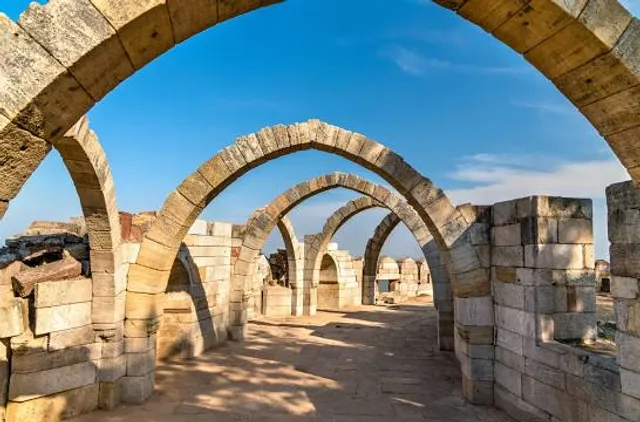
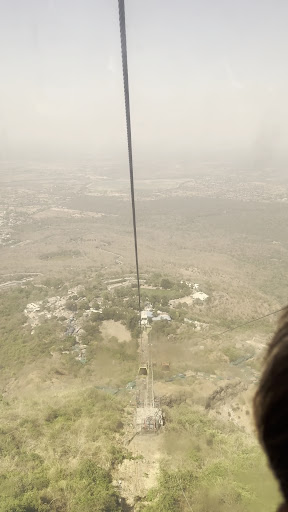
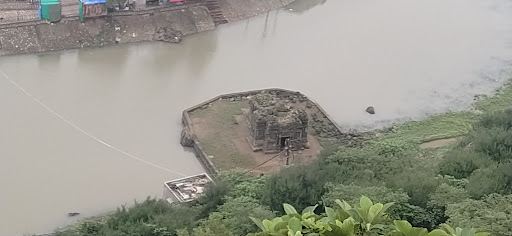
Champaner and Pavagadh Hill are the words – I always heard together. It was one of the few UNESCO world heritage sites in India that I had not visited. So I planned my Gujarat trip to cover this and the newly included Rani ki Vav. It is only when I reached the site, some 45 km’s from Vadodara, I realized that Champaner is the village below the hill. The monuments are of course scattered all over the hill, on the foothill and on top of the hill. You can hear and read as many myths, legends and stories about this place as the number of sources you access.Almost everyone guided us to go on top of the hill first, before exploring the village below. We listened and reached the foothill to be told that cars are not allowed, as it was Navratri time. And a lot of people climb the hill on foot to reach the temple on top. However, there were ample Gujarat state transport buses to take you to a certain level on the hill called Machi.From here there are two options – either take a ropeway called Udal Khatola to the top that takes about 6 mins on a steep hike. Or take the old route that goes around the hill through many man-made monuments that belong to different eras of mankind. And takes maybe 1-2 hours depending on your ability to climb. As you keep going up, the lush green hill starts appearing with its various ponds and lakes. Temples atop the Pavagadh Hill
From the point where the ropeway drops you, there are another 250 or so steps that you need to climb to reach the Kalika Mata temple on the peak of Pavagadh hill. The hill keeps getting narrower as you reach closer to the temple. The climb is scary as one small slip can lead to stampede on a studded uneven staircase. But it looks worth the risk when you look back and see the landscape that keeps changing with every turn of the staircase. Old sculpted stones adorn the sides of the staircase. Some of them had vermillion marks – reminiscent of the times when they would have been worshiped.
Kalika Mata Temple atop Pavagadh Hill
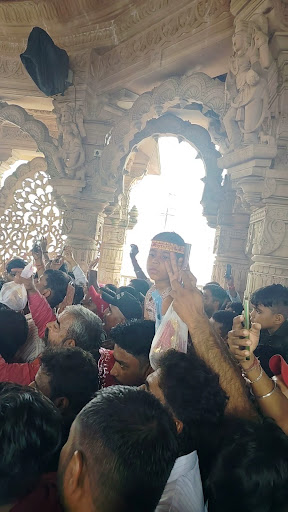
The temple at top dates back at least 1000 years and maybe more. It is supposed to be one of the 51 Shaktipeeth temples across the country. It is said that the toe of the Goddess Sati had fallen here. A small temple with idols of three goddesses attracts a lot of cult devotees as we saw some women with swords in their hands moving through the crowds in a possessed state – obviously, everyone left the way for them. I was amused to see some women pretending to be possessed so that they do not have to stand in the long queue. I held one such woman’s hand and with my expressions asked her ‘what’s the matter’, to which she replied with a sheepish smile and joined the queue.
Temple in itself is ordinary looking but the devotion on the faces all around makes it special. Sacrificial altars still exist in the temple, though I am not sure if sacrifices are still made here. I did not see any in the process.
Jain Temples
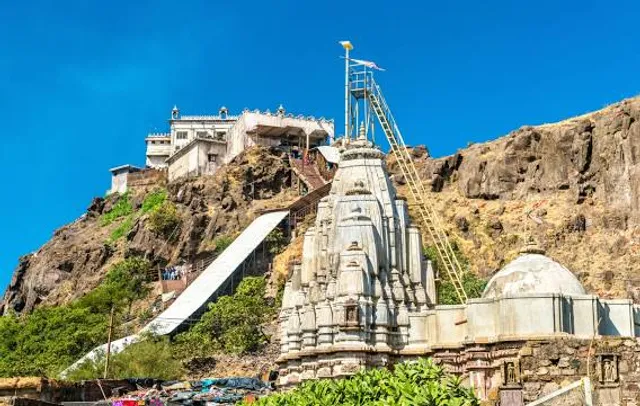
At the base of this temple are few Jain temples, which look at least 400-500 year old. We spoke to a priest at one of the temples. But his story was hardly convincing and we decided to make our own observations. Jains claim that this hill was once full of Jain temples before the Islamic rulers came and made Champaner their capital and it became dominated with mosques. Other records say that the tribes like Bhil and Rathwas used to live and they were Shakti worshipers and temple belongs to them. We may never know the whole truth. But what matters is that it is an ancient place of worship and is a living temple that appeals to millions of devotees.
Ponds
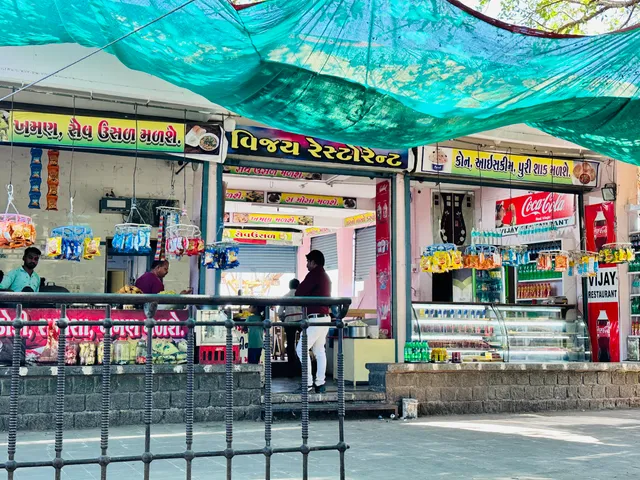
The two ponds here on each side look beautiful from the top. But can do a lot of cleaning is what you realize when you reach closer. Shops selling all kinds of devotional stuff that are offered to the Goddess and mementos to take back line the sides of the path. There were photo studios with large backdrops of the hill against which you can get yourself clicked.
To see the hill properly you must climb it on foot right from the base to the top. But it would need a lot of...
Read morePavagadh Hill is a significant pilgrimage site for Hindus, located in the Indian state of Gujarat. At the summit of the hill, which stands 800 meters above sea level, lies the ancient temple of Mother Kali. This temple, which dates back to the 10th-11th centuries, is the oldest in the area and has been attracting pilgrims from all over the country for centuries. The temple is a 5 km walk along a jungle footpath to the top of the hill, which is a challenging but rewarding trek. Alternatively, visitors can take a cable car that runs from the midway point, which is the last accessible point by road.
The temple has large fortifications and an open chowk in front, with two altars for sacrifices, and an array of lights for special occasions. The inner sanctum houses the idol of Kalika Mata, which is only the head, the mukhwato, painted in red. Additionally, the temple also has full idols of Mahakali and the yantras of Bahuchara. The temple is open from very early to quite late to accommodate pilgrims arriving at all hours. For the convenience of pilgrims, Machi Haveli, a rest house, is available for accommodation.
The Pavagadh Hill is not only a place of religious significance but also a natural beauty. The trek to the top of the hill offers breathtaking views of the surrounding landscape, with lush greenery and diverse wildlife. Visitors can enjoy a picnic or take a leisurely stroll in the natural surroundings. The hill also has several other temples and historical monuments, including the Jain temples and the ancient fortifications of Champaner-Pavagadh Archaeological Park, a UNESCO World Heritage Site.
In conclusion, Pavagadh Hill is a unique destination that offers a combination of spiritual, natural, and historical experiences to visitors. The ancient temple of Mother Kali at the summit of the hill is a must-visit for pilgrims, while the trek and cable car ride to the top offer scenic views and an adventurous experience. The Machi Haveli rest house provides a comfortable stay, and the Champaner-Pavagadh Archaeological Park offers a glimpse into the rich history of the region. Pavagadh temple, also known as Mahakali temple or Kalika Mata temple, is a significant pilgrimage destination located on Pavagadh hill in the Panchamahal district, Gujarat. This temple draws a huge number of devotees every day and is one of the Shakti Peethas where the toe of Sati fell. If you are planning to visit this temple, it is important to know the timings of the ropeway and aarti. The temple is open for darshan throughout the day from 5:00 AM to 7:00 PM. Visitors are not required to pay any entry fee to visit the temple.
In addition to darshan, two aartis are performed every day at Mahakali temple. The morning aarti is held at 5:00 AM, and the evening aarti takes place at 6:30 PM. These aartis are a significant part of the temple's rituals and offer a truly divine experience to the visitors.
If you are not up for climbing 2000 steps to reach the temple, you can opt for the Pavagadh ropeway. The ropeway station is located on Pavagadh hill near Maachi Haveli. After buying the ticket for the ropeway, visitors can board the cable car that will drop them at a certain height. From there, they still need to climb 250 more steps to reach the temple. The ropeway has the capacity to carry 400 people in one hour, making it a convenient way to reach the temple without much effort.
The ropeway operates from 6:00 AM to 6:00 PM, and the last return cable car is at 7:30 PM. It takes only about 6 minutes to reach the temple by ropeway, making it a quick and comfortable way to reach the top. Visitors can avail of ropeway facilities all days of the week. Recently, a provision has been passed to improve the capacity of cable cars and lead them closer to the temple so that visitors need to walk less.
If you're traveling from other major cities in India, you can take a domestic flight to Vadodara (BDQ) airport, which is well-connected to major cities in the country. From Vadodara, you can hire a taxi or take a bus to reach...
Read moreThe hill is a southern Aravalli Range outlier, rising 800 metres (2,600 ft) above the surrounding plains.4] The Dhadhar River and Vishwamitri River originate on the hill.[5] The Surya stream, which also rises on the hill, joins the Vishvamitri.[6] There are five successive plateaus, Kalikamata Plateau, Mauliya Plateau, Bhadrakali Plateau, Machi Plateau and Atak Plateau.[7] Plateau reservoirs (talaos) form a chain up the hill. Other features include dense forest, reddish-orange rhyolite boulders, and a natural cave just below the summit. Strong monsoon breezes blow winds upwards onto steep hill slopes.[4]
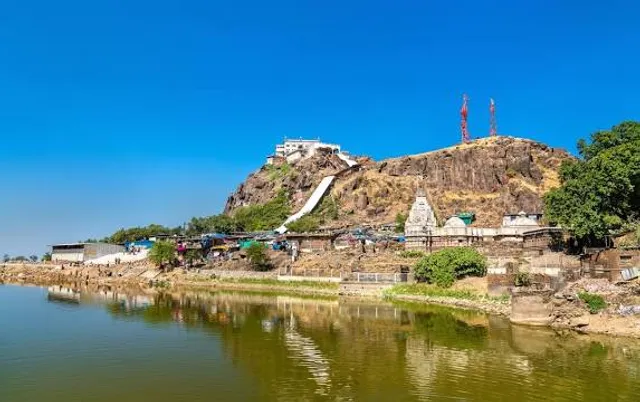
The arrangement of the rock formations of Pavagadh Hill is stated as being "rhyolite, green bedded tuffs, porphyritic basalt, olivine dolerite and nonporphyritic alkaline basalt."[8] There are steep rock exposures whose geological formation is attributed to ancient volcanic eruptions and lava flows. Pavagadh Hill has a geological setting of reddish-yellow coloured stone, and is considered to be one of the oldest rock formations in India.[110
The geological formation of Pavagadh Hill is thus very complex. It is interpreted as part of the Deccan Traps, which arose from the "tumultuous outpour of lava beyond 106 cubic km in volume. Eruption is deduced to have occurred 69-65 Ma age. These basaltic rocks said to be one of the largest continental flood basaltic provinces in the world." Studies carried by geologists have indicated eleven basic flows superposed by felsic volcanics. New varieties of rocks such as "rhyodycite, alkal-olivine basalt, mugearite and ankaramite" are reported. It is also recorded that except for rhyolite, all the rocks have an "alkaline-oloivine lineage." Geologists have also observed that "seventeen horizontal flows have occurred in Pavagadh" and postulated that the "whole series resulted by fractionalism in two episodes."[12]
The highest point of the hill presents an undulating forested topography in the direction of Jambughoda. The path ascending the hill passes through many old gates and cuts through natural ledges of rock like a staircase, with precipitous sides. Midway up this path is a flat ground which is strewn with boulders. The mountain above the flat ground is a very steep hill scarp.[13]
TransportationEdit
While private vehicles are not allowed, registered buses and government vehicles provide transportation up the hill. As the road ends before reaching the summit, there are only two options to reach the top, either on foot or by ropeway.[14] The mono-cable ropeway is 740 metres (2,430 ft) in length. It can carry 1,200 people per hour. It is stated to be the country's highest ropeway, connecting the summit of the hill with the plateaus of Champaner.[15]
History and legendsEdit
As per Jain texts, it is believed as a salvation place of Lav and Kush (son of Ramachandra). In recent history, human settlement occurred around the second century after the hill became associated with the goddess Kali. It is believed that the foot of Parvati fell on this hill, making it sacred.[citation needed] Legend states that the hill's formation is attributed to the sage Vishwamitra Rishi, who lived here in bygone days. He had a cow named Kamadhenu. One day, the cow slipped while grazing and fell into the valley, which resulted in the cow attempting to scramble up the hill. Finally she produced milk, which filled the valley, and swam to higher ground. The Rishi came to know of this mishap, and in order to prevent any such incident in the future, he prayed to the gods to fill the valley. The gods fulfilled his prayers with one fourth of a hill projecting out of the plains, Pavagadh Hill.[16]
Known for its forts, there are also dozens of heritage structures on the hill.[2] It...
Read more