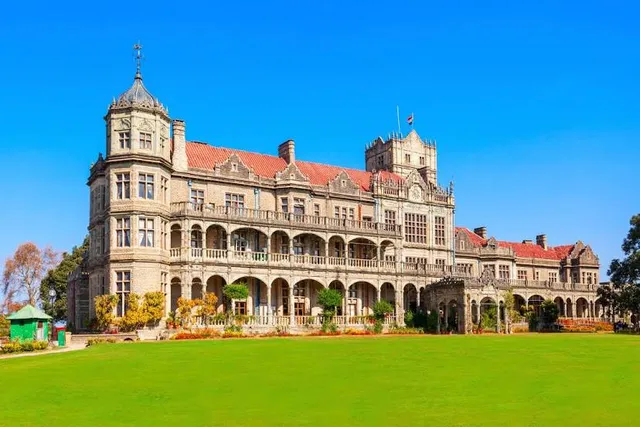
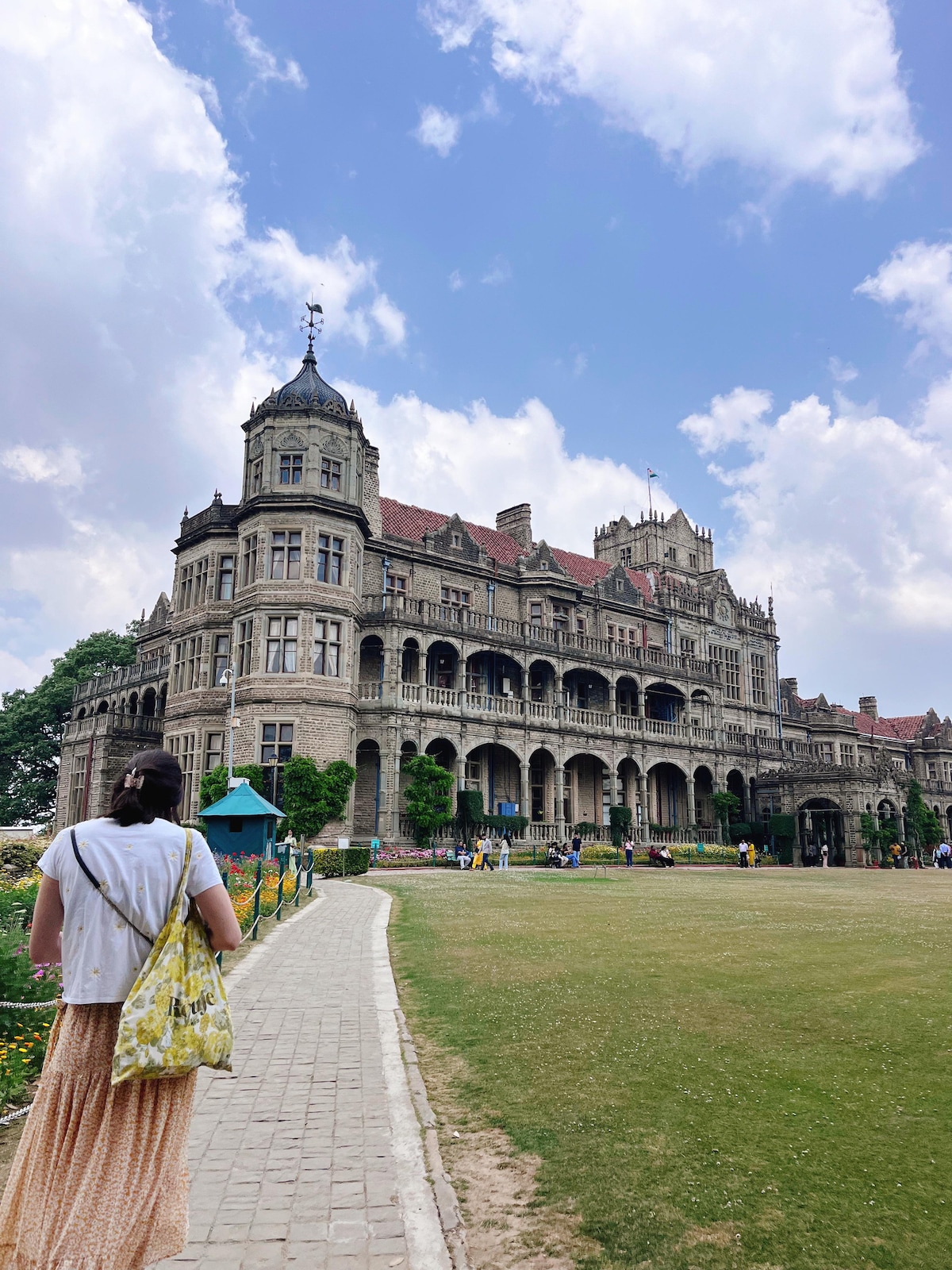
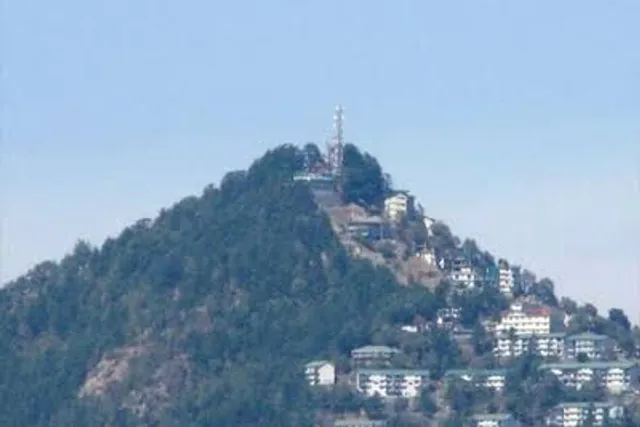
The Indian Institute of Advanced Study (IIAS) is a research institute based in Shimla, India. It was set up by the Ministry of Education, Government of India in 1964 and started functioning from 20 October 1965. The building that houses the institute was originally built as a home for Lord Dufferin, viceroy of India from 1884 to 1888, and was called the Viceregal Lodge.[2] It housed all the subsequent viceroys and governors-general of India. It occupies Observatory Hill, one of the seven hills that Shimla is built upon. The building was designed by Henry Irwin, an architect in the Public Works Department. The Viceregal Lodge had electricity as early as 1888, much before the rest of the town of Shimla.[2] The building also was equipped with a sophisticated firefighting mechanism through wax-tipped water ducts.
Many historic decisions were taken in the building during the Indian independence movement. The Simla Conference, to discuss self-rule for India, was held here in 1945. The decision to carve out Pakistan and East Pakistan from India was also taken here in 1947.[2]
After India gained independence, the building was renamed as Rashtrapati Niwas and was used as a summer retreat for the president of India. However, due to its neglect, Dr. S Radhakrishnan decided to turn it into a centre of higher learning. The summer retreat of the president was shifted from here to a building known as "The Retreat" situated in Chharabra, on the outskirts of Shimla.
The Indian Institute of Advanced Study was first created as a society on 6 October 1964. The institute was formally inaugurated by Prof. S. Radhakrishnan on 20 October 1965. The eminent historian, professor Niharranjan Ray, was appointed as the first director of the institute.
Around 2004, a rare stické court was discovered on the grounds of the Viceregal Lodge complex.
A bell made of eight metals which was presented by the king of Nepal was available to be admired by tourists until April 2010.
The lawn in front of the lodge is above a water tank. All the rainwater from the building goes to this water tank. This rainwater harvesting system goes back to the 19th century when this building was designed.
The Institute of Advance Studies was the first electrified building in Shimla. This electricity was produced by steam engines which were brought from Britain. The institute is administered by a Society and a Governing Body, the members of which come from varied backgrounds. A statutory Finance Committee advises the Governing Body in financial matters.
The director of the institute is assisted by a secretary, a deputy secretary a public relations officer and other supervisory staff. The International Centre for Human Development (IC4HD) is set up in IIAS to support efforts by governments of the South to integrate human development approaches and ensure improved development outcomes for poor and marginalized people. The IC4HD center was inaugurated on 19 August 2013 in the institute with the aim to promote policy dialogue on human development in the Global South and work towards translating human development analysis into action. The partnership between the Ministry of Human Resource Development, Government of India, the Indian Institute of Advanced Study, and the United Nations Development Programme (UNDP) was officially launched at an event held in Delhi on 4 January 2013. The centre will provide a range of services to national governments in translating human development approach into policy through a four-pronged approach viz. Policy Advisory Services, South-South Cooperation, Research on HD issues and Monitoring...
Read moreThe Viceregal Lodge in Shimla used to serve as the erstwhile summer Capital for the British Government in India during the pre Independence era from where the entire administration of the British Raj in India and its sub continents were conducted. It is also known as Rashtrapati Niwas. It was originally built as the summer residence of the British viceroys and was later used as the summer retreat for the President of India. Now, it serves as the Indian Institute of Advanced Study (IIAS), a center for research and higher learning.
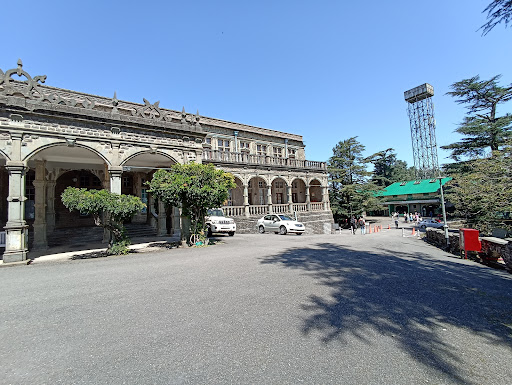
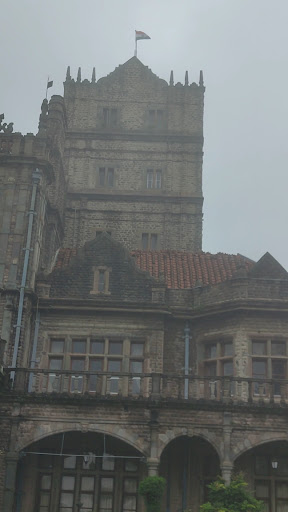
The Viceregal Lodge was designed by British architect Henry Irwin and built in the Jacobethan style during Lord Dufferin’s tenure as Viceroy. Its construction started in 1880 and was completed in 1888. Lord Dufferin occupied the lodge on 23 July 1888. The final cost of the project was around 38 lakh (3,800,000) rupees with the annual upkeep cost being around 1.5 lakh (150,000) rupees in the 1880s. At that time the estate stood on an area of 331 acres (134 ha), but today is reduced to 110 acres (45 ha). The structure draws inspiration from the architectural style of the English Renaissance, and also reflects elements of the castles of the Scottish Highlands. The building is of light blue-grey stone masonry with tiled pitch roofing. The interior of the main building is noted for elaborate woodwork which has stood the test of time. Teak was brought from Burma, and was supplemented by local cedar wood and walnut.
The Simla Conference convened by Lord Wavell in 1945 to approve the Wavell Plan for Indian Self Government was hosted at this estate. This place also saw the buildup and finalisation of the borders after partition and demarcation of lines drawn on map to create India and Pakistan. The summer capital of India was of little use to the President of India who visited it only for a few days in the year, if at all. Professor S. Radhakrishnan thought of putting it to academic use. The Rashtrapati Niwas Estate was transferred to the Ministry of Education to be handed over to the Indian Institute of Advanced Study. The C.P.W.D., the Himachal Pradesh High Court, and the Himachal Pradesh University were allowed in due course to use some of its buildings but the bulk of the Estate, including its well kept lawns and rich greenhouse, has remained in use for the Indian Institute of Advanced Study.
The Viceregal Lodge is renowned for its stunning British architectural design, combining both stone and wood elements. Its lush botanical gardens and picturesque surroundings make it one of the must-visit places in Shimla for tourists and history enthusiasts. There is a 30 minute guided tour (guide speaks in both English and Hindi) inside the Lodge and each slot has limited quota with a maximum of 50 pax. Last slot is at 4.30PM as this place closes at 5PM. Guided tour along with access to outer area and botanical garden is charged 100/- for adults and 50/- for kids. If not interested in tour, visitors can pay 30/- for entrance. The entry fee for foreign visitors is Rs. 500 per person.
The best times to visit are from March to June and October to December when the weather is generally pleasant. The Lodge is closed on Mondays and other national holidays. Photography is not allowed inside the lodge, but visitors can capture the beauty of the exterior and the scenic...
Read moreHere’s a review of the Viceregal Lodge (Rashtrapati Niwas), Shimla combining facts + impressions. If you want, I can tailor it (short version, for social media etc.).Viceregal Lodge, Shimla — Review The Viceregal Lodge (now Rashtrapati Niwas), perched atop Observatory Hill, is one of Shimla’s most majestic heritage landmarks. Originally built between 1880–1888 for Lord Dufferin, it was designed by Henry Irwin in a Jacobethan / Scottish Baronial style. It later became the summer residence of the British Viceroys, and after Independence it was converted into the Indian Institute of Advanced Study.
What to See & Experience
Architecture & Interiors: The grandeur hits you immediately. The lodge features ornate woodwork (teak, cedar, walnut), spacious halls, fireplaces, large windows, balconies with views, and an overall design evocative of old colonial-era power and elegance.
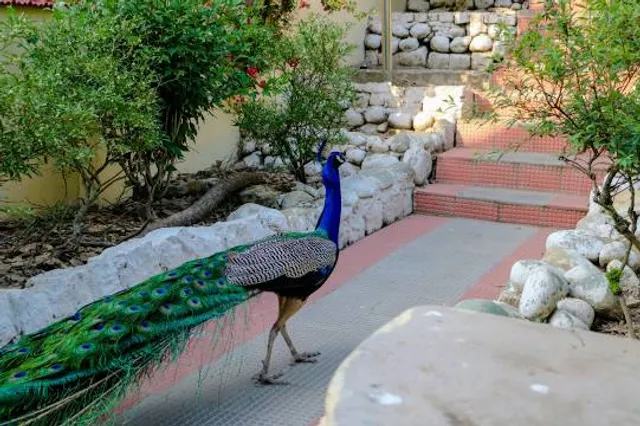
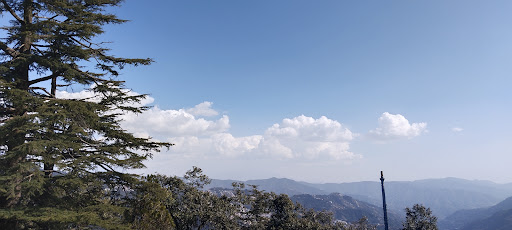
Gardens & Grounds: The lawns, gardens, pine trees, well-maintained paths all around add to the charm. The landscape setting gives lovely views of nearby hills and Shimla’s skyline. Perfect for leisurely strolls, photography.
Guided Tours: Only certain rooms are open to public—history exhibits, photographs, some hallways etc. You cannot access all parts (since much of it is used for academic functions). Tours are fairly well organized. Guides provide historical context (Simla Conferences, British Raj, etc.).
Practical Details
Timings: Typically open 10:00 AM to 5:00 PM. Closed on Mondays.
Entry Fee: Very reasonable. For Indians very low (₹20 or so), higher for foreign tourists.
Access: It’s uphill, set on Observatory Hill. You can drive up to certain point; walking can be involved but the walk is scenic.
Positives
Immense charm and preserved heritage: one of the best heritage buildings in Shimla. The architecture, materials, and historical aura are impressive.
Beautiful views and peaceful grounds. Offers respite from the bustle of Mall Road or main Shimla markets.
Informative tours; good value for history lovers. Even if many inner rooms are off-limits, what is open is done well.
Drawbacks
Limited access: Only a few rooms are open to tourists; the rest are used by the Institute. So if you expect a full mansion-tour, you may feel slightly restricted.
Photography rules: Inside the building, photography is restricted. You can take photos outside and in gardens, but not in every interior space.
Uphill walk / entry logistics: For some visitors (especially those with mobility issues), the slope and pathways may be tiring.
Overall Impression
The Viceregal Lodge is not just a building—it’s a story. It captures colonial history, architectural artistry, and political significance (Simla Conferences, etc.). Visiting it offers more than just sightseeing; it gives a connection to India’s past, while also providing gorgeous visuals and calm ambience.
If I had to rate it: 4.5/5 for heritage lovers; it might be 4/5 for a casual tourist who expects full access. Definitely must-visit if you’re in Shimla and have a half day or more to spare.
If you like, I can also write a short 2-line version (for Google reviews or social media), or compare it with other Shimla...
Read more