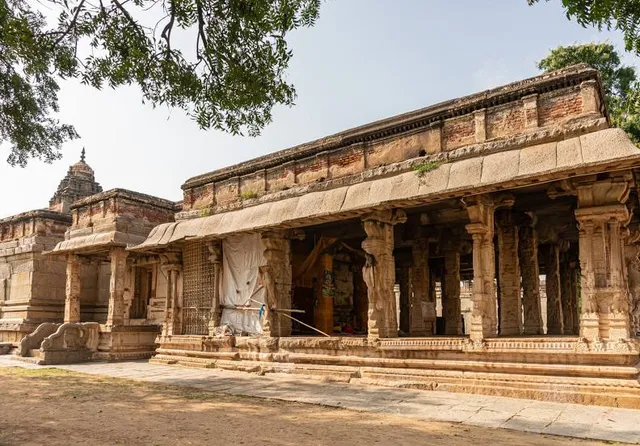
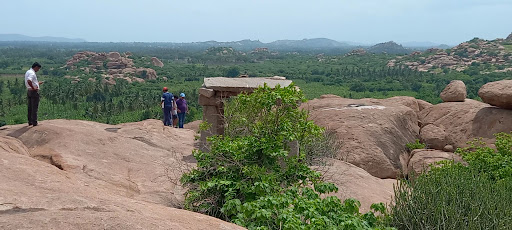
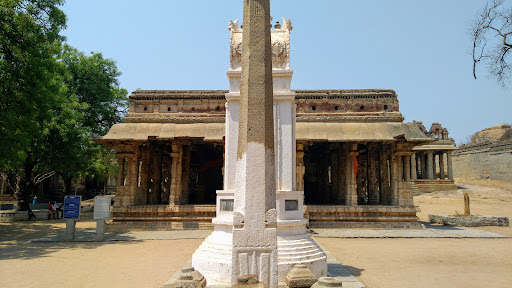
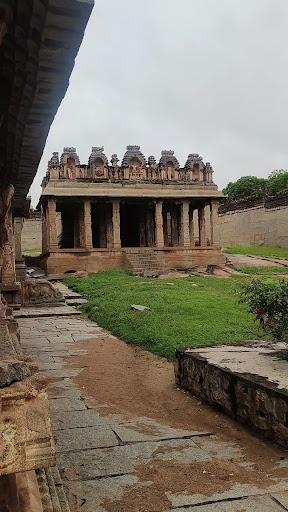
Rama and Lakshmana were looking for a shelter during the monsoon season. Rama aimed an arrow in the Malyavanta hill direction. A cleft on the boulder atop the Malyavanta Hill is caused by the arrow, according to this story. Rama and Lakshmana stayed here till the monsoon rains are over, before marched to Lanka along with the army of Hanuman. The images of the deities are carved on the face of a massive boulder. Rama and Lakshmana are sitting posture, Sita is standing next to them, and Hanuman , a kneeling posture with great attitude. A massive temple complex is built around this boulder, keeping the images portion within the inner shrine. The boulder protruding above is further enhanced with a tower structure over the boulder. This makes boulder is an integral part of the structural elements. You'll see many such instances in Hampi. This is one of the peculiarities of the Vijayanagara architecture. The temple complex is otherwise typical of any large temple complexes in Hampi. The whitewashed pillared hall stands in the axis of the main shrine at the center of the complex. A long colonnade stands along the enclosure wall facing the temple compound. This has been used as a shelter and place for prayer by the pilgrims. The kalyana mantapa (a large pavilion) is located on the southwest quarter. The sub-shrine of the goddess is on the northern side of the main shrine. Towards the south of the temple you'll find a natural well with image of Krishna playing flute carved on the inner wall (boulder) surface. You'll enter the temple complex through a tower in the east, where the road from the foothill ends. You'll find a massive boulder almost covering the entrance. A little ahead on the boulder you'll find a Hanuman shrine. On the southern side of the compound wall overlooking the Kampili road is another gateway tower. There is a small opening at the rear part (west) of the tall enclosure wall . On either sides of these openings, on the wall you'll find a great deal of relief work, mostly of aquatic creatures. A little ahead is the Shiva Cave Temple, built under a massive boulder. This is a great site to get a panoramic view of the valley beneath. Somewhere in the middle you can see the road to Vittala Temple sneaking through the planes. Somewhere nearby is the cleft caused by Rama's arrow, mentioned earlier. Also the cleft are rows of Shiva lingas and Nandi images carved...
Read moreMalyavanta Raghunatha Temple, dedicated to Lord Ram is on the Malyavanta Hill.
Rama & Lakshmana stayed here till the monsoon rains are over, before marching to Lanka along with the Hanuman's army to rescue Sita
The walls of the garbagudi are attached to the large natural boulder on which are carved images of Rama & Sita. Rama who is always seen standing is found here in sitting position. Sita is known as Kamleshwari at this temple since she is sitting on a lotus flower.
The temple never closes & hymns of Rama would be sung continuously. Sadhus from different parts of India come here to conduct kirtans of Rama with mridanga & kartalas
The temple has motifs of fish & marine creatures carved along its outer walls.
Here you also find the map of Ram's footprints, retracing the epic journey. Some of the important landmarks of the Ramayana trail from Ayodhya to Lanka are : After leaving AYODHYA behind, Rama, Lakshman & Sita arrived at PRAYAG where sage Bharadwaj advised them to move to CHITRAKUTA. Here Bharata urged Rama to return. However, Rama moved on to DANDAKARANYA. Here in the forest, sage Atri's wife Anasuya gifted jewels to Sita, which she later dropped in Kishkindha, while Ravana abducted her off to Lanka Later at PANCHAVATI, Surpankha, Ravan’s sister in her attempt to seduce Rama had her nose cut off by Laksman. This led to the abduction of Sita & the fight between Ravana & Rama. At LEPAKSHI (means rise bird), the words uttered by Rama to Jatayu after his wings were cut off by Ravana when he had tried to stop Ravana from carrying Sita off to Lanka.
KISHKINDHA near Hampi, is where Ram helped Sugreev win the Kishkindha kingdom from Bali & Sugreev promised help in return to rescue Sita. At RAMESWARAM, Ram built a bridge from Dhanushkodi to Talaimannar to cross over to Lanka with the help of Vanara army using stones ASHOK VATIKA in Lanka is the place where Sita stayed during her capture. USSANGODA has black soil, as Hanuman had set fire to this place
TALAIMANNAR is the battlefield where Rama, beheaded Ravana with the help of the Bramhastra.
At DIVURUMPOLA, Ram & Sita...
Read moreMalyavanta Raghuvanta temple, Hampi. Again not a very famous attraction and many people miss to see this place due to its isolation from the main touristy circuit. But once we went here, thanks to our guide, Virupaksha(not Lord Shiva ) this was an amazing hill top with some amazing sunset views. We spent almost 2 hours here waiting for the sunset, although it was anti-climatic in the end. The hill top offers view of the famous Matunga hill, Hampi landscape and at the bottom there is the beautiful Rama temple where Lord Ram vigraha is without any weapons and that is rare to find. So if you're in Hampi don't miss this place! The sunset, panaromic views of Hampi and more in the upcoming posts, stay tuned. .... The Virupaksha Temple, Hampi, Karnataka. On my recent trip to hampi I got really spell bound by the beauty even in the ruins, if the ruins are so picturesque and beautiful, imagine what the Vijayanagara Kingdom at its peak could have been One can only wonder. I was there for 2 days but I will certainly be back for more because for a photographer Hampi is divine! There's always a certain feeling-nostalgia when you are capturing a city to show what could have been, if it did survive. Enough reason to spend more and more time at Hampi. ...... The Virupaksha Temple gopura, from within the temple complex at sunset. The temple was built by Lakkan Dandesha under the ruler Prauda Deva Raya of the Vijayanagara Empire. It is a UNESCO World Heritage Site and is dedicated to Lord Shiva, also one of the very few temples left behind from that era. Hence it is over one of the main attractions at Hampi, also because of the natural Pin hole camera at the temple where the gopura's shadow falls inverted on the wall, a km away inside the temple. It speaks volumes about the architectural finese and mastery of the people back then and is still a wonder to watch! Do not miss to visit this place as during sunset it is a picture of serenity and calm with the Tungabhadra flowing right behind the...
Read more