Pushkara Khanda chapter of Padma purana has details of this temple. Suta Puranika narrated this mahatme on the request of Muni Pungavas.
The land mass given by Samudra Raja on the request of Parashurama ranging from the current Gokarna on the North to Kanyakumari on the south is called Parashurama Kshetra.
This place has many important Thirta Kshetras and Thirta Sarovaras. Narada Muni visited the place between Seetha river and Kumbha Kashi kshetra where many Koota Muni Pungavas where meditating, after taking holy dip in different theerta sarovaras and meditating at thirta kshetras.
During this time a unexpected event happened at this place. Earth shook and there was a thunderous sound. All animals were scared and birds circled the sky. There was heavy winds and the freightned Munis came to Narada and requested for protection. Suddenly they heard a Divya Vani that preached about Narasimha Vichara.
The Divya Vani informed that an deity of Lord Narasimha, holding Shanka and Chakra in both hands and seated in Yogananda Posture that is worshiped by Brahma and Rudra is sitated between Shanka and Chakra thirta in middle of a Ashwatta (people) tree. This will be installed by Narada Muni. Narada agreed that he had realized the same during his meditation.
They searched and found the statue of Lord Narasimha and prayed to him. Narada then installed the statue of Lord Narasimha in between Shanka and Chakra Theertha. On Narada’s prayer Lord Narasimha appeared and as per his request agreed to be there in the location permanently.
This place in the middle of Koota Kshetra, where Lord Narasimha resides in Saligrama deity is called Saligrama. Devotees will acheive all their desires by worshipping this Saligrama deity. Taking holy dip in Chakra Theertha rids one of all diseases and fear of enemy. Holy dip in Shanka Theerta clenses one from all the sins. One who takes holy dip in both the theerthas and worships Narasimha will attain prosperity.
According to Skanda Purana Sahyadri Kanda, learned Brahmin families under the leadership of Bhattacharya, came to present day Saligrama from Ahichatra on the banks of Godavari river, on the request of King Lokaditya. King Lokaditya wanted to reinstate learned Brahmins in his kindgom for the prosperity of the kingdom. Maha Yagna’s like “Atiratra” were performed by these Brahmins on request of King Lokadithya. Before starting these yagnas, “to avoid obstacles” these learned, prayed to Lord Ganapathi and obtained blessings.
Bhattacharya was delighted to see elephants and lions living together, a situation which he had already experienced during his meditation and named this place “Nirvairya Sthala” meaning “Enemy less abode”. This is signified by the symbolic representation of elephant in the form of Lord Ganapathi and Lion in the form of Lord Narasimha, even till this date in the Saligrama temple. The deity is facing west and has chakra in right hand and conch shell in the left hand.
King Lokaditya allocated 14 villages to Brahmins who accompanied Bhattacharya and requested them to stay there and perform yagas and yajnas. While returning back to Ahichatra, Bhattacharya instructed his disciples staying back, to worship Lord Narasimha as both Guru and Lord.
From those days we Koota Brahmins worship Lord Narasimha as both...
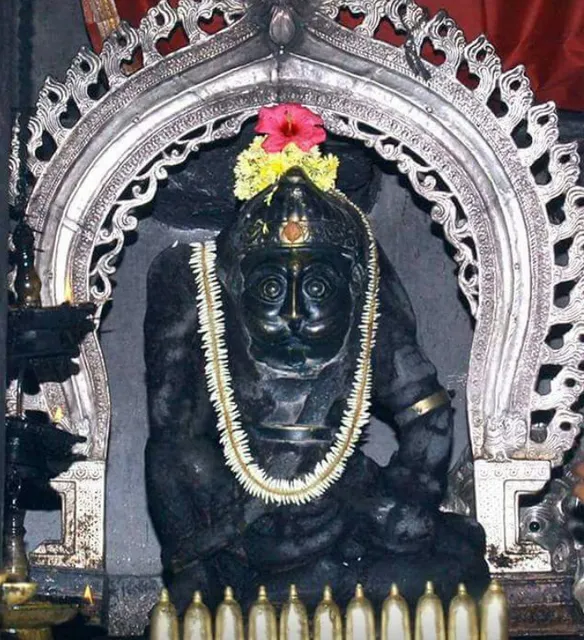
Read moreThe Deity of Guru Narasimha is entirely made of the sacred Saligrama stone. The Deity itself was never carved by anyone, but is "Swayambhu".[clarification needed] The name of the place "Saligrama" owns to this legend. The Deity has a Shankha(conch) in one hand and a Chakra(disc) in another. It is seated in a yogic posture attributing to the name "Yogananda Guru Narasimha". The Deity is seated on a Mahaganapati yantra. The reason for this is that, Bhattacharya witnessed that in this place lions and elephants lived in harmony, which is quite contradictory to their nature. As a result, he called this place as "Nirvairya sthala" meaning "the place of no enmity". The Deity faces west and 2 ponds are located on either sides of its hands, namely, the Shanka Teertha and the Chakra Teertha. There is a crack in the top portion of the Deity. The story behind this is that- Earlier, the deity of Guru Narasimha was facing east. Because of the "Ugra" nature of Narasimha, the crops facing the direction of the eyesight of the deity used to get burned to ashes. An angry Brahmin once struck the Lord with a plough, and hence a scar was formed on the deity. It is deemed that the person who struck the deity faced a lot of problems later on in his life. Several citations from the Shilpa Shastra can be used to prove that the deity was once facing east.
The 'Sri Saligrama Kshetra Mahatmyam' of the Pushkara khanda of the Padma Purana, the Sahyadri khanda of the Skanda Purana and the Lokadityapaddati provide the details of the significance of this temple. According to the Padma Purana, the deity of Guru Narasimha appeared at the bottom of a pipal tree holding Shankha(conch) and Chakra(disc) in its hands. Narada muni who had heard this through an akashavani (celestial message) installed the deity of Guru Narasimha. The akashavani described the deity as 'Yogananda Nrusimhakyam'. According to the Sahyadri khanda of the Skanda Purana, Lokaditya, the son of Mayura Varma of the Kadamba Dynasty came along with his army and a group of Brahmins headed by a great man called Bhattacharya. The priests performed mahayagas like Poundra, Atiratra etc. on the request of the king. The blessings of Mahaganapati had been invoked at the start of the yagnas. Ganapathi appeared in the dreams of Bhattacharya with 10 hands and told him to re-install the deity of Lord Yogananda Narasimha and from henceforth Narasimha himself shall be the Guru and god for the Brahmins of the 14 villages surrounding the temple. To this day, the Brahmins of these 14 villages, known as Kota Brahmins follow Guru Narasimha as...
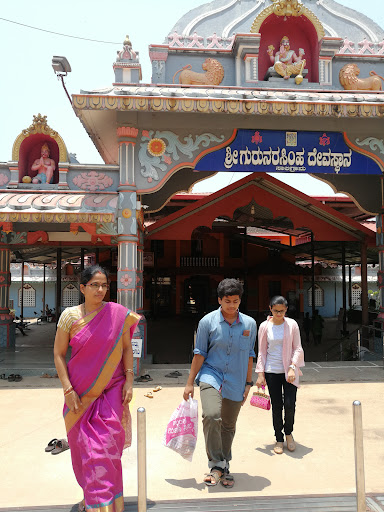
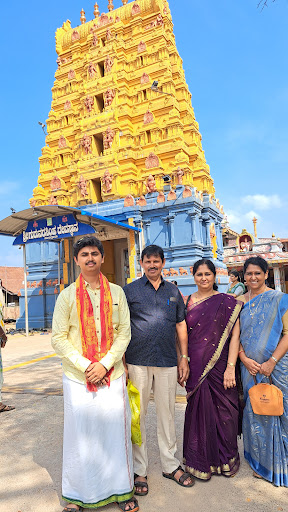
Read moreSrimad Yogananda Guru Narasimha is the chief deity of the town of Saligrama, Udupi, India. The temple of Guru Narasimha is located on NH 66 at a distance of 22 km from Udupi City. To this day, the Brahmins of these 14 villages, known as Kota Brahmins follow Guru Narasimha as their sole Guru.
According to the Padma Purana, the deity of Guru Narasimha appeared at the bottom of a pipal tree holding Shankha(conch) and Chakra(disc) in its hands. Narada muni who had heard this through an akashavani (celestial message) installed the deity of Guru Narasimha. The akashavani described the deity as 'Yogananda Nrusimhakyam'.
The Deity of Guru Narasimha is entirely made of the sacred Saligrama stone. It is to be noted that the Deity itself was never carved by anyone, but is "Swayambhu". The name of the place "Saligrama" owns to this legend. The Deity has a Shankha(conch) in one hand and a Chakra(disc) in another. It is seated in a yogic posture attributing to the name "Yogananda Guru Narasimha".
The Deity is seated on a Mahaganapati yantra. The reason for this is that, Bhattacharya witnessed that in this place lions and elephants lived in harmony which is quite contradictory to their nature. As a result, he called this place as "Nirvairya sthala" meaning "the place of no enemity".
Earlier the Deity of Guru Narasimha was facing east. Because of the "Ugra" nature of Narasimha, the crops in the direction of the eyesight of the Deity used to get...
Read more