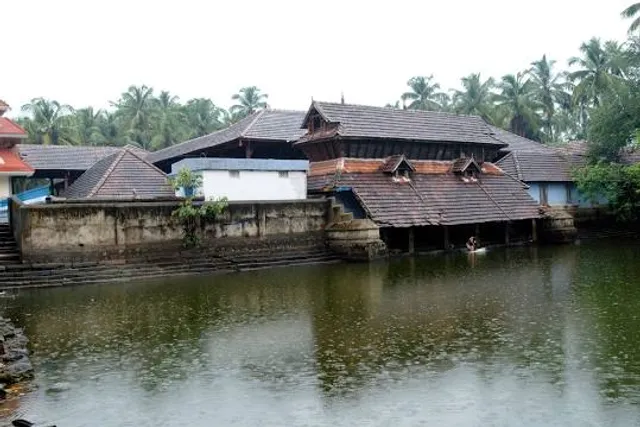
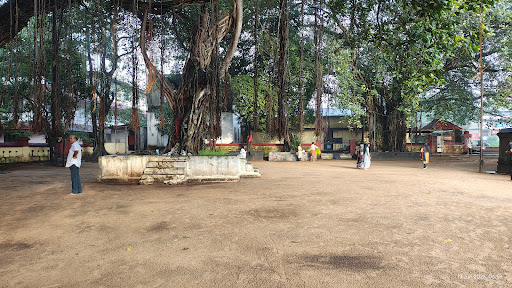
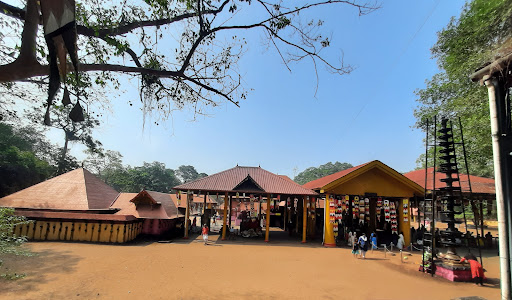
The Presiding Deity: Sree Bhagavathi Some of the salient features of this temple are…. The temple faces east with Dwajasthambam, balipeedam, (opposite to Shiva’s sannidhi) Thulabaram are in front of the temple. Bhagavathy Shrine… The Dwarapalakis are on both sides of the entrance to the sanctum sanctorum of Bhagavathy Amman who faces north. The goddess is also known by the names "Sree Kurumba" (The Mother of Kodungallur). This temple is the head of 64 Bhadrakali temples of Kerala. Bhagavathy is with 8 hands holds, Sword, a Pot (vattaka), a tri-spear (Trishul), khatvanga (a weapon with a skull embedded), the head of demon Darika, a Snake, a bell, another weapon called kheta. The idol of Her Holiness Bhagawati is about seven feet high and is made from seasoned Jackfruit timber. The structure of the idol is adequately protected by yearly “Chandattam” – or bathing with adhesive made of various ingradients. In the inner praharam Saptamatrikas, namely Brahmi (the power of Lord Brahma), Maheswari, Vaishnavi, Vaaraahi and Narasimhi (the powers of Lord Vishnu including his incarnations of Varaham and Narasimham), Koumari (the power of Lord Subrahmanya), Indrani (the power of Lord Indra), and Chamunda (the power of Durga herself), Shiva, Vinayagar and Dakshinamurthy. In the Thiruchuttambalam /outer praharam Kshetrapala is in a separate temple facing north. Dwarapalakas are on both sides of the entrance to sanctum sanctorum. On the north side of Thiruchuttambalam, a small stone temple called 'the Samadhi of Vysoori', perhaps a medieval shrine for a deity of smallpox, chicken pox, mumps and other contagious diseases. Devotees make offerings of turmeric powder, sprinkled and rubbed on its walls. ARCHITECTURE The temple premises consists of a Shiva Temple and a Bhagavathy Amman Temple. Both the temples are square in plan, and the vimanas are dwitala Kerala style vimanas. Both shrines are with Sree kovil, namaskara mandapa, and a common nallambalam. HISTORY AND INSCRIPTIONS It is said that the temple was constructed by Cheraman Perumal. The first Shakteya Pooja in kodungallur temple was performed by a Thiyyar from Malabar. Even present day, The Thiyya thandans (An administrative position) of 64 tharas meet at Nilapaduthara at Kodungaloor in the presence of kodungallur Raja. The kodungaloor meena bharani is conducted under these Thiyya thandans. No proof is found to prove this temple’s antiquity. Cocks are offered to the temple as apart of prayer and the Cocks images are found on the entrance pillars. LEGENDS The people of Kodungallur believe that this temple was, in the olden days, a Shiva shrine and it was Parasurama who installed the murti of Bhadrakali close to one of Shiva. The pujas are conducted; it is said, under direct instructions from the goddess herself. Five 'Sri Chakras', said to have been installed by Adi Shankaracharya, are believed to be the main source of the powers of this deity (to calm the ferociousnes). The priests are Namboodiris and Adikas (Madhu Brahmins) who have a right to perform 'Pushpanjalis' to the Goddess. Legend says it is in this temple that “Kannaki Amman” the heroine of “Silappathikaram”, a Tamil literature written by Ilangovadigal, attained salvation. She came to Kodungallur, prayed to the Bhagavathy and merged with Bhagavathy Amman. In Tantric terms, the divinity is installed in what is called the "Rurujit Vidhaana" pattern, a form of installation with Shiva in one end, Ganesha in the other, with the Sapta Matrika...
Read moreNestled amidst the serene landscapes of Kerala, the Kodungallur Temple is an extraordinary spiritual abode that exudes a sense of ancient grandeur and divine energy. I recently had the privilege of visiting this magnificent temple, and it left an indelible mark on my heart. Here is why I believe the Kodungallur Temple deserves all the accolades it receives.
First and foremost, the temple's architecture is a sight to behold. With its towering gopurams (entrance towers) adorned with intricate carvings and vibrant hues, the temple truly stands as a testament to the rich heritage and craftsmanship of ancient Kerala. The moment you set foot inside, you are transported to a bygone era, where devotion and artistry intertwined seamlessly.
The main deity of the temple, Bhagavathy, is believed to be the goddess of power and prosperity. The energy surrounding her idol is palpable, invoking a sense of awe and reverence. The temple complex also houses several other shrines dedicated to various deities, each with its own unique charm and significance. The vibrant rituals and melodic hymns sung during the daily pujas (religious ceremonies) create an atmosphere of spirituality and inner peace.
Beyond its architectural splendor, the Kodungallur Temple has a profound historical significance. Dating back to centuries, the temple has witnessed the ebb and flow of time, playing a pivotal role in the cultural and religious tapestry of the region. The annual Bharani festival, held in the temple premises, is a spectacle that draws pilgrims from far and wide. The festival is marked by vibrant processions, traditional music, and captivating performances, immersing visitors in a cultural extravaganza like no other.
The temple's surroundings are equally enchanting, with lush greenery and tranquil backwaters creating a serene ambiance. The gentle breeze, carrying the scent of incense and flowers, adds to the ethereal experience. The temple also houses a small pond where devotees can partake in a purifying dip, further enhancing the spiritual journey.
Moreover, the Kodungallur Temple boasts excellent amenities and facilities for visitors. The temple management ensures a well-maintained premises, cleanliness, and safety for all. The staff and volunteers are extremely courteous and helpful, guiding visitors with warmth and a genuine smile.
In conclusion, the Kodungallur Temple is a divine sanctuary that captivates with its awe-inspiring architecture, profound spirituality, and cultural significance. Whether you are a devout pilgrim or an admirer of art and history, this temple offers an experience that transcends time and connects you to a realm of spiritual tranquility. A visit to the Kodungallur Temple is not just a journey; it is a soul-stirring pilgrimage that lingers in your heart long after you leave. I highly recommend this temple to anyone seeking solace, enlightenment, and a deeper connection...
Read moreKodungalloor Bhagavathi Temple is the most famous temple of Goddess Bhadrakali at Kodungalloor, Thrissur district, Kerala. This temple is considered as the origin temple of all Bhadrakali temples in Kerala.
Deities: Main deities are in Father-daughter relation, Lorde Siva is facing to East direction and Sreebhadrakali to North direction, inside Nalambalam in separate sanctums. However, the temple is famous as the most powerfull Saktheya temple in kerala.
Upadevatha (Subdeities): Ganapathi, Kshetrapalan, Vasoorimala...
Festival: Meena Bharani and Thalapoli during Makaram are the famous festivals.
Kodungalloor Bharani is very famous and a unique festival of this kind. A special ritual called Kavutheendal and Bharani songs is the main attraction of this festival. Devotees are making sound by hitting on the brass sheets of the temple while rounding the temple on Aswathy day of the festival. Also some songs realated to Devi are sung aloud inside the temple premise by the group of devotees are the main content of this ritual. The origin or evolution of such rituals are not known exactly but performed as part of worshipping Saktheya power linked to the mythology of Bhadrakali or Kannaki. However, it may be evolved as to demonstrate the openness character of village cultures or may be evolved as part of allowing to burst out the suppressed emotions or feelings of common people once in an year.
History/Mythology: The Moola kshetram (origin temple) of Kodungalloor was related to the mythology of Kannaki. Kannaki was the heroine of ancient Tamil Classic Chilappathikaram written by the great poet Elankovadikal.
The capital of old Chera dynasty was Vanchi/Mahodayapuram/ Kodungalloor and it is believed that the Chera King had built the Kannaki temple in his capital during 2nd century AD and worshipping as the main temple of his country as per the request of his Queen.
However on later periods, Shri. Sankaracharya swamikal had renovated the systems and rituals of hindu temples through out India and as part of renovation at Kodungalloor temple, the idol of Kannaki might had been shifted to a nearby sanctum as Vasoorimala and Lord Siva and Goddess Bhadrakali were put as the main deities of the temple to start Rurujith system of worshipping first time in Kerala temple.
Also it is believed that Kodungalloor Bhagavathi is one among the 108 Sakhti peedoms in the world and it became the most powerfull Saktheya temple due to installation of Sreechakram inside the sacred sanctum by Sankaracharya swamikal.
Location/Travel: At Kodungalloor of Thrissur district by the side of National highway, NH66 in it's Ernakulam-Guruvayur stretch. Public transport connectivity (KSRTC and Private buses) from Ernakulam, Aluva, Thrissur, Guruvayur etc.
Facility: Vehicle parking and Washrooms facilities are available within the...
Read more