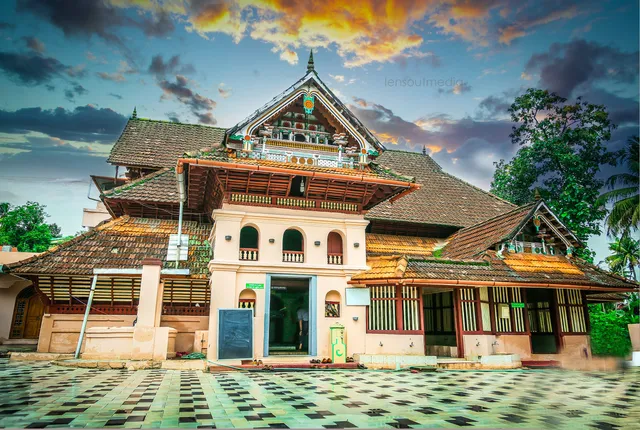
Kottayam Thaliyil Mahadeva Temple
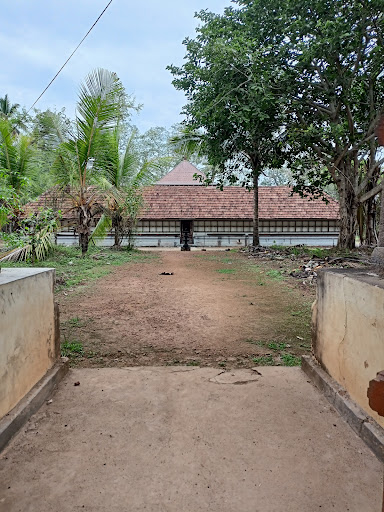
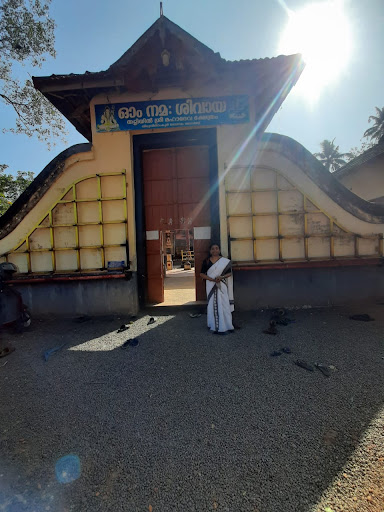
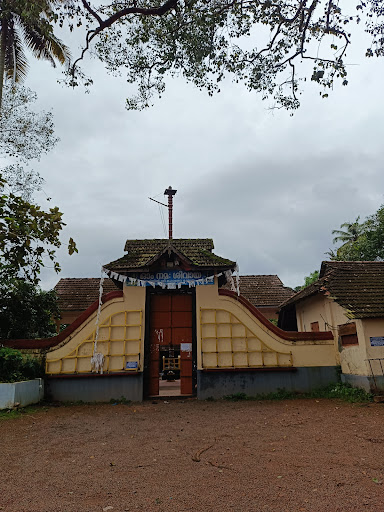
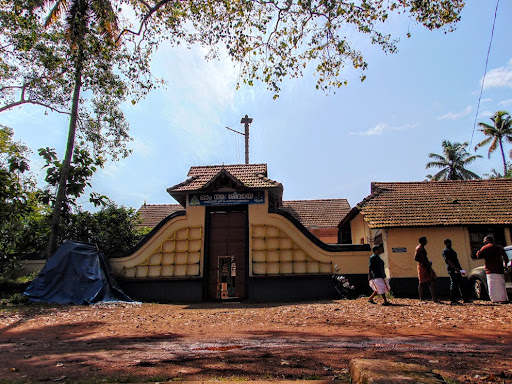
Kottayam Thali is one of the eighteen and a half Thalis mentioned in the history of Kerala. This holy temple overlooks the top of Thaliyil hill which was the Royal headquarters of the Old Kottayam town the Capital of Thekkumkur Dynasty. River Gauna (Meenachilar) flows in a southerly direction, touching the foot of the hill in the west. Just as Lord Parameswara is seated facing West in Kailasa, Mahadeva is also seated facing West here. There is a belief that in old days the ablution water of the temple flows through a canal in the northern side to a small pond and then joins the river through a canal. The fact that this Tirtha stream is similar to the Ganga from Gangotri makes the location of this temple great.
Inside the sculptural-painting sanctum sanctorum of unique architectural beauty is a huge Lord Shiva Lingam made of Black stone. Ganesha, Subrahmanya, Sastha and Srichakram are also placed inside the sanctum sanctorum itself. Cheruvallikavu Bhagavathy is the main sub-deity installed in the Upadevalaya atthe South-East corner of Temple yard. Nagadevathas, the serpent deities and Rakshas are given separate places in the temple sanctum.
Temple History
From AD 820 to 1103, the Second Cheral dynasty was under the control of the "Nanku Thalis" (Melthali, Kizhthali, Chingapurathu Thali, and Nediyathali) based at Mahodayapuram, the present Kodungallur. By the 10th century, the Nankuthalis (fourThalis) were expanded to establish eighteen and a half thalis throughout the Malanadu, including the Kaduthuruthi Thali in Vembalanad and the Thali in Kottayam, the headquarters of Munjhunad.
The Bhattathiris, known as Thaliars, who were scholars in Vedic science, Philosophy, Logic, Law and Thanthra used to come and stay in the Shalas of Thalis. The Local King ruled according to the instructions of the Thaliyars. Taliathiri was the head of Thali. In Kottayam thali, an Azhvancheri Thambrakkal was a Thaliathiri. The sorrounding area came to be known as Thalianthanapuram as the Pattathanam (scholarly assembly) was attached to the Shala in Thali. Before the name Kottayam was born, the name of the place was Thalianthanapuram.
A Shiva temple was a part of almost every thali. All administrative decisions were made in the presence of the temple. As the kshathriya swarupas gained power by acquiring autonomy in Kerala, the positions of authority in thalis became irrelevant, but the temple remained.
By the beginning of the 15th century, when the Thekkumkur dynasty shifted its headquarters from Vennimala to Thalianthanapuram, the Kottayam Thali here became a royal temple. The temple was rebuilt as it stands today and protected by a fort on top of the hill. With the arrival of fort, the name of the place changed to Kottayakam (Place inside the fort). Inside the fort, the palace buildings were on the northeast side of the temple. During the period of Thekkumkur rule which lasted till AD1749, the "Ariyittu Vazhcha" (Coronation) of about twelve Kings took place in front of the Thali. It was also in the presence of the temple that King Thekkumkur signed the land transfer agreement that formed the basis for the emergence of the Poonjar princely state in AD 1419.
In AD 1749, Marthandavarma's army of Travancore invaded Kottayam, damaging the fort and palaces but not attacking the temple. After the fall of Thekkumkur rule, the temple remained in a state of disrepair for two decades. After Karthika Tirunal Ramavarma (Dharma Raja) came to power, he renovated the temple and gave the temple's pooja privileges to Thuyyathu Bhattahiris brought from North Malabar. Now this temple is under Travancore...
Read more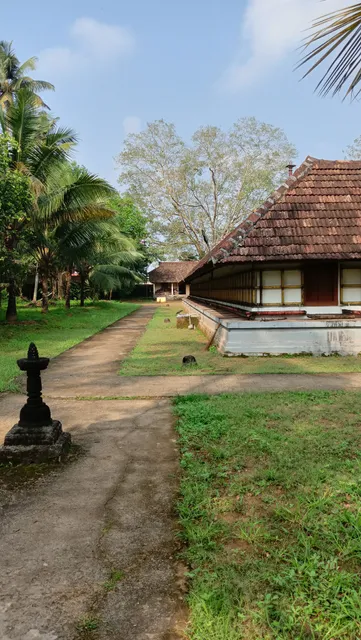
 Learn more insights from Wanderboat AI.