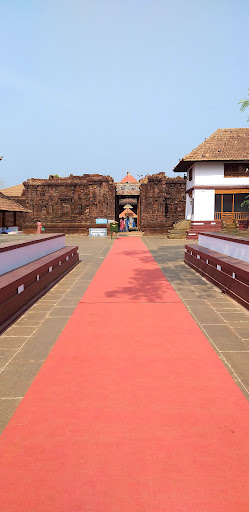
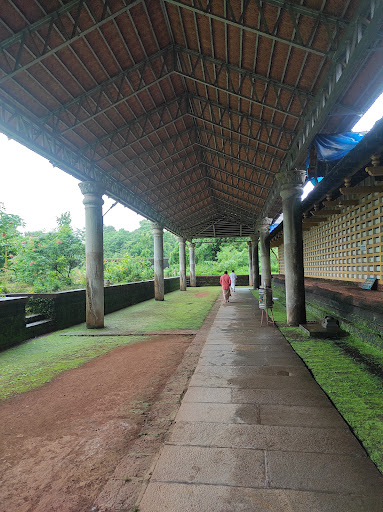
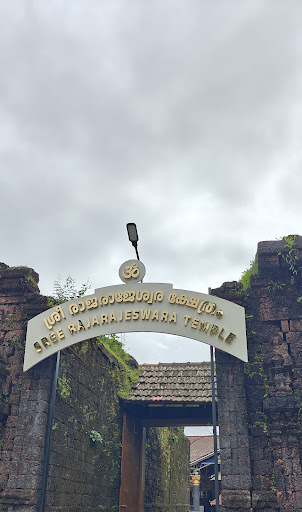
Sri Rajarajeswara temple at Taliparamba is among the 108 ancient Kerala temples dedicated to Shiva.
Taliparamba is regarded as one of the ancient Shakti Peethams. Legend has it that the head of Sati fell here after Shiva's tandavam following Sati's self-immolation. Sati was the daughter of Daksh, a respected Hindu king who had a disregard for Shiva.
The Shiva Linga here is believed to be several thousands of years old. Legend has it that Shiva gave three sacred Shiva Lingas to Parvati for worship. One sage, Maandhata, propitiated Lord Shiva with intense prayers. Shiva was so pleased that he presented one of the Shiva Lingas to him with the injunction that it should be installed only at a place where there was no cremation ground. The sage, after searching all over, found Taliparamba the most sacred spot where he installed the Shiva Linga.
After his death the Linga disappeared into the earth.Then his son Muchukunda offered similar prayers to Shiva and got a second Shiva Linga, which too disappeared in course of time. Centuries passed. The third Shiva Linga was handed down to Satasoman, a king of Mushaka/Kolathiri/Chirakkal Royal Family, who then ruled the region. He was an ardent devotee of Shiva. On the advice of sage Agastya, he prayed to Lord Siva, who granted him the Shiva Linga. The king installed it in the present temple built by him. However, many legends associated with the Temple, claim Agastya Himself as installing the Shiva Linga (which is believed as per those legends to be a 'Jyothirlingam').
It is believed that Sri Rama during his victorious return from Lanka stopped here to offer worship to Lord Shiva. In honor of His presence, devotees are not allowed into the namaskara mandapam even today.
Lord Shiva, as worshiped in this sacred temple, is known as Sree Rajarajeswara, which means the Emperor of Emperors — the Lord Supreme. The name signifies the supreme transcendental power in the background of mysterious drama of the boundless universe. That power is invoked here as Lord Rajarajeshwara. Devotees address the lord with such royal appellations as Perumthrikovilappan, Perum-chelloorappan and Thampuraan Perumthrikkovilappan.
The Jyothirlingam in the shrine in vibrant with spiritual power that exerts an enriching influence both on the material and spiritual levels of the earnest devotees. The celebrated ancient sage Agasthya Maharishi is associated with the installation of the Jyothirlingam in the shrine.
The legends of temples are usually symbolic in character and are intended to convey deep messages to the spiritual inquirer and instill faith in the common man. The legends of Sri Rajarajeshwara Temple reveal the antiquity and the special significance of the Spiritual Presence.
A major legend about this temple, begins with the visit of the Puranic sage Parashurama, one of the incarnations of Lord Vishnu. Seeing there, an ancient shrine of vibrant spiritual power in a dilapidated condition, the sage was grief-stricken and wanted to know its history. Thereupon, sage Narada appeared there and related to him the story of the temple. According to it, sage Sanaka and others, the sons of the creator Lord Brahma, churned the disk of the Sun to lessen its fierce heat. They mixed the dust, which was formed while churning, with the divine nectar of immortality, Amrita, and out of it gave shape to three spiritually to Lord Brahma presented them to Goddess Parvathi, the consort of Lord Shiva. Goddess Parvathi presented these Shivalingams to three kings who were doing intense austerities to invoke the Goddess, one in the Thretha Yugam and the other two Dwapara Yugam. Maandhatha was the king to whom the Goddess presented the Shivalingam in the Thretha Yugam, and Muchukundam and Shathasoman were the devotees who received the other two lingams in Dwapara Yugam. Goddess Parvathi advised each of them to install the idols in such a place where no death of any creature had taken place or any dead...
Read moreThe Rajarajeswara temple is a Shiva temple located at Thaliparmba of Kannur districh of Kerala. This temple is also called Thiruchellur and god as Chellur nadhan.The deity is also called Rajadhi Rajan. The temple is regarded as one of the existing 108 ancient Shiva Temples of Kerala. It also has a prominent place amongst the numerous Shiva temples in South India. It is as famous as the Siva temples at Vaikom, Ettumanur and Vadakkunnathan temple at Trichur.. It had the tallest shikhara amongst the temples of its time. The Rajadhi Raja temple has a top a stone of about 90 tonnes. If any problem is encountered in any other temples of Kerala , the devotees seek a solution in this Temple through a prasna, a traditional method of astrological decision making .The prasna is conducted on a peedha (a raised platform) situated outside the temple. It is believed that when Goddess Sati devi self immolated herself in the sacrificial fire of her father Daksha Prajapathi. The furious Shiva took her body and started dancing as if it was deluge. Understanding that things will go out of hand , Lord Vishnu cut her body in to pieces and it is believed that her head fell in Thaliparambu , and this temple was supposed to commemorate that event. There are also other stories about the origin of the temple. It seems king Mandatha did great penance to please Lord Shiva and when Lord Shiva came in front of him, he presented the lking with a great Shiva Linga and ordered him to consecrate it in a place where there was no cremation ground. After great search, king Mandatha located Thaliparambu and consecrated there and after his death that Shiva LInga was covered by earth. Later King Muchukunda did penance to please Lord Shiva and at the end Lord Shiva gave him a Shiva linga with the same condition that was imposed on Mandatha. He also consecrated it in Thaliparamba and after his salvation that Shiva Linga also vanished. Later a royal sage called Satha soma also pleased Lord Shiva by penance , and Lord Shiva blessed him saying that the Shiva Linga with the same instructions. As per the earlier practice when this idol was also sinking in earth, Sathasoman lit a lap of Ghee and then the God stood firm. Due to this the most important offering to God in this temple is a pot of Ghee. This pot could be earthern or made of silver or gold. The ghee has to be left on the steps of the sanctum sanctorum and is used to keep burning the ghee lamp before the Lord..This is the idol which is being worshipped in Rajadhi Raja Temple of Thaliparamba. A major legend about this temple begins with the visit of the Puranic sage Parashurama, one of the incarnations of Lord Vishnu. Seeing there an ancient shrine of vibrant spiritual power in a dilapidated condition, the sage was grief-stricken and wanted to know its history. Thereupon, sage Narada appeared there and related to him the story of the temple. According to it, sage Sanaka and others, the sons of the creator Lord Brahma, churned the disk of the Sun to lessen its fierce heat. They mixed the dust, which was formed while churning, with the divine nectar of immortality, Amrita, and out of it gave shape to three spiritually to Lord Brahma presented them to Goddess Parvathi, the consort of Lord Shiva. And these were the ones that were given by Lord Shiva to the three kings. And so the temple was built by Sage Parashurama long before the Kali yuga commenced., the architect being Viswa Karma, the architect of the devas. It is believed that sage Agasthya was the one who consecrated this temple. . It was renovated in the eleventh centaury and was renovated later by the the Kolathiri Dynasty Kings. The quadrangular sanctum has a two tiered pyramidal roof, in front of the sanctum is the namaskara mandapam but the temple has no kodi maram (flagstaff), unlike other...
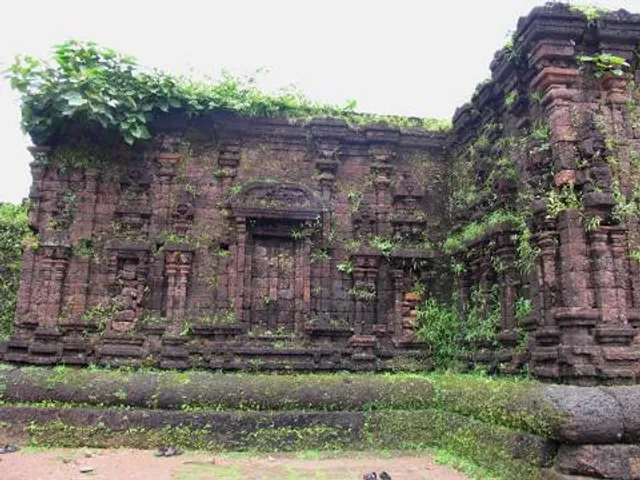
Read moreRajarajeswara(Rajarajeswara is one of the names of Shiva) Temple is situated at Taliparamba, 25 km away from Kannur. Taliparamba or Perinchalloor was one among the 64 brahminical settlement. The old name of Taliparamba was 'Lakshmipura' as this place was considered as an abode of prosperity. All the fame and prosperity to Perinchelloor Gramam is because of the presence of Sree Raja Rajeswara temple and the blessings of Perum Thrikkovilappan.Perinchelloor Gramam has been referred in the Tamil book "Pathittupathu",Chelloor Nadhodaym Chambu (Sanskrit), Kerala Pazhama, Kerala Mahatmyam,Jambukolpathi,Kokila Sandesam, Keralolpathi and many more. Between A.D.216 and 333 Perinchelloor was the capital of Perumakkans as referred in "Pathittupath".
Specialities
This temple has a prominent place amongst the numerous Shiva temples in South India. If any problem is encountered in temples of South India, the final solution is sought in this Temple through a prasna, a traditional method of astrological decision making. The prasna is conducted on a peedha (a raised platform) situated outside the temple. Taliparamba is one among 108 Shiva Temples in Kerala(ancient Kerala from Gokarnam to Kanyakumari) created by Lord Parasurama. Among these temples 12 are considered as most important and called Dwadasa Shivalayas(12 shiva temples). They are Gokarnam Mahabaleswara Temple(now in Karnataka), Taliparamba Rajarajeswara Temple, Kottiyoor Perumal Temple, Thrissur Vadakkunnatha Temple, Peruvanam Mahadeva Temple, Kodungalloor Thiruvanchikkulam Mahadeva Temple, Vaikom Mahadeva Temple, Ettumanoor Mahadeva Temple, Kaduthuruthy Mahadeva Temple, Chengannur Mahadeva Temple, Kandiyoor Mahadeva Temple and Suchindram Sthanumalaya Perumal Temple(for more details about these temples visit 108 Shivalya page).
Taliparamba is regarded as one of the ancient Shakti Peethams. Legend has it that the head of Sati fell here after Shiva's tandavam following Sati's self-immolation. So this temple is popularly known as Rajarajeswari Temple. Siro Peetham or Sirassu is the other names given for Rajarajeswari Temple in some ancient documents. Interestingly Taliparamba Rajarajeswari Temple is also included in the list of 108 Durga Temples created by Lord Parasuram. In the list Taliparamba is mentioned as "Sirassilum".
Pooja Timing
The temple opens at 4.00 am in the morning and after Uchha pooja the temple will be closed at 12 am. The temple opens again at 5 pm. The Deepaaraadhana is performed at 6.30 pm and the last pooja, the Athazha pooja takes place at 8 pm.
While men are allowed to enter the Nalambalam always, woman are allowed only after the Athazha pooja in the night. At this time the Lord is supposed to be happy in the company of his consort, Parvathi, and pleased to grant the desires of His devotees whom pray to Him with humility and sincerity and this is considered to be the most auspicious time for women to enter the Naalambalam as they get the occasion to worship the...
Read more