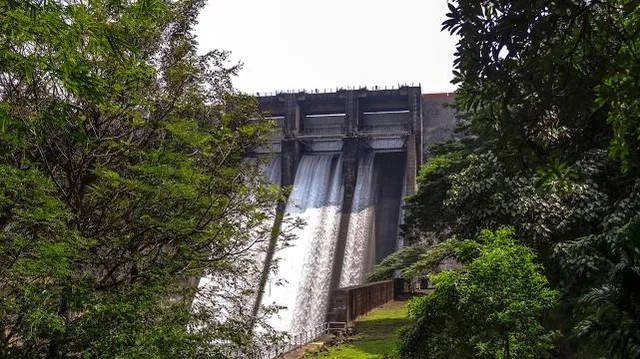
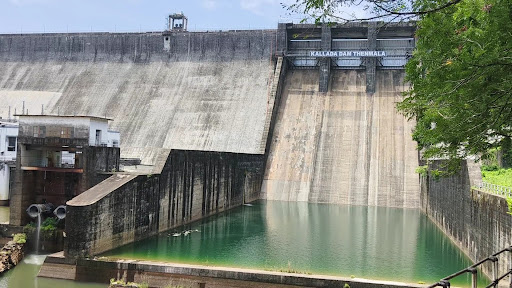
A gravity dam is a solid masonry or concrete structure, generally of a triangular profile, which is so designed that it can safely stand against a pre-calculated volume of water by virtue of its weight. All the forces arising in such a dam – as due to the thrust of the impounded water and the massive weight of the dam material – are assumed to be directly transmitted on to the foundation rocks. Hence the strength of the foundation rocks is the most critical factor in their design.
A gravity dam, when properly designed and carefully constructed, is considered among the safest types.
Many derived types of gravity dams have also been constructed with advantage. The Buttress Dam is such a type in which a thin concrete slab is supported from the downstream side by buttresses thereby saving considerable construction material. The upstream face in a gravity dam may be vertical or inclined.
Similarly, the axis of the dam may be straight or a curvature may be induced in the design of the dam. The buttresses in such dams are narrow, heavily loaded structures which take most of the load from the dam and transmit the same to isolated foundations under them. Hence rocks must be exceptionally strong under the buttresses.
b. Arch Dams:
An Arch Dam, as the name implies, is an arch-shaped solid structure mostly of concrete, which is designed in such a way that a major part of the thrust forces acting on the dam are transmitted mainly by the arch action, (and also cantilever action at the base) on to the abutment rocks, that is, rocks forming the left and right sides of the stream valley. Hence, such dams can be built even on those sites where the foundation rocks may not be sufficiently strong.
Two main types of Arch Dams are:
i. The constant radius Arch Dam, in which the radius of curvature throughout the structure is constant and upstream face, is vertical.
ii. The variable radius dams, in which curvatures are different on the upstream and downstream sides. An arch dam having a curvature both in horizontal and vertical alignment is often called a cupola dam.
Arch dams are better suited for narrow valleys with strong and uniformly sloping walls or abutments. In ideal situation, they offer many advantages over the other types of dams. Arch dams are quite thin walled compared to gravity dams and hence lighter in weight.
Sometimes the designers mix the better points of both the gravity and arch dams and prefer to design a mixed arched-gravity-dam. A combination of series of arch dams called the Multiple Arch Dams is sometimes applied with advantage when the valley is too wide for a single arch...
Read moreThenmala Dam, located in Kollam district, Kerala, is a popular eco-tourism destination and India's first planned eco-tourism spot. Here's what you need to know:
About Thenmala Dam
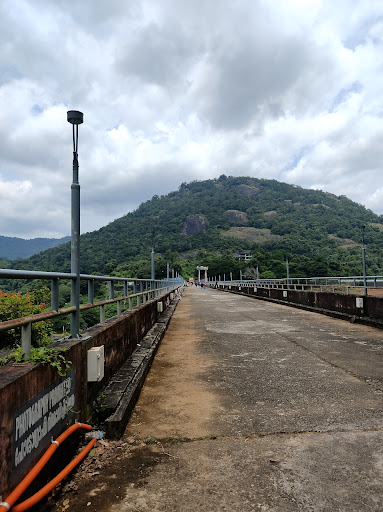
Built across the Kallada River, it's the second-largest irrigation project in Kerala and impounds the longest reservoir in the state. The dam offers breathtaking views, boating facilities, and adventure activities like trekking and mountaineering. It's surrounded by the Shendurney Wildlife Sanctuary, a biodiversity hotspot with diverse flora and fauna.¹ ²
Things to Do
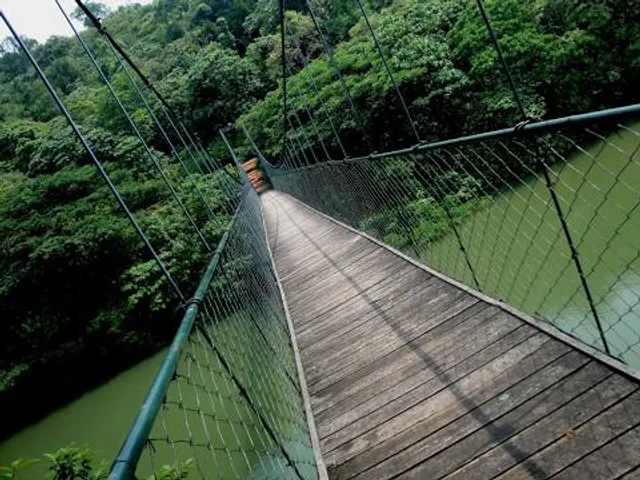
Boating: Enjoy paddle boating, row boating, or canoeing in the reservoir. Trekking and Mountaineering: Explore the surrounding hills and forests with guided treks and mountaineering activities. Musical Fountain: Witness a captivating light and sound show in an open-air amphitheater. Sway Bridge: Take in panoramic views of the dam and surrounding landscape from a suspension bridge. Wildlife Sanctuary: Visit the Shenduruney Wildlife Sanctuary to spot animals like elephants, leopards, and various bird species.³
Visiting Information
Location: Thenmala Dam is 70 km from Thiruvananthapuram, 64 km from Kollam, and 39 km from Tenkasi. Timings: Open daily from 7 am to 6 pm. Nearest Airport: Trivandrum International Airport (74 km). Nearest Railway Station: Thenmala Railway Station (1 km) or Shengottai Railway Station (32 km).⁴ ⁵
Tips
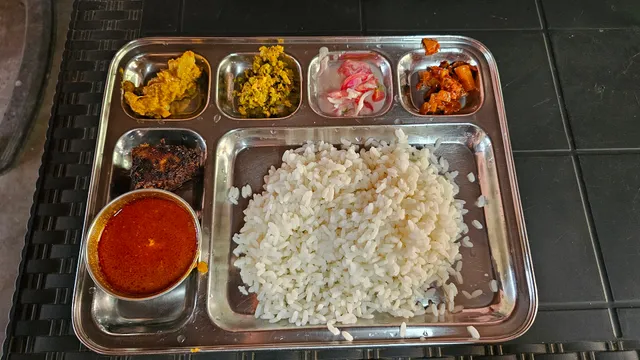
Plan your visit during the evenings, from November to February, for the best experience. Wear comfortable shoes and clothing for trekking and adventure activities. Don't forget to try the local cuisine and explore the nearby attractions like Palaruvi Waterfalls and Shenduruney...
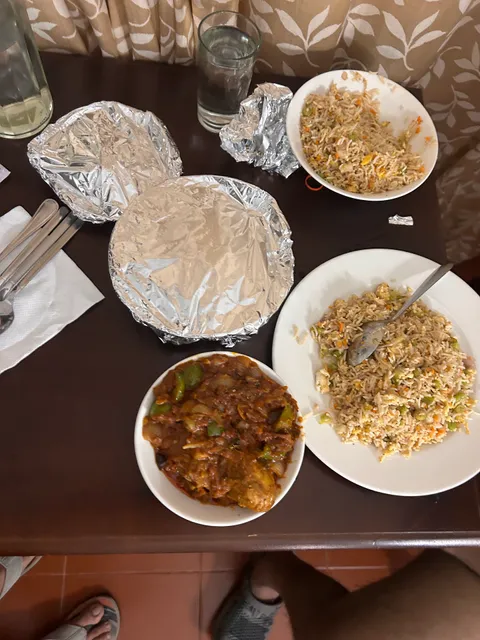
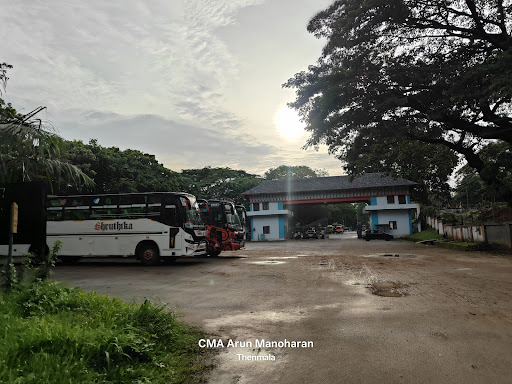
Read moreThenmala dam is constructed under Kallada Irrigation Project (KIP). KIP is Kerala's largest irrigation project. Thenmala dam is also called Parappar dam as the dam is situated in Parappar near to Thenmala. The main purpose of this dam is for irrigation and it is also used for power generation. The dam is having a length of 335m and a maximum height of 85.35m. The dam is having 3 spillways. Thenmala dam is a straight gravity masonry dam. Thenmala dam is built over Kallada river. Kallada river is formed by three rivers. They are Kulathupuzha, Chendurni and Kalthuruthy, which joins near Parappar. Kallada Irrigation Project is benefited for a net cultivable command area of 53514Ha in 92 villages in Kollam, Pathanamthitta and Alappuzha. Thenmala is India's first planned ecotourism destination. Shenturney Wildlife Sanctuary is the ecotourism resource. Thenmala dam have the longest reservoir in Kerala. The reservoir is formed by constructing a gravity type masonry dam across Kallada river. Thenmala dam is a famous tourist destination. There is a leisure zone, an adventure zone, a suspension bridge and lot more.There are good sceneries on this place. There is parking space inside and outside the entrance. You can see lots of monkeys around this place. You have to walk a long way to reach the dam from the entrance. The ticket charge for entry is ₹10. Food from hotels near the dam is not good. Food from canteen is...
Read more