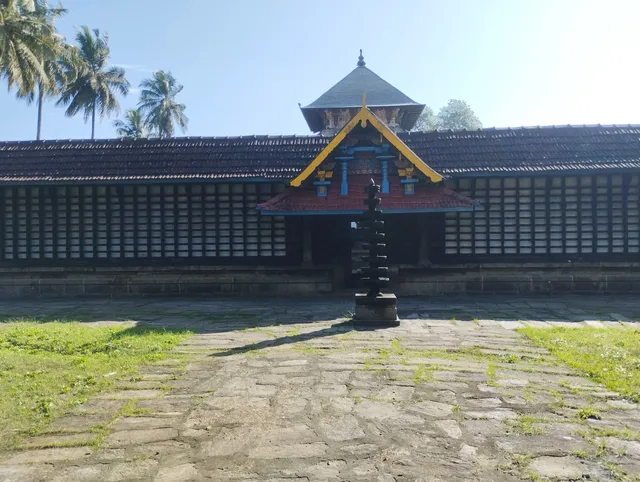
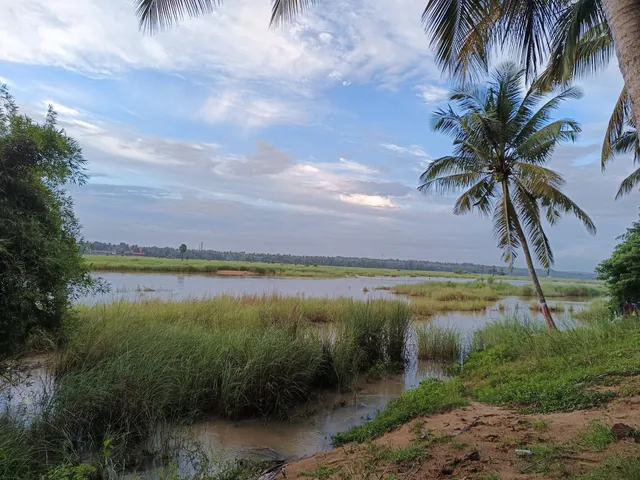
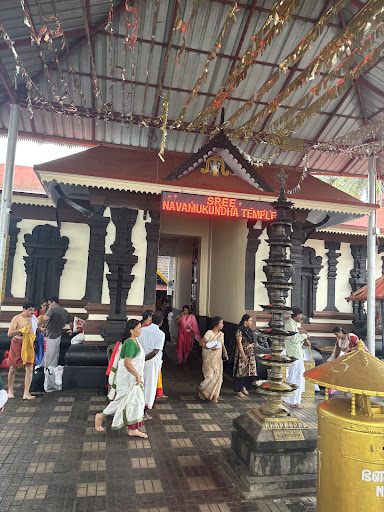
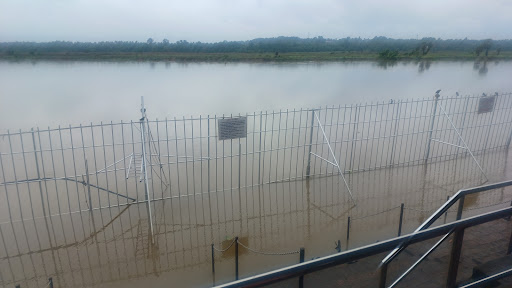
This temple of Lakshmi Narayana which is situated on the banks of Bharatha Puzha(Also called Neela Nadhi) is one of the most ancient temples of Kerala replete with history and several stories about it, This temple is situated 8 km away from Tirur town on the way from Shoranur to Kozhikode. On the opposite shore of the temple of Vishnu, there are temples of Lord Shiva and Lord Brahma. There is also a celebrated school of Vedas to the Namboodiris adjacent to the Brahma temple , which it is believed was consecrated by Lord Parasurama. So the devotes consider this place as equivalent to Varanasi (Benares) , The river near the temple also is considered extremely important to do Pithru Karmas(Worship of manes) especially in the months of Thulam(October-november) and Karkidagam( July-august) It is not clear whether the idol of the temple is made of metal or stone even to those who touch and worship it. The temple was supposed to have been established by the nine occult yogis viz. Sathuvanathar, Saaloga nathar, Aadhinathar, Arulithanathar, Madhanga Nathar, Macchendira Nathar, Kadayanthira Nathar, Korakkanathar and Kukkudanathar. It seems the idol of Mukunda was consecrated by one of these yogis and as per the custom, the temple was shut for seven days. But when they opened the temple after seven days , there was no trace of the idol. Then the second yogi did the consecration. The same story was repeated till the eighth yogi. So when the ninth yogi consecrated the yogis did not wait for the stipulated seven days but opened the temple after three days. They were surprised to see that the idol has already sunk up to the knee. They immediately used occult manthras and stopped the further sinking of the idols. So even today , you can see the idol sunk up to the knee. It is believed that in spite of it the idol is sinking and when it has completely sunk, Kali Yuga will come to an end the final deluge will take place then . In course of time the first eight yogis attained salvation but the ninth yogi , prayed God and wanted him to send those great yogis back to the temple , The god replied to him that the eight yogis were still there worshipping the God and showed them to him, The ninth yogi also wanted to join them. The God fulfilled his wish and it is believed that al the nine yogis are always there worshipping the god. It seems there is a bottomless pit behind the present idol and once upon a time a priest wanted to measure its depth. He tied his ring to a very , very long thread and slowly introduced it in side the pit . But in spite of keeping on adding fresh threads, the ring seemed not to touch the bottom. Hurriedly he withdrew the thread and was surprised to find that the ring was missing. The Great yogis and Thanthris do not stand on their foot in this temple but kneel down before the deity in the belief that underneath the entire floor several God’s idol (which were lost) lay buried. Just behind the temple there is a lotus pond and it seems the great devotee of Vishnu Gajendra( king of elephants) and goddess Lakshmi used to pluck the lotus flowers from the tank and offer it to Lord Mukunda. At one particular time the lotus flowers were about to be over and the upset Gajendra petitioned the Lord. To solve his problem, Lord Vishnu drew Goddess Lakshmi inside his temple and gave her a separate sanctum inside the temple compound and requested her to make the place prosperous. Another story is about the connection of sage Markandeya to this temple. It seems when Markandeya attained the age of 16, Yama , the God of death started chasing him. Markandeya ran in side the Nava Mukunda temple. It seems then the God gave him one handful of mud and instructed him to rush through the west door to the Shiva temple at Thirprangode , make a shiva linga out of the mud given to him and worship it. As soon as Markandeya crossed the west entrance, Lord Vishnu closed it by putting a big stone there.(Even to this day , that door...
Read moreThis was the first time I visited this place in my life. I lost my mom on the 18th of August and as per my religious belief, I need to perform pithru tharpanam on the 16th day which was 2nd September, We are seven children to our mom and am the 6th one (I have three elder sisters and two elder brothers and one younger brother). One elder brother left us before due to ill health. Although my siblings had performed this offerings to some other family members who left us in the past, for me this is the first time to visit this place for this purpose.
This place, Thirunavaya where this temple "Nava Mukunda Kshetram" located is an important place for people believe in Hinduism. The main deity of the temple is Lord Vishnu, The sub deities (upadevathas) are Aadi Ganesha, Sree Mahalakshmi & Swami Ayyappa. Thousands come here to perform rituals to propitiate the souls of thier deceased near and dear ones.
We reached this place before 5 am but being a special day (karutha vavu) the crowd was too high. I managed to stand in the queue to get the tickets to perform the pithru tharpanam for all of us (six). The ticket charge is Rs. 50/- per person - all the ritual pooja items and an instructor (poojari) will be provided by the temple. We went near the river (Bharathapuzha) wearing the allowed dresses and took a dip in the river water and sat on the river bank (there is steps constructed using stones for us to sit on it and perform the pithru tharpanam). The instructor (poojari) came and gave us the necessary instructions to perform the rituals for our mom. We gave "dhakshina" to the poojari and left the place to visit inside the Navamukunda Temple. We got "dharhan" of lord vishnu idiol (named Navamukunda) and also the sub-deities (upadevathas). We took a "pradakshinam" of the temple and reached the "oottupura" where we got free breakfast from the temple (upma and tea). It was considered as a "prasadam". I liked the food very much.
At the "prasadam" counter we purchased "kadina payasam" and gave certain amount to the temple oottupura as our complimentary contribution towards "annadhaanam". I took some photographs as shown below and left the temple premises by 9:30 a.m.
It was a wonderful experience for me to visit this place and experience the auspicious ambience. You can also visit this temple as usual (not for the cause of pithru tharpanam).
Mamangam:
When talking about this place I can't stop without mentioning two words about "Mamangam". As per the available information MAMANGAM was a festival took place once in every twelve years on the banks of the "Nila" also known as "Bharathapuzha" at Thirunavaya on the premises of the Navamukunda Temple. The festival lasted for 28 days starting from Pooyam (malayalam date) and ends Makam (malayalam date) in the malayalam month of Kumbam. The festival was a celebration of art and culture as well as science and trade fair, It was also a timewhen the Samoothiris (Zamorins) would show off their power and pomp in front of other provincial rulers. The festival was believed to have huge economic, social and political significance.
The first Mamangam festival is believed to have been celebrated in 892 AD and the last one in 1755 CE. The festival was eventually discontinued after the British gained control of Malabar, following the attack...
Read moreThe sthala perumal, Naavaay Mugundhan is in Nindra Thirukkolam along shore of Bharathappuzhai river. The specialty of this sthalam is the thaayar Periya Pirattiyar Lakshmi devi is in a separate sannadhi and it is one of the specialty among the Malayala Naatu Divyadesam.
Opposite to the Bharathappuzhai river, a separate temple for Lord Shivan and Brahma devan are found. So, we can get the seva of all the Tri-Moorthies in this Thiru Naavaay divya desam.
The piratti, Lakshmi devi and Gajendran (the elephant) worshipped the perumal and dedicated him with the Lotus flowers from the Lake. But, Lakshmi devi was jealous and angry on the Gajendran since he also dedicate the flowers to his perumal, who thinks that the perumal is only for him. But, perumal who can know all about this, wanted to make clear to his wife, Lakshmi devi that she is wrong.
Lakshmi devi daily plucked, all the flowers from the pond before its being plucked by Gajendran, the elephant. Seeing the action of Lakshmi piratti, Gajendran felt sad and worried for it. It cried for this and prayed to the perumal. Hearing the voice of Gajendran, the perumal ordered Lakshmi piratti not to dedicate the flowers that is plucked from the pond and instead she has to sit beside him and should accept the flowers that's being dedicated by Gajendran. Accepting the words of the perumal, Lakshmi piratti seated along with the Naavaay perumal and accepted the flowers of Gajendran.
By performing this Leelai (action of the perumal), the perumal explains that all the aathmaas in the world should be taken care of. And at the same time, if anyone doesn't give respect (or) interferes on the bhakti dedication towards him, they should be taught with a lesson and thereby making them to understand their fault. Like-wise only, the perumal gives the respect for the bhakti of Gajendran and at the same time he teaches a lesson for Lakshmi Piratti by making her to accept the bhakti of Gajendran.
In this sthalam, the perumal Naavaay perumal is treated as the father, Lakshmi piratti as mother and Gajendran is treated as their son. Thus, this sthalam explains the relationship between the perumal (father) and Lakshmi (mother) and between the perumal (father) and Gajendran (son).
Since, the thaayar, Lakshmi piratti doesn't want Gajendran to dedicate the Lotus flowers (Malar), the thaayar is named as "Malar Mangai Naachiyaar".
This sthala perumal also gave prathyaksham for Nava yogi. The Nava yogis are Sathuvanathar, Saaloga nathar, Aadhinathar, Arulithanathar, Madhanga Nathar, Macchendira Nathar, Kadayanthira Nathar, Korakkanathar and Kukkudanathar. They are so great and are capable of doing lots of Yaagams. Since, because of this, this sthalam is also called as "Thirunavayogi". And as the time passed, the name Thirunavayogi is changed to "Thirunaavaay".
Since, the perumal is also found with Lord Shivan, this sthalam is said to...
Read more