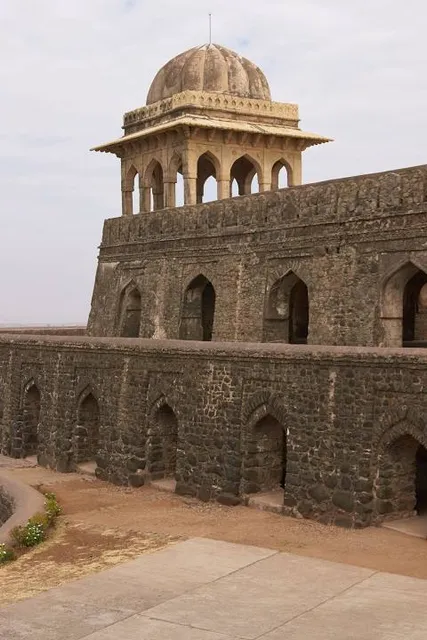
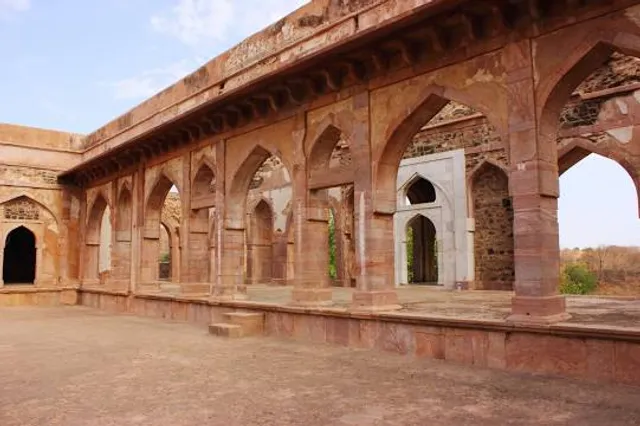
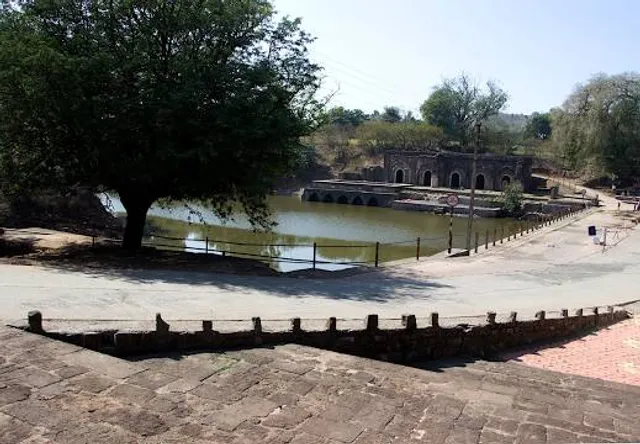
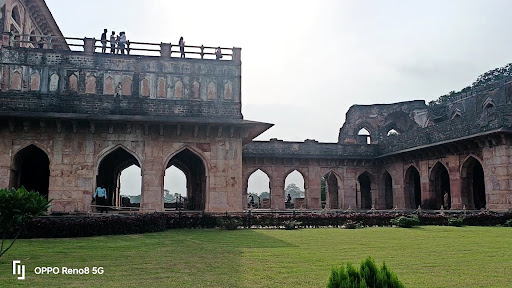
Nice place.On the lofty hill to the south beyond the palace of Baz Bahadur stands the pavilion associated with the romantic name of Roopmati. A closer examination of the building shows that it had undergone two or three stages of construction in different periods.. The original structure, as will be clearly seen from the east, consisted of a low but massive hall with two rooms at both ends. The walls have a sharp slope towards the base and the arches are rather heavy in proportion to their spans. The parapet above the walls also belonged to the original structure. This part of the building without the pavilions above thus belongs to the earliest stage and seems to have been built originally for maintaining an effective military watch over any possible enemy movement on this side of the fort, which falls down here abruptly to a depth of 365.8 m towards the distinctly visible Nimar plains below.
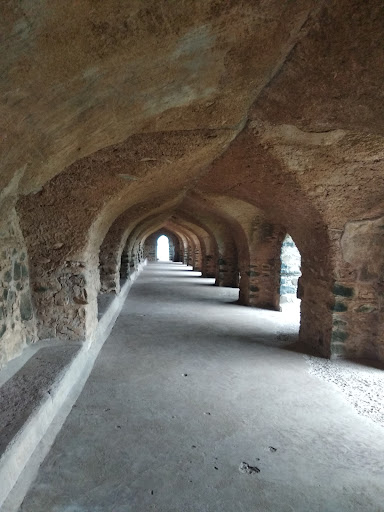
The remaining part of the building was built along the western side of the plinth of the original block on the slope of the hill, so as to form a basement which has two prolonged projections, in the form of corridors, one going towards the west and the other, in the opposite direction, along the northern side of the block, towards the east. The corridors in the basement have a number of arched openings across their width to support the ceilings. The western projection contains a large cistern to which only rain water during the monsoon through a channel running from the roof to the reservoir below.
If history is to be believed, this building was erected because Rani Rupmati, a very beautiful Hindu singer had supposedly caught the interest of Baz Bahadur.
So, Baz Bahadur using all his clout and wealth built this magnificent piece of architecture to showcase his love for her. It is constructed on the banks of river Narmada because it is believed that Rani Rupmati was so much in awe of the river that she would not even drink water unless she saw the Narmada river. This place is still squeaky clean as the earlier times.
Among the plethora of monuments that dot the landscape of the historical city of Mandu in Madhya Pradesh, is the Roopmati Pavilion, an ode to love. The sandstone structure is perched regally on the edge of a 365m precipice overlooking the Nimar Valley and to the south of the Baz Bahadur Palace. It stands as testimony to the legendary tragic love story of Baz Bahadur, the mid-16th century Sultan of Mandu, a great musician, and his queen, Rani Roopmati, a singer of repute.
We traverse a broad, winding pathway to come upon a flight of stairs that brings us to the 16th century monument. The 72m high fort, Roopmati Pavilion, the southern-most monument in the city, is a magnificent expression of Afghan architecture in sandstone. It is evident that the monument underwent construction in phases during different time periods. The original design, sans pavilions, was built as an observation post for the royal army as a low, large hall with a pair of rooms on each side and a heavy sloping base. A symbol of their undying love, it was later transformed into the abode of Roopmati with a western side extension along the plinth. It was extended so as to enable the queen, who fervently worshipped the Narmada, to see the river and perform religious rites without stepping out...
Read moreAmong the plethora of monuments that dot the landscape of the historical city of Mandu in Madhya Pradesh, is the Roopmati Pavilion, an ode to love. The sandstone structure is perched regally on the edge of a 365m precipice overlooking the Nimar Valley and to the south of the Baz Bahadur Palace. It stands as testimony to the legendary tragic love story of Baz Bahadur, the mid-16th century Sultan of Mandu, a great musician, and his queen, Rani Roopmati, a singer of repute.
We traverse a broad, winding pathway to come upon a flight of stairs that brings us to the 16th century monument. The 72m high fort, Roopmati Pavilion, the southern-most monument in the city, is a magnificent expression of Afghan architecture in sandstone. It is evident that the monument underwent construction in phases during different time periods. The original design, sans pavilions, was built as an observation post for the royal army as a low, large hall with a pair of rooms on each side and a heavy sloping base. A symbol of their undying love, it was later transformed into the abode of Roopmati with a western side extension along the plinth. It was extended so as to enable the queen, who fervently worshipped the Narmada, to see the river and perform religious rites without stepping out of the fort.
The basement of the pavilion is characterised by corridors that have several arched openings along their width. The western ledge has a large reservoir from which rainwater collected during the monsoons would be channelled from the roof of the structure to a tank below by means of conduits.
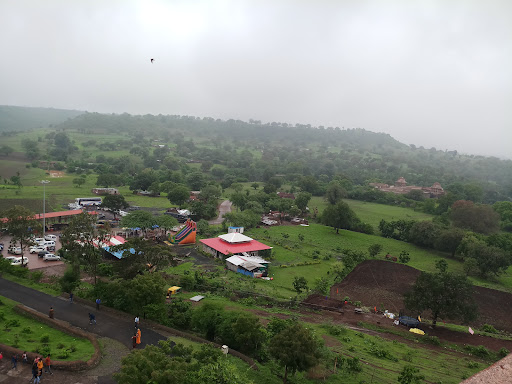
However, it is the pavilions on the terrace of the original block that we access via spiral stairs, a later addition, which lends the structure its distinctive allure. The square-based pavilions are crowned with hemispherical domes that are fluted on the interior and exterior. We are treated to a visual delight as we climb a flight of steps to reach the pavilion top. Nature's enchantment leaves us mesmerised as lush forests, plateaus, valleys and vast stretches of far away hills...
Read moreAmongst the many monuments and palaces that adorn the historical city of Mandu famous for the legendary tragic love story of Prince Baz Bahadur and Roopmati is the Roopmati’s Pavilion, one of the most visited tourist attractions in Mandu. Perched atop a hillock on the southern side of the Baz Bahadur Palace, Rani Roopmati Pavillion is from where the queen would view the palace of her beloved, Baz Bahadur
Originally built as an army observation post, the structure later on took the shape of symbol of undying love between Baz Bahadur and Rani Roopmati. Lying to the south of Baz Bahadur’s Palace, Roopmati’s Pavilion was then a low and large hall with two rooms on each side and a thick sloping base. Later, the building was extended on the western side along the plinth and the most interesting additions were the square pavilions housing hemispherical domes.
The corridors in the basement of the Roopmati's Pavillion have a number of arched openings across their width. The western ledge contains a large reservoir in which rain water was collected during the monsoon through a channel running from the roof of the structure to the tank below. Also the sensational view of river Narmada flowing 305 meters below is a sight to behold.
History
Rani Roopmati’s Pavilion bears witness to the love story between Queen Roopmati and Baz Bahadur. It was on one of his hunting excursions that Baz Bahadur got attracted to the mellifluous tunes of Roopmati, then a simple Hindu peasant girl. Love blossomed among them and she was brought to Mandu by the sultan on the condition that she would stay in such a place as to be able to view her paramour’s palace as well as the flowing Narmada. Thus began the love story between the two, though it ended tragically due to the intrusion of Adham Khan, a general of Mughal Emperor Akbar, who was attracted by the beauty of Roopmati. However, the queen died a self inflicted slow poisoned death, unable to bear such...
Read more