A must visit place in Mandu with historical importance.
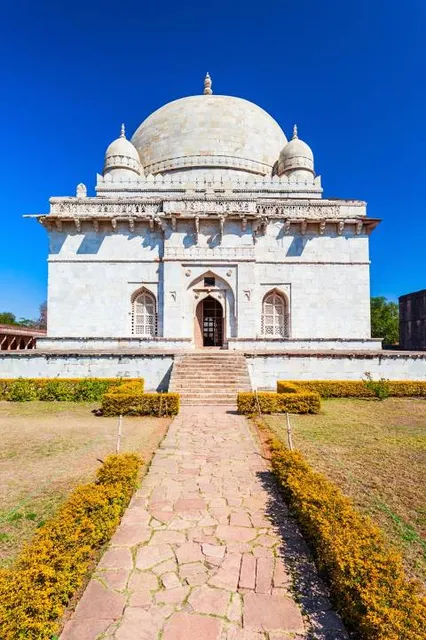
Hoshang Shah’s Tomb , Mandu, Dhar, Madhya Pradesh, India.
Mandu or Mandavgad is an ancient city. This fortress town is celebrated for its fine architecture. The word "Mandu" is believed to be a Prakrit corruption of "Mandapa Durga”.
Mandu gained prominence in 10th and 11th century under the Paramaras.
In 1305, the Muslim Sultan of Delhi Alauddin Khalji captured Malwa, the Paramara territory.
When Timur captured Delhi in 1401, the Afghan Dilawar Khan, governor of Malwa, set up his own little kingdom and the Ghuri dynasty was established, His son, Hoshang Shah, shifted the capital from Dhar to Mandu and raised it to its greatest splendour.
His son and third and last ruler of Ghuri dynasty, Mohammed, ruled for just one year till his poisoning by the militaristic Mohammed Khalji.
Mohammed Khalji established the Khalji dynasty of Malwa (1436-1531) and went on to rule for the next 33 years. It was under his reign that the Malwa Sultanate reached its greatest height.
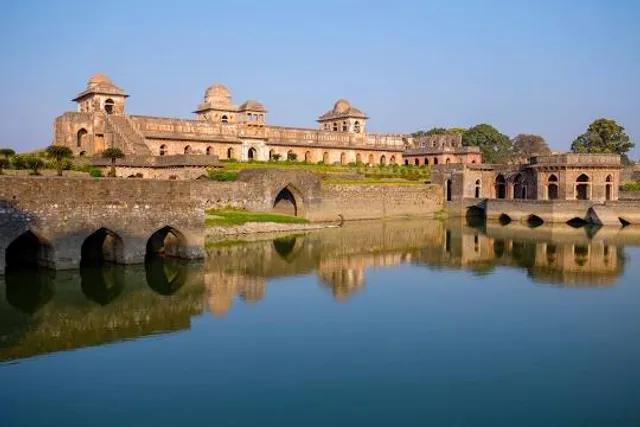
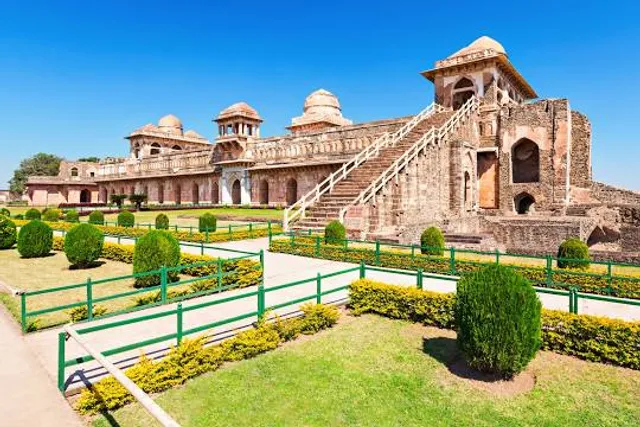
He was succeeded by his son, Ghiyas-ud-din, in 1469 and ruled for the next 31 years, who was a pleasure seeker and devoted himself to women and song. He had a large harem and built the Jahaz Mahal for housing the women, numbering thousands, of his harem. Ghiyas-ud-din was poisoned, aged 80, by Nasir-ud-din, his own son.
Bahadur Shah of Gujarat conquered Mandu in 1531. In 1534 Mandu came under Humayun's rule. Humayun lost the kingdom to Mallu Khan, an officer of the Khalji dynasty. Ten more years of feuds and invasions followed and in the end Baz Bahadur emerged on top.
In 1561, Akbar's army led by Adham Khan and Pir Muhammad Khan attacked Malwa and defeated Baz Bahadur in the battle of Sarangpur. One of the reasons for Adham Khan's attack seems to be his love for Rani Roopmati. Rani Roopmati poisoned herself to death on hearing the news of fall of Mandu.
After Akbar added Mandu to the Mughal empire, it kept a considerable degree of independence, until taken by the Marathas in 1732 by Peshwa Baji Rao I. The capital of Malwa was then shifted back to Dhar by Marathas under Maharaja Pawar,...
Read moreThis Place is aka Jami Masjid, One of the Major tourist attraction of Mandu, It's belived that this place was originally build by Parmar rulers, as High Court ( Deewan-e Aaam) & Dharam Shala but when Hoshang Shah captured Mandu, he converted this Place in Masjid, & in center part he erected his own Tomb which was made from full white Marbles.
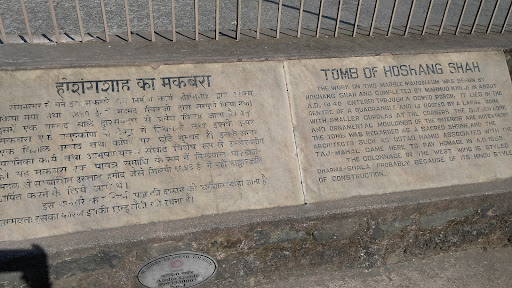
The tomb is a marble construction in honor of Hoshang Shah who holds a significant position in the history of India. It is noted that the tomb was constructed in the 15th century. The tomb was so beautiful that it impressed Shah Jehan and so he sent four of his architect before construction of Taj Mahal. It has been said that Ustad Hamid had a great association with the team who constructed Taj Mahal.
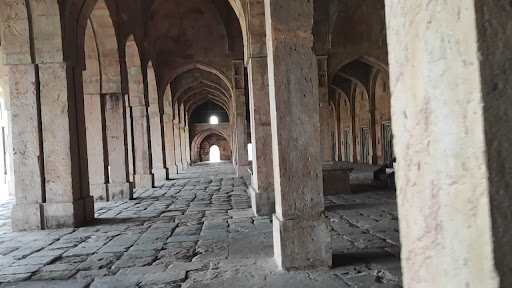
Third part of this complex is Dharamshala, Dharmashala within the Compound of Hoshang’s Tomb is situated to the west of Hoshang’s Shah’s tomb and annexed to it is a Dharamshala. It consists of a colonnade divided into three aisles by rows of pillars. The flat ceiling supported on pillars, brackets and lintels is typical of Hindu architecture. However, a long narrow hall at its back with vaulted ceiling is purely Indo-Islamic in architectural style.
Entry Fees Indian Rs. 15/- Foreign National Rs.200/- Free entry to children up to 15 years
Tip Hire a...
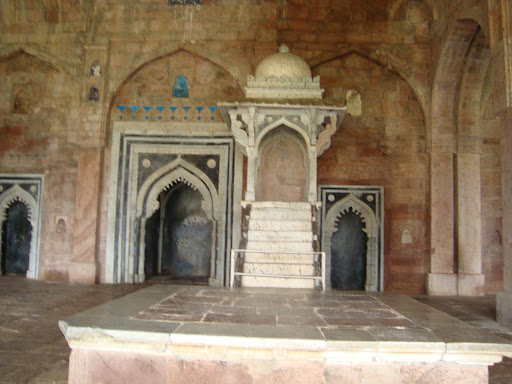
Read moreThe entrance to the Hoshang Shah's tomb is through a porch, square in plan, with well-proportioned and artistic arched openings on three sides supporting the marble dome above. The interior of the porch is plain except for a band of carved miniature arches set with blue ornamented tiles.The exterior of the dome is also simple with a low protective wall carved in relief along its drum and a band of stars cut in the stonework below. The main sarcophagus of Hoshang is carved in th form of a coffin with receding bands and with a mihrab moulded at the top having posts of Hindu design. There are also other graves below the dome only three of which are in marble. Externally the dome is flat and heavy, adorned with small domed turrets or tower-shaped projection on a building, of rather conical shape, at the four corners. To the west of the Tomb is a series of columns with three rows of pillars dividing its depth of 7.6 m into three aisles. What is interesting here is the predominant influence of Hindu architecture in the designs of the pillars and brackets and the arrangement of the flat roof supported on horizontal beams. At the back of the colonnade is a long and narrow hall with a long barrel-vaulted ceiling. It is believed that earlier this was shiv Temple, later it is...
Read more