Cathedral
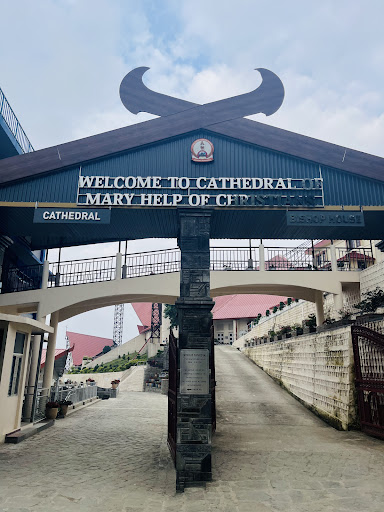
Cathedral of Mary Help of Christians, Kohima (A Bridge for the living & the dead)

The Cathedral is the most important Church in a diocese since it is the seat of the diocesan bishop and as the symbol of unity and hierarchical communion in the Church. In fact the term “Cathedra” means Chair. It is the Church where the bishop of the diocese presides over the liturgy. The word “Catholic” is derived from the Latin word “Catholicus” and the Greek adjective” Katholkose” meaning ‘Universal”. The building itself by its physical structure symbolises both the glory of God and of the Church.
Though the diocese of Kohima-Imphal was erected in 1973 there was no Cathedral Church built for the diocese. Bishop Abraham Alangimattathil, SDB, who was the first bishop of the diocese of Kohima wanted to build a Cathedral blending
and amalgamating the Christian theology and architecture with the local cultural tradition and symbols. In many places the Catholic Church has the agent of inculturation mainly in the architectural, furnishing and decoration in literature and liturgy. With this plan in mind in 1982 the agreement with the Architect was signed and in 1983 the Church site was dedicated in the plot of land measuring 9.13 at Kuozhu, on the Aradurah hill now called New Minister Hill, overlooking the beautiful Kohima town and facing the historic Second World War Cemetery. It is visible from most of the mountain ranges surrounding the capital city of Kohima.
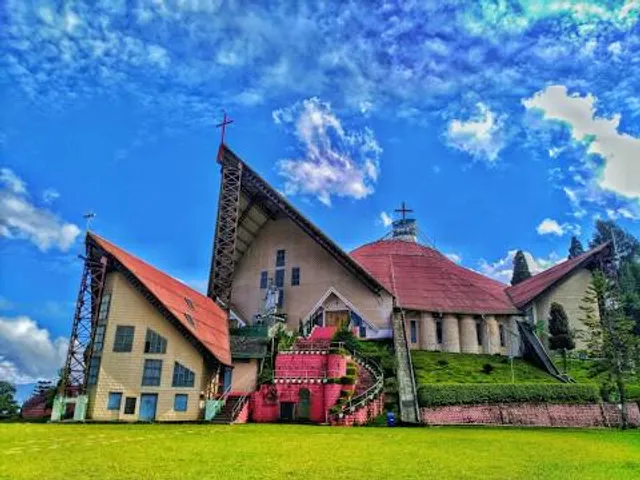
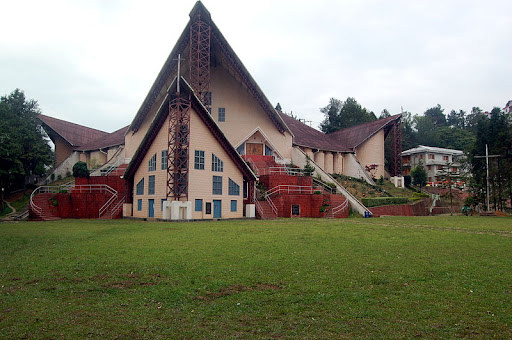
The construction of the Cathedral began in 1985. Designed in Naga-Gothic style, built in a semi-circular shape, adapting and harmoniously blending both Christian and Naga cultural elements and art, the Cathedral stands as a historical monument. The Cathedral of Mary Help of Christians was officially consecrated in April 1991, after a peace memorial service, in which some war veterans from England and Japan who fought in the battle of Kohima, the last battle in the east of the Second World War, participated and came together for a reconciliation service and peace treaty, which may be first of its kind in the post-world second war period. In fact the roof of the Cathedral is red to signify the blood of Christ and blood of humans and of...
Read moreThe Cathedral of Kohima (Mary Help of Christians Church) is the church of the bishop of the diocese of Kohima, and hence, the main church of this diocese of Nagaland, India. The church is noted for its architecture which incorporates many elements of traditional Naga houses, including its facade which resembles that of a Naga house. The architecture of the cathedral blends into the hill on which it is situated. The 16 feet high carved wood crucifix is one of Asia's largest crosses.
The cathedral was conceptualised by the first bishop of Kohima, Abraham Alangimattathil. The cathedral complex also contains Bishop Alangimattathil's tomb.
The construction commenced in 1986 and the church was consecrated in January 1991. The three-crore expense for constructing the cathedral was mostly funded by Japanese people who wished to construct a monument to the Japanese soldiers who died in the Battle of Kohima during the Second World War. For this reason, the following quote is engraved in the environs of the cathedral:
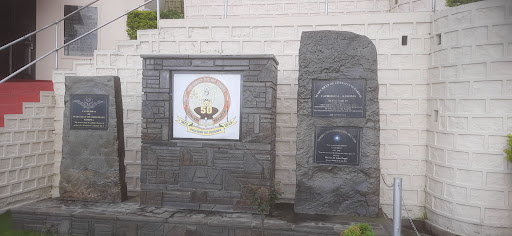
"...It is with thankfulness that we heard that a Catholic Cathedral was built at Kohima, where Mass would be offered every morning in the memory of the fallen..." There is also another inscription near the entrance to the building:
"When you enter in here, bring before the Lord all those who gave their life and who will give their all, for your safer and better Nagaland." The cathedral was used as the venue for reconciliation meetings between the Japanese and British veterans who fought each other...
Read moreThe Kohima Cathedral, also known as Mary Help of Christians Cathedral, is a prominent landmark and the largest church in Nagaland. It is situated on a hilltop in Kohima, offering a serene view of the town and the surrounding hills. The cathedral is known for its unique architectural design, which blends traditional Naga elements with modern styles.
Key Features:
Architecture: The church features a distinctive A-frame structure, inspired by Naga house architecture. The steep, sloping roof resembles a Naga hat, and the design allows for excellent natural ventilation.
Capacity: It is one of the largest cathedrals in Northeast India, with a seating capacity of around 3,000 people.
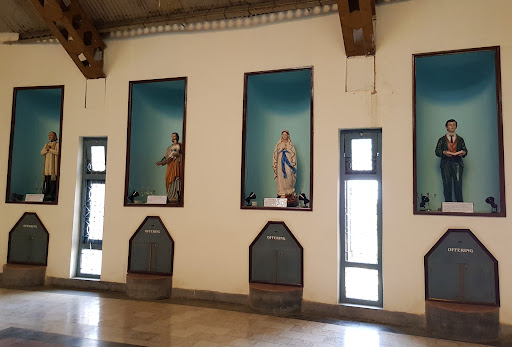
Interiors: Inside, the cathedral is spacious and adorned with wooden beams and carvings. The altar and stained glass windows are notable features that add to its spiritual and aesthetic appeal.
Significance: Built in the 1980s, the church stands as a symbol of peace and resilience. It was constructed with contributions from Japanese soldiers' families as a memorial to those who lost their lives in the Battle of Kohima during World War II.
Events: The cathedral hosts various religious events and celebrations, especially during Christmas, Easter, and local festivals.
The Kohima Cathedral is not just a place of worship but also a popular tourist attraction, drawing visitors for its architectural beauty and...
Read more