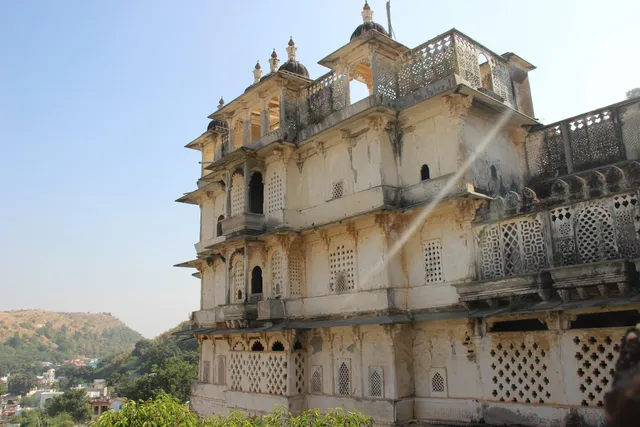
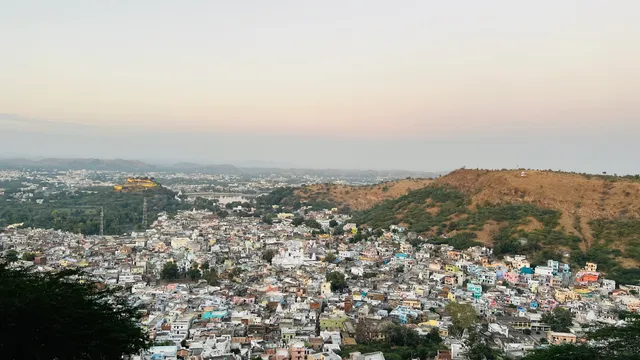
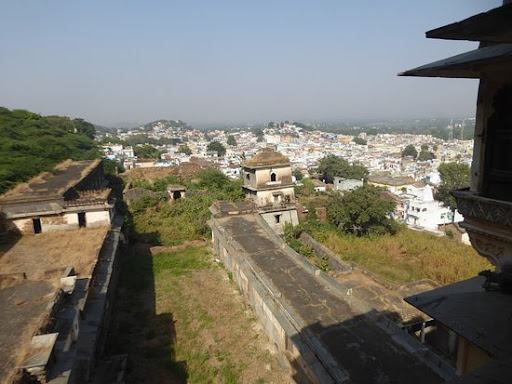
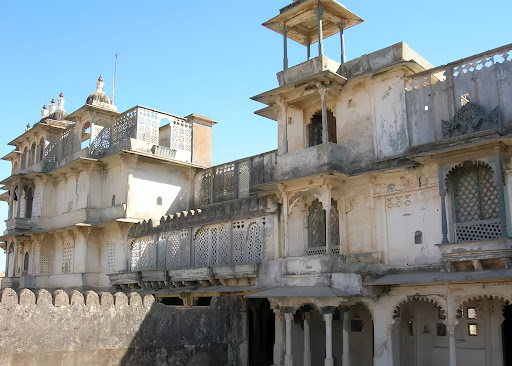
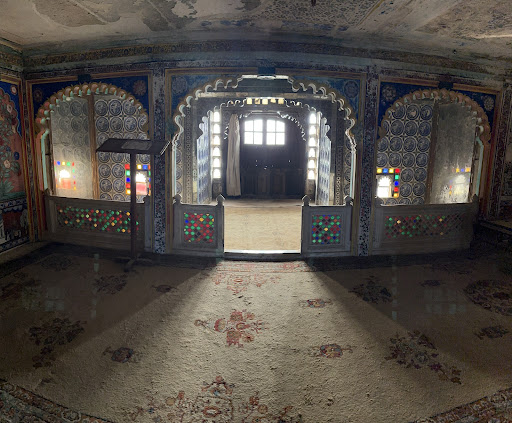
Juna Mahal, a former royal residence, is located near the town of Dungarpur in the Thar Desert at the base of the picturesque Aravalli hills in southern Rajasthan. The first palace on the site was constructed in the late thirteenth century, and additional rooms, wings, floors, courtyards, and fortifications were added through the nineteenth century by successive rulers. The multi-layered, seven-story complex is decorated with pareva, a local green stone, as well as murals, frescoes, and glass and mirror inlay. Juna Mahal’s fortifications and extensive decorations are representative of early Rajput fort-palaces and show the ways in which the artistic design, architectural planning, and construction techniques of this building type evolved from the thirteenth to the nineteenth century.
Juna Mahal was in use until the mid-twentieth century, after which the structure fell into a state of disrepair. One of the oldest continuously inhabited buildings in the country, the structural integrity of the palace is threatened due to a lack of consistent maintenance. The interior has been vandalized and much of the artwork has been defaced. The site was included on the 2014 World Monuments Watch to bring greater awareness of its historic and artistic significance to community leaders and the public. The building is in need of a comprehensive conservation management plan and a long term reuse strategy, as well as emergency repairs of the historic fabric that would address...
Read moreDominating the landscape of Dungarpur is the gigantic Juna Mahal that stands tall on a high platform constructed from dawra stone. The initial structure of this seven-storeyed edifice was built in the 13th century, while the additional rooms, wings, floors, courtyards, and fortifications were added through the years by the successive rulers. Current status of the Juna Mahal's architecture is completely in ruins due to lack of consistency maintenance. But unlike its exteriors, the interiors are well vandalized and glows with its exuberant ornamentation and mirror works. The palace is adorned with frescos, murals, local green stones and mirror inlays that proudly represent the uniqueness of Rajput construction techniques and how it has evolved over centuries. Decoration styles like color paintings and arrangement of glass work that can be seen in some rooms are hard to find in anyother Rajput heritages. Remarkably well preserved, these include a series of paintings from the Kama Sutra in erstwhile rulers bedroom on the top floor of the palace. The palace has always been the talk of the town not only because of its unique structure but also due its comprehensive conservation...
Read moreDungarpur Raj- Since the time of Rajwads, this city has its own separate place in the state and country because of its historical events. Got fame. Along with education, bravery, cleanliness and social harmony, Dungarpur state has always played its leading role in various public awareness Major events of history on 17th Foundation Day ....
According to the historian, from 1282 AD to 1850 AD. of | middle less than 40 outer | There were attacks. Eight Maharanas of Mewar, three Sultans of Malwa, The two Sultans of Gujarat, the Mughals. Emperor Akbar, Bajirao Peshwa, | Malharrao Holkar, of Gwalior. Scindia and Khudada Khan were prominent among the Sindhi invaders.
Five doors used to protect. During the princely state, Nagarkot was built around Dungarpur for the internal and external security of the townspeople. In this, cannons, turrets for keeping weapons and soldiers and guns and arrows were built in the middle. There were five big doors with this Nagarkot to...
Read more