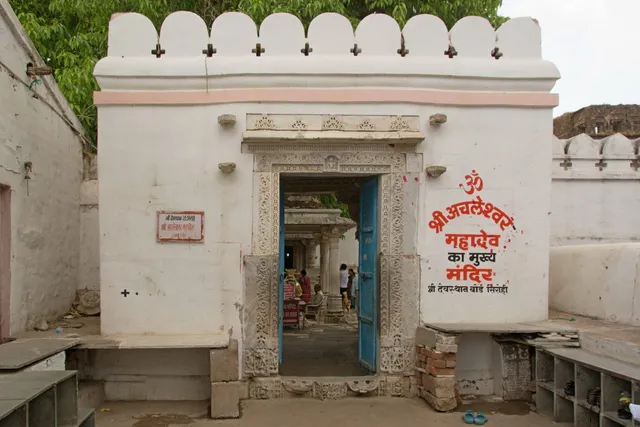
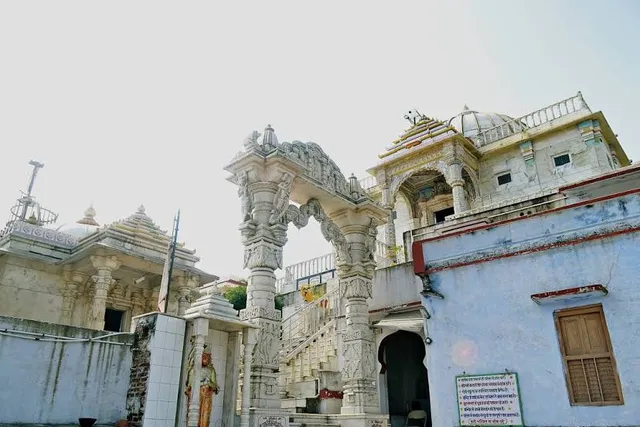
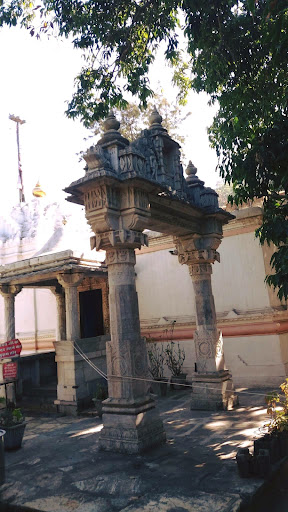
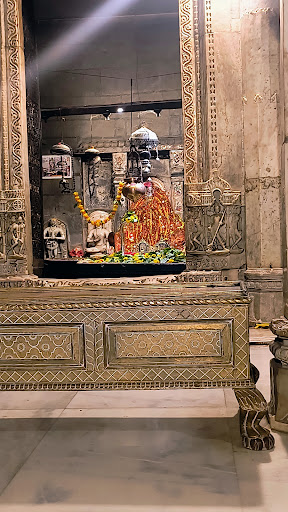
This temple dates back to earliest century. — in Mount Abu. According to legend, Hindus respect this place because once Nandini, the cow of the sage Vashisht was caught in a deep gorge and could not free itself. The sage called for Lord Shiva's assistance. Shiva sent Saraswati, the divine stream, to help flood the gorge so that the cow could float up. Sage Vashisht then assured that such mishaps would not occur in future and asked the youngest son of Himalaya to fill the gorge eternally. With the help of the snake, Arbud he successfully completed the task. He took the help of the snake, Arbud. To honor the help, Achalgarh Shiva Temple in Mount Abu is considered to be a revered place amongst all tourists and Hindu pilgrims. It is a Shiva temple situated just outside the Achalgarh fort constructed sometime in the 9th century AD, and by the Paramara dynasty , later the Fort was reconstructed, renovated and named as Achalgarh by Maharana Kumbha in 1452 CE. According to local legend, the temple is built around a toe print of Shiva. Shiva is worshipped, like at most Shiva temples, in the form of a Shiva linga, The shiva linga at this temple is a naturally occurring stone structure. The temple stands in the centre of the complex on the southern side of the Agnikund.There are two Elephant Statues at the entrance. There is a "4 tonne" Vahan (Shiva's Mount), Nandi statue of pancha dhaatu,(five metals – gold, silver, copper, brass and zinc). The temple also has several other idols, sculpted from sphatik, a quartz stone, which appears opaque in natural light but becomes crystal-like translucent when a light is held against it. Within the temple is a pit which is believed by the locals to be a doorway to Naraka, the netherworld. Close to the temple is a pond with three large stone buffalo statues. These buffaloes are believed to be representative of demons who, according to legend, flocked to the watering hole, which was said to be filled with ghee, until they were shot dead by the king, Raja Adi Pal. Shri Shanti nath ji jain Mandir is located...
Read moreAchal = that cannot be shaken ; Mountain Eeshwar = Lord Shiva It is a Shiva temple situated just outside the Achalgarh Fort....constructed sometime in the 9th century AD, and by the Paramara dynasty , later the Fort was reconstructed, renovated and named as Achalgarh by Maharana Kumbha in 1452 CE. According to local legend, the temple is built around a toe print of Shiva. Shiva is worshipped, like at most Shiva temples, in the form of a Shiva linga, The shiva linga at this temple is a naturally occurring stone structure. The temple stands in the centre of the complex on the southern side of the Agnikund. There are two Elephant Statues at the entrance There is a "4 tonne" Vahan (Shiva's Mount), Nandi statue of pancha dhaatu,(five metals – gold, silver, copper, brass and zinc)
There are several small shrines dedicated to other deities Shri Suryanaaraayan ji Shrine Shri Paapa Kanteshwar Shrine Shri Somnath Ji Shrine Shri Maarkundeshwar Ji Shrine Shri Narbadeshwarji Shrine Shri Omkaareshwar ji Shrine Om Chamunda Mataji Shrine Shri Shankhateshwar ji Shrine Shri Badrinath ji Shrine
The temple also has several other idols, sculpted from sphatik, a quartz stone, which appears opaque in natural light but becomes crystal-like translucent when a light is held against it. Within the temple is a pit which is believed by the locals to be a doorway to Naraka, the netherworld. Close to the temple is a pond with three large stone buffalo statues. These buffaloes are believed to be representative of demons who, according to legend, flocked to the watering hole, which was said to be filled with ghee, until they were shot dead by the king, Raja Adi Pal. Shri Shanti nath ji jain Mandir is located...
Read moreAchaleshwar Mahadev Temple is a remarkable and spiritually charged shrine dedicated to Lord Shiva, situated approximately 11 km north of Mount Abu, just outside Achalgarh Fort . This ancient temple is one of the very few places where devotees worship the toe of Lord Shiva, believed to have thrust into the earth to stabilize the Aravalli hill range—hence the name “Achaleshwar” (immovable lord) . Legend says the Shiva Linga here is self-manifested and connected to that divine toe imprint, which devotees honor with great reverence . The temple is famed for its 4-ton Panchadhatu Nandi statue—a finely crafted bull guardian made of five metals. Local lore credits Nandi with miraculously defending the temple from invaders by releasing swarms of bees . Nearby, three stone sculptures of buffaloes stand around a pond, symbolizing demons vanquished by divine power, while sacred waters offered into a pit vanish instantly—locals believe it leads to the netherworld or Patal Lok . The temple sanctuary was buried under lime for centuries, preserving its marble carvings until rediscovered in 1979 by the Sirohi crown prince. It was meticulously restored to reveal its original Solanki-style craftsmanship—intricate pillars, toranas, and a circumambulatory path around the sanctum . The temple is open daily from early morning to evening (roughly 6 AM–6 PM), entry is free, and most visitors spend about 30 to 60 minutes exploring the site . Best visited between October and March, when Mount Abu’s climate is pleasant, though summer days are also manageable...
Read more