Padmanabhapuram Palace
Padmanabhapuram is a town in Tamil Nadu’s Kanyakumari district. Previously known as Kakulam, Padmanabhapuram was the capital of the Venad Kingdom as it was situated close to steep mountain ranges. The huge Padmanabhapuram or Kalkulam Palace complex, an administrative centre of the old Venad monarchs, is located within the historic Kalkulam fortress.
Padmanabhapuram Palace’s History
The Padmanabhapuram Palace, located around 64 kilometres from Thiruvananthapuram, was the former residence of Travancore’s monarchs.
The Mudaliyar records explain the origins of the Kalkulam Palace. The Padmanabhapuram Palace was constructed in 1601 by Venad ruler Iravi Varma Kulasekhara Perumal. Anizham Tirunal Marthanda Varma (r. 1729-1758) restored the palace as well as the fort. The Kalkulam Palace was presented to Shree Padmanabha Swamy, the royal family’s tutelary god.
The Padmanabhapuram Palace was again found in 1934 by J. H. Cousins, Travancore Government’s Art Advisor, and R. Vasudeva Poduval, who led the Archaeology Department.
The historic palace was converted into a complex museum in 1935, with the royals’ full cooperation. The palace, which is located in Kanyakumari District, is overseen by a Curator from the Kerala Government’s Archaeological Department.
Padmanabhapuram Palace’s Architecture
The Padmanabhapuram Palace has intricate hardwood and teak woodwork columns. It also has huge earthen urns, holding oil lamps, and coloured magnetite on the window panes. The floors of the Kalkulam Palace are dark and reflective, made using egg whites and coconut shells.
The Kalkulam Palace’s architecture has Chinese carvings on aristocratic seats with 17th-century Belgian mirrors. One can also find murals with complex paintings on the ceilings. These murals show the social life in Padmanabhapuram at the time.
Every element of the palace, from the dance halls to the museums, the council chamber, the dining halls, the Mother Palace, the inner courtyards, and the King’s chambers, has a unique interior.
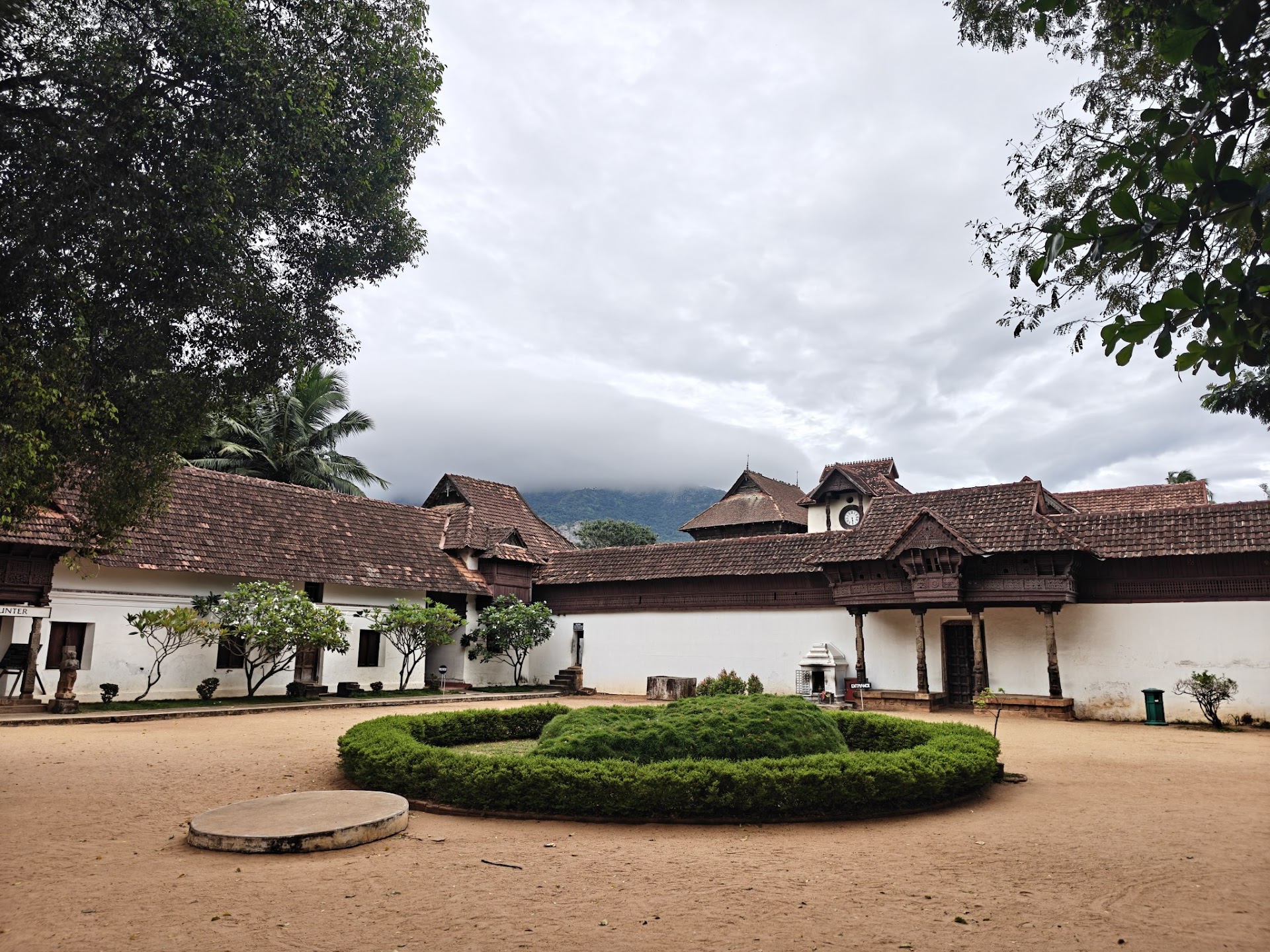
The palace’s main entrance is on the west side, which may be accessed by passing through a large courtyard.
The council room, known as Manthrasala, is the most magnificent component of the palace. It is where the King’s official meetings were held. This room has tinted mica windows with latticework and dark flooring that keep the room cool.
The Queen’s Mother Palace, also known as Thai kottaram, is a notable feature of the Padmanabhapuram Palace. It is the palace’s oldest section, having been erected in 1550. Its painted and carved ceilings have floral motifs of over 90 different types, and it was constructed in the Kerala style of architecture. Thai kottaram also features an inner courtyard known as ‘nalukettu.’
The Padmanabhapuram Palace also has a tiny room in its southwest corner called ekantha mandapam. It means ‘chamber of solitude’. In the room is a pillar made of jackfruit tree wood. The pillar has many floral designs carved into it.
The King’s bedroom consists of a medicinal bed made of 64 types of herbal woods. It was given to the Kind by Dutch merchants.
The palace also has an audience hall called Natakasala. It is the palace’s newest addition, constructed between 1829 and 1846. It has granite pillars and peepholes for royal women to view the performances.
The palace’s dining hall provides seating for around 1000 people.
There is also a hidden tunnel in the castle, called ‘charottu kottaram’. This secret passage was constructed to transport the royals in the event of an attack. It took them to another palace roughly 2...
Read moreA must visit place if you are near Kanyakumari or Nagercoil or even in Trivandrum which is hardly 50 kms away from the location. The palace is an architectural marvel with a lot of history around it. As per records, the original palace was completed early 16 th century and was renovated around 1750 by his highness Marthanda Varma of the Travancore Royal Family. The oldest of the constructions date back to around 1550 while the latest additions to the complex were made not later than 1850. The palace itself is a treasure trove of information for history enthusiasts too since it used to be the former seat of the erstwhile Travancore kingdom till late 18 th century.
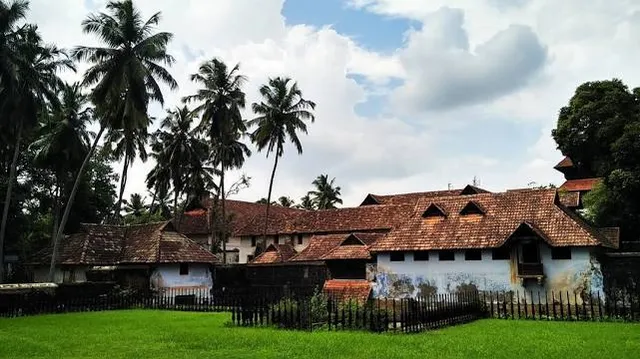
The palace is a classic display of traditional kerala architecture complete with dance halls , council chambers , museums, dining halls etc . The oldest of the structures is called the Thai kottaram (king’s mothers palace) and has an inner courtyard called “nalukettu” and displays some beautiful floral carvings. Main structure is a four storied building in the center which used to house the Kings chamber , kingdoms treasury as well as the famous upparikka Malika (Place devoted to god) Most striking aspect of the palace is its wooden structures and intricate carvings. Along with this one may find unique exhibits like “sapramanchakattil” (King’s bed) made of 60 plus woods of medicinal properties, a 300 year old clock which still keeps time , a lamp with a ever glowing flame , belgian mirrors, brass lamps , stone carvings etc .One of the old palaces is now converted to an archeology museum and its exhibits include different artifacts , coins , furniture, wooden structures, armaments etc .More information on the history of the kingdom , notable events , social practices and even related folklores like that of the infamous “Kalliyankattu Neeli” can be found here .
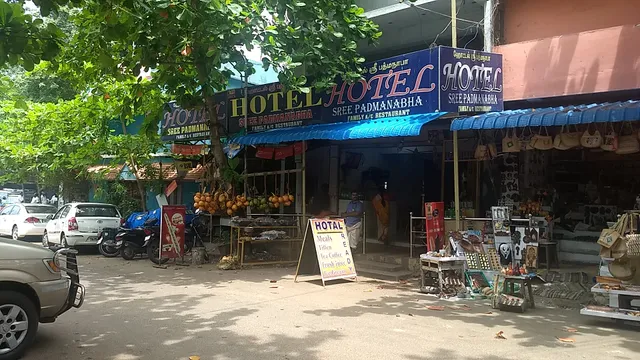
The palace is in Padmanabhapuram very near to the town of Thuckaly in Tamil Nadu and can be easily accessed by road. Indicators can be found on the main road itself and once you reach near the location, parking fees must be paid but you will have to park the vehicle outside the premises. From there you may proceed on foot along a narrow street with shops selling souvenirs and food items on both sides . There is a place with locker facilities available to keep your footwear safe. Entry fee is cheap with a small addition for still cameras. Videography will involve additional costs. The staff was generally very responsive and supportive.
The place is open from 9.00 am to 4.30 pm every day except Mondays but It may be noted that there is a break every day at noon (1.00 pm to 2.00 pm) so you must plan your visit accordingly. I highly recommend this place for all those who are interested in history and traditional architecture. It will be a...
Read moreAfter watching the movies His Highness Abdulla and Manichithra Thazhu, the immediate desire is to go to the lecture palace of those movies. Padmanabhapuram Palace, the crown jewel of Kerala architecture. Land of Kerala in Tamil Nadu.
Nestled in the verdant landscape of Kanyakumari district, the Padmanabhapuram Palace stands as a testament to the rich cultural heritage and architectural prowess of the erstwhile kingdom of Travancore. This well-preserved wooden palace is a marvel of traditional Kerala architecture, with intricate carvings and remarkable craftsmanship that speak volumes of the artisans’ skills from centuries past.
As you step into the palace compound, you are greeted by the imposing Padippura, the main gate, which leads to the Poomukham, the central courtyard. The palace complex is a labyrinth of halls, chambers, and courtyards, each with its own story to tell. The Mantrasala, the King’s Council Chamber, is particularly noteworthy for its ornate ceiling and latticed windows, which allowed the king to listen to the proceedings without being seen.
The palace also houses an impressive collection of antique artifacts, showcasing the rich culture and history of the era. The Thaikkottaram, the Queen Mother’s Palace, with its painted ceilings and rosewood carvings, is a sight to behold. The sheer scale of the palace, with its 6.5 acres of sprawling grounds, is awe-inspiring.
Visitors often remark on the palace’s hidden gems, such as the secret underground passages and the Saraswati Bhandar, the library that once held a vast collection of palm leaf manuscripts. The Nataksala, the performance hall, still resonates with the echoes of traditional art forms that were once performed there.
However, it’s not just the architecture that captivates the visitors; the palace’s location, right at the southern tip of the Indian Peninsula, offers breathtaking views of the surrounding landscape. The tranquility of the palace grounds provides a stark contrast to the bustling towns nearby.
While the palace is a historical treasure, some visitors have noted that the management could be improved, especially during busy days when crowds can overwhelm the space. Nonetheless, the Padmanabhapuram Palace remains a must-visit for anyone interested in exploring the grandeur of India’s royal past and the architectural splendor of Kerala’s tradition. It is a hidden gem that continues to enchant visitors with its timeless beauty and historical...
Read more