HTML SitemapExplore
logo
Find Things to DoFind The Best Restaurants

Thillai Natarajar Temple, Chidambaram — Attraction in Tamil Nadu

Name
Thillai Natarajar Temple, Chidambaram
Description
Nearby attractions
Divya Desam 40 Sri Govindaraja Perumal Temple (Thiruchitrakoodam) - Divya Desam
9MXV+M8Q, Chidambaram, Tamil Nadu 608001, India
Chit Sabha, Chidambaram
9MXV+P9W, E Sannathi, Chidambaram, Tamil Nadu 608001, India
Sivakama Sundari Amman Temple
CM2V+52Q, Chidambaram, Tamil Nadu 608001, India
Thillai Kaali Amman kovil
Gayathri Amman Koil St, Chidambaram, Tamil Nadu 608001, India
Arulmigu Keezhatheru Mariamman Thirukoil
Chidambaram, Tamil Nadu 608001, India
Nearby restaurants
Palagaram.com
9MXR+XG4 Palagaram.com, 156, West Car St, Chidambaram, Tamil Nadu 608001, India
Sri Krishna Vilas
95/129, E Car St, Chidambaram, Tamil Nadu 608001, India
Ramesh High Class Vegetarian Restaurant
E Car St, Chidambaram, Tamil Nadu 608001, India
Hotel SABASH veg restaurant
64/43, Malaikatti St, Chidambaram, Tamil Nadu 608001, India
Southernspice Non-Veg Restaurant
12, VGP St, Chidambaram, Tamil Nadu 608001, India
New Double A Restaurant
554, S.P Kovil Street, Chidambaram, Tamil Nadu 608001, India
CHENNAI SREE SARAVANA BHAVAN
18/20, E Car St, Chidambaram, Tamil Nadu 625588, India
Nearby hotels
ArudhrA residency
No 20/9, Natraja temple, E Sannathi, First residency from the lord, Chidambaram, Tamil Nadu 608001, India
Parisha Residency - Temple Side Hotel
No 16/1, S Sannathi St, Chidambaram, Tamil Nadu 608001, India
Pari Muthu Vilas (Temple View Inn)
15/1, S Sannathi St, Chidambaram, Tamil Nadu 608001, India
The Grand Park
59, E Car St, near Natarajar Temple, Chidambaram, Tamil Nadu 608001, India
Hotel Akshaya
17, 18, E Car St, Chidambaram, Tamil Nadu 608001, India
Homestay Senthil Akam
0.3, km from Temple, 42/18, Vellapiranthan St, near South Car Street, Chidambaram, Tamil Nadu 608001, India
Nataraja Residency
Chidambaram, Tamil Nadu 608001, India
Suloram illam
19, Vellapiranthan St, opposite to MLA office, Chidambaram, Tamil Nadu 608001, India
KG Homes
72, Vellapiranthan St, Chidambaram, Tamil Nadu 608001, India
Shriram Guest House
76/01, VOC St, Chidambaram, Tamil Nadu 608001, India
Related posts
Keywords
Thillai Natarajar Temple, Chidambaram tourism.Thillai Natarajar Temple, Chidambaram hotels.Thillai Natarajar Temple, Chidambaram bed and breakfast. flights to Thillai Natarajar Temple, Chidambaram.Thillai Natarajar Temple, Chidambaram attractions.Thillai Natarajar Temple, Chidambaram restaurants.Thillai Natarajar Temple, Chidambaram travel.Thillai Natarajar Temple, Chidambaram travel guide.Thillai Natarajar Temple, Chidambaram travel blog.Thillai Natarajar Temple, Chidambaram pictures.Thillai Natarajar Temple, Chidambaram photos.Thillai Natarajar Temple, Chidambaram travel tips.Thillai Natarajar Temple, Chidambaram maps.Thillai Natarajar Temple, Chidambaram things to do.
Thillai Natarajar Temple, Chidambaram things to do, attractions, restaurants, events info and trip planning
Thillai Natarajar Temple, Chidambaram
IndiaTamil NaduThillai Natarajar Temple, Chidambaram

Basic Info

Thillai Natarajar Temple, Chidambaram

Chidambaram, Tamil Nadu 608001, India
4.7(13.5K)
Open 24 hours
Save
spot

Ratings & Description

Info

Cultural
Family friendly
attractions: Divya Desam 40 Sri Govindaraja Perumal Temple (Thiruchitrakoodam) - Divya Desam, Chit Sabha, Chidambaram, Sivakama Sundari Amman Temple, Thillai Kaali Amman kovil, Arulmigu Keezhatheru Mariamman Thirukoil, restaurants: Palagaram.com, Sri Krishna Vilas, Ramesh High Class Vegetarian Restaurant, Hotel SABASH veg restaurant, Southernspice Non-Veg Restaurant, New Double A Restaurant, CHENNAI SREE SARAVANA BHAVAN
logoLearn more insights from Wanderboat AI.
Phone
+91 97914 94280
Website
chidambaramnataraja.org

Plan your stay

hotel
Pet-friendly Hotels in Tamil Nadu
Find a cozy hotel nearby and make it a full experience.
hotel
Affordable Hotels in Tamil Nadu
Find a cozy hotel nearby and make it a full experience.
hotel
The Coolest Hotels You Haven't Heard Of (Yet)
Find a cozy hotel nearby and make it a full experience.
hotel
Trending Stays Worth the Hype in Tamil Nadu
Find a cozy hotel nearby and make it a full experience.

Reviews

Nearby attractions of Thillai Natarajar Temple, Chidambaram

Divya Desam 40 Sri Govindaraja Perumal Temple (Thiruchitrakoodam) - Divya Desam

Chit Sabha, Chidambaram

Sivakama Sundari Amman Temple

Thillai Kaali Amman kovil

Arulmigu Keezhatheru Mariamman Thirukoil

Divya Desam 40 Sri Govindaraja Perumal Temple (Thiruchitrakoodam) - Divya Desam

Divya Desam 40 Sri Govindaraja Perumal Temple (Thiruchitrakoodam) - Divya Desam

4.7

(176)

Closed
Click for details
Chit Sabha, Chidambaram

Chit Sabha, Chidambaram

4.4

(26)

Open 24 hours
Click for details
Sivakama Sundari Amman Temple

Sivakama Sundari Amman Temple

4.6

(24)

Open 24 hours
Click for details
Thillai Kaali Amman kovil

Thillai Kaali Amman kovil

4.6

(1.1K)

Closed
Click for details

Nearby restaurants of Thillai Natarajar Temple, Chidambaram

Palagaram.com

Sri Krishna Vilas

Ramesh High Class Vegetarian Restaurant

Hotel SABASH veg restaurant

Southernspice Non-Veg Restaurant

New Double A Restaurant

CHENNAI SREE SARAVANA BHAVAN

Palagaram.com

Palagaram.com

4.0

(1.8K)

$

Click for details
Sri Krishna Vilas

Sri Krishna Vilas

4.3

(1.9K)

Click for details
Ramesh High Class Vegetarian Restaurant

Ramesh High Class Vegetarian Restaurant

3.8

(257)

Click for details
Hotel SABASH veg restaurant

Hotel SABASH veg restaurant

4.4

(10)

Click for details
Get the Appoverlay
Get the AppOne tap to find yournext favorite spots!
Wanderboat LogoWanderboat

Your everyday Al companion for getaway ideas

CompanyAbout Us
InformationAI Trip PlannerSitemap
SocialXInstagramTiktokLinkedin
LegalTerms of ServicePrivacy Policy

Get the app

© 2025 Wanderboat. All rights reserved.
logo

Reviews of Thillai Natarajar Temple, Chidambaram

4.7
(13,547)
avatar
5.0
2y

The Thillai Nataraja Temple: Unveiling the Cosmic Dance of Divinity

Nestled in the vibrant town of Chidambaram, Tamil Nadu, India, the Thillai Nataraja Temple stands as a testament to the rich cultural and spiritual heritage of the region. Dedicated to Lord Shiva in his celestial form as Nataraja, the cosmic dancer, this temple is not just a place of worship but a sanctuary of art, philosophy, and devotion. Spanning centuries of history, the temple’s architecture, rituals, and significance in Indian culture paint a vivid portrait of its profound impact on the spiritual landscape.

Historical Origins: The origins of the Thillai Nataraja Temple trace back to antiquity, with its inception shrouded in myth and legend. According to one legend, a devotee of Lord Shiva named Govinda Muni prayed to the deity under a Thillai (mangrove) tree, eventually leading to the manifestation of Lord Shiva as Nataraja. This mystical event marked the sanctification of the area and the eventual construction of the temple. Historical records suggest that the Chola dynasty played a pivotal role in constructing and embellishing the temple complex, elevating it to its current grandeur.

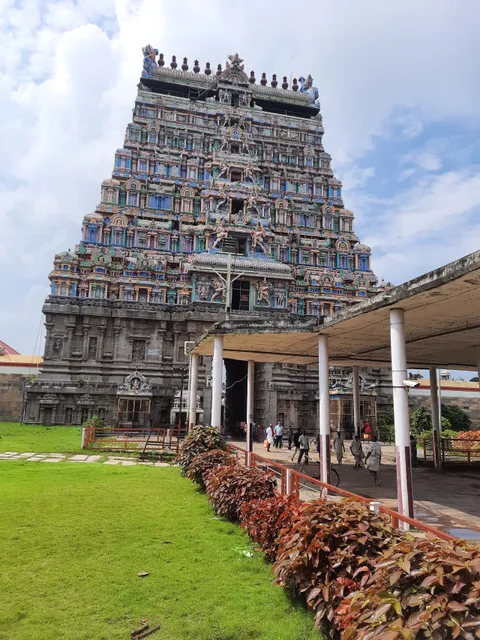
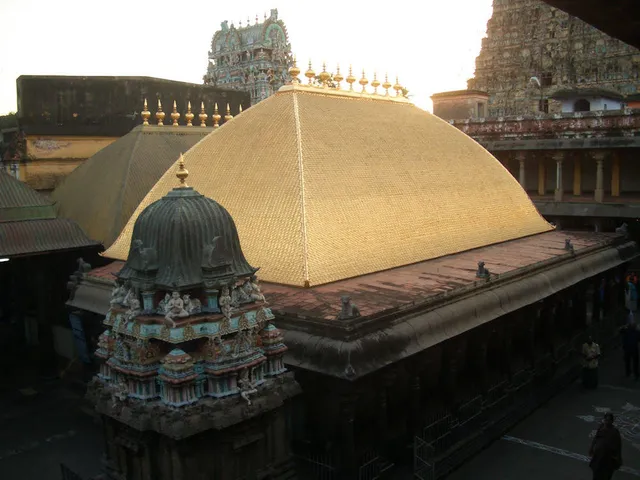
Architectural Marvel: The architecture of the Thillai Nataraja Temple is a true marvel, blending intricate details with spiritual symbolism. The temple follows the Dravidian architectural style, characterized by towering gopurams (gateways), ornate pillars, and elaborate sculptures. The principal sanctum enshrines the Nataraja deity within a sanctified dancing hall (Chit Sabha) which represents the cosmic dance of creation, preservation, and destruction. The Chit Sabha’s roof is adorned with intricate carvings depicting scenes from Hindu mythology. The temple’s distinct feature is its five sabhas or courts, each symbolizing different stages of human spiritual progress.

Cosmic Dance of Nataraja: At the heart of the Thillai Nataraja Temple lies the captivating depiction of Lord Shiva as Nataraja, the cosmic dancer. This iconic sculpture captures the essence of the universe’s eternal rhythm – creation, preservation, destruction, illusion, and liberation. The dance’s dynamic pose and symbolism encapsulate the fusion of art and spirituality, reflecting the Hindu belief in the cyclical nature of existence. Devotees from around the world flock to witness this remarkable embodiment of divinity in motion.

Cultural and Artistic Significance: The Thillai Nataraja Temple is more than a religious site; it is a cultural and artistic treasure trove. Bharatanatyam, a classical Indian dance form, finds its roots intertwined with the temple’s history. The temple served as a sanctuary where Bharatanatyam’s codification and teachings took place. The rhythmic footwork, graceful hand gestures, and emotive expressions of Bharatanatyam dancers mirror the cosmic dance of Nataraja himself. This connection between temple rituals and dance continues to be celebrated today.

Spiritual Pilgrimage: For devotees and spiritual seekers, the Thillai Nataraja Temple is a destination of pilgrimage. The temple’s atmosphere resonates with a palpable sense of divinity, inviting individuals to explore their spiritual depths. The rituals conducted within its sacred precincts, from the daily poojas to the grand festivals, offer a conduit for connecting with the divine. The annual Natyanjali Dance Festival, dedicated to Lord Nataraja, draws artists and spectators alike to celebrate the divine art of dance.

Conclusion: In the heart of Chidambaram, the Thillai Nataraja Temple stands not only as a place of worship but as a testament to the interplay of art, spirituality, and tradition. Its architectural grandeur and divine iconography are reminders of the timeless connection between the physical and the metaphysical, the human and the divine. As generations come and go, the temple remains a timeless sanctuary where the cosmic dance of Lord Nataraja continues to inspire, uplift,...

   Read more
avatar
5.0
28w

The Thillai Nataraja Temple in Chidambaram is not just one of India’s holiest Shaivite shrines, but a deeply symbolic confluence of spirituality, science, and art. At the heart of the temple lies the awe-inspiring idol of Lord Nataraja — Shiva as the cosmic dancer — a form that is both philosophically profound and scientifically significant. The Nataraja statue, cast in bronze, captures the moment of Ananda Tandava, the dance of bliss, symbolizing the eternal cycles of creation and destruction, the pulsation of the cosmos itself. This form has inspired not only spiritual seekers but also physicists, notably at CERN, where a statue of Nataraja stands as a metaphor for the cosmic energy underlying the universe.

The sanctum sanctorum housing this form is designed to represent Chidambara Rahasyam, or the "Secret of the Ether" — the belief that the divine exists in the unseen, the formless. This shrine is unique in the world, where the curtain occasionally drawn aside reveals not an idol, but an empty space adorned with golden vilva leaves, symbolizing Akasha (ether), the subtlest of the five elements. It is a meditative reminder of the divine presence in the unmanifest.

The architecture of the temple is mathematically and spiritually aligned. The temple is constructed based on ancient Agamic and Tantric principles, with precision reflecting the human anatomy — likened to the yogic concept of the body as a temple. The layout represents the human body with various parts corresponding to energy centers (chakras) and nadis (energy channels). The temple's structure is said to be aligned with the flow of prana (life force), and the main sanctum represents the Sahasrara, the crown chakra. The four massive Gopurams (towers) aligned in the cardinal directions not only serve as majestic gateways but are also symbolic of the four Vedas guarding the spiritual nucleus.

The temple is spread across a sprawling 50-acre complex and includes a sacred tank, the Shivaganga Pushkarini, believed to purify and energize those who take a dip. The thousand-pillared hall is a marvel of symmetry, echo, and acoustics — a testament to the deep integration of science and art in Dravidian architecture.

The temple isn't limited to Lord Shiva alone. It houses shrines for Goddess Shivakamasundari (Parvati), who represents the divine feminine energy and complements the cosmic dance. There are also beautifully carved sanctums for Lord Ganesha, the remover of obstacles; Lord Murugan (Kartikeya), the commander of celestial forces; Bhairava, the fierce form of Shiva; and other deities, making it a complete spiritual ecosystem.

Adjacent to the main complex is the temple of Lord Vishnu in his reclining form as Lord Govindaraja Perumal (similar to Lord Ranganatha), symbolizing the oneness of Shaiva and Vaishnava traditions. The presence of both Shiva and Vishnu in the same sacred space reinforces the underlying unity in diversity found throughout Hindu philosophy.

A visit to Chidambaram is not merely a pilgrimage—it’s an immersive journey into a sacred space where science, metaphysics, art, and devotion merge seamlessly. It leaves the devotee and the seeker alike with a deep sense of awe, not just for its religious significance, but for the layers of ancient wisdom encoded in its stones, spaces,...

   Read more
avatar
5.0
13w

This is the 55th Thevaram Paadal Petra Shiva Sthalam and the 1st Sthalam on the north side of river Kaveri in Chozha Nadu. This place Thillai was named after a flora called Thillai Tree that dominates in this area. Chitrambalam (Chit+Ambalam – small veli or sky), which turned into the present name of Chidambaram. Hence this is one of the Pancha Bhutha Kshethra/Sthalam. Chidambaram was also called different names line, Puliyur, PerumpaRRappuliyur during the 7th to 8th Century, and Pundarikapuram during the Purana period. This is the place where the devotees attain mukti, and worship Lord Shiva.

HISTORY AND ARCHITECTURE. The praharam wall bearing the Vikrama Chozha inscriptions was constructed during the 12th century with an entrance opposite to stucco Rishabam and balipeedam. The South entrance existed till the 19th century. It was told there was a Nandanar statue at the south side entrance. The entrance was closed during, the 20th century beginning and the fate of Nandanar’s statue is not known.

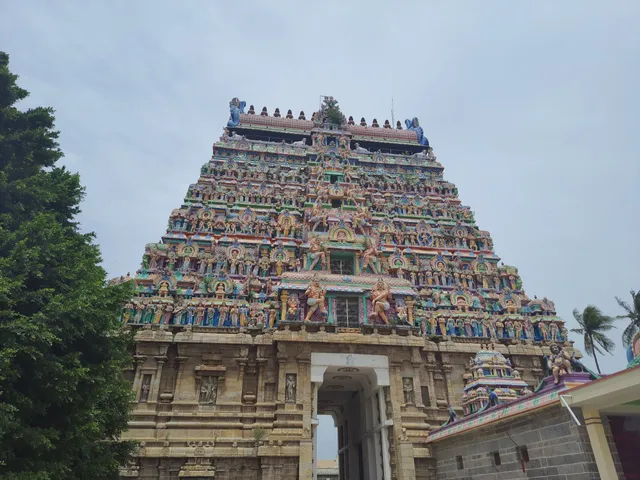
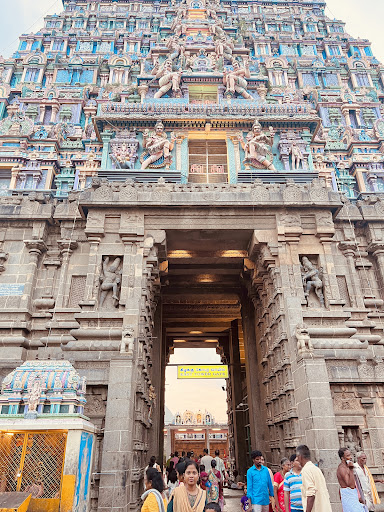
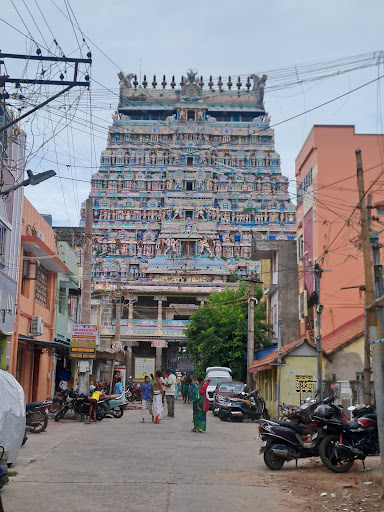
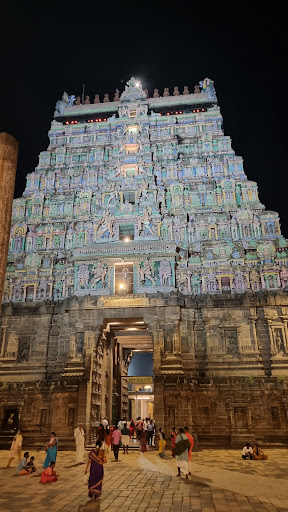
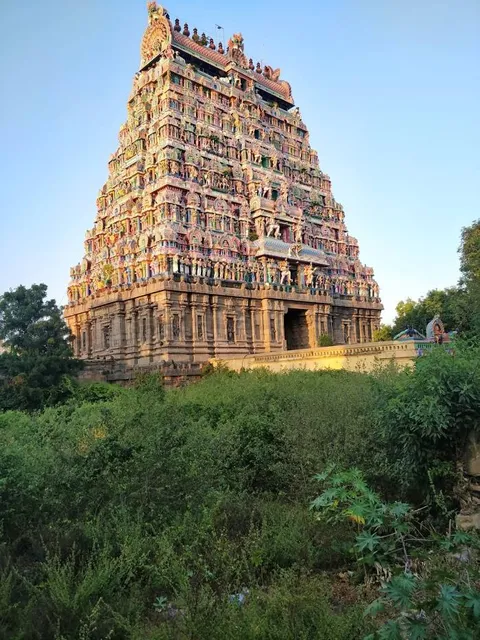
RAJAGOPURAMS. There are 4 Rajagopurams (all the Rajagopurams are built with the same height even though they were built during different periods and by different Dynasties) of 7 tiers, 135 feet tall. The entrance is 40 feet high and 16 feet wide with single stone lintels. The Rajagopuram is constructed with stone up to lintel and the superstructure is of stucco. The passage walls have the reliefs of 108 Bharatanatyam postures. Stucco images of deities are on the Gopuram. All 4 saints are believed to have entered through 4 Rajagopurams, though they may not have existed during their periods.

The east Rajagopuram was constructed by Vikrama Chozha through which Manickavasagar entered into the temple. The base has two tiers in which various sculptures and deities like Pichadanar, Gajasamhara murti, Gangadhara, Gangalar, and Mahishasuramardini are there. The Tricolor National flag will be hoisted on the top of the gopuram on August 15th of every year, by Deekshithars.

The south Rajagopuram facing Nataraja is called Chokka Seeya Gopuram, the title of Koperunchingen, who built it and Thirugnanasambandar entered through this Rajagopuram.

The west Rajagopuram was built by Jadavarman Sundara Pandyan and the entrance to the sanctum complex is opposite it and also called Akalangan Vayil. Appar entered through this Rajagopuram.

The 16th-century North Rajagopuram was built by Krishna Devaraya of the Vijayanagara Dynasty. Krishna Devaraya and his sthapathi’s images are on the North side of the Rajagopuram passage. Sundarar entered through the Rajagopuram ie from the back side of Natarajar.

Govindaraja Perumal temple also known as Thiruchitra Koodam. This Maha Vishnu was installed by the Pallava King Nandi Varman from 726 to 775 CE. Mangala sasanam was done by Thirumangai Alwar and Kulasekara Alwar. Perumal was removed during Kulothunga Chozha-II and thrown into the Bay of Bengal (Hence he was called Kirumi kanda Chozhan) and re-installed back during the Vijayanagara Period.

In Natarajar sanctum, Sivakama Sundari, Chandra Mouleeswarar, a spatika Lingam, Rathna Sabhapathy, Swarna Akasa Bhairava, Chandrasekarar. Natarajar belongs to...

   Read more
Page 1 of 7
Previous
Next

Posts

Alok SahooAlok Sahoo
The Thillai Nataraja Temple: Unveiling the Cosmic Dance of Divinity Nestled in the vibrant town of Chidambaram, Tamil Nadu, India, the Thillai Nataraja Temple stands as a testament to the rich cultural and spiritual heritage of the region. Dedicated to Lord Shiva in his celestial form as Nataraja, the cosmic dancer, this temple is not just a place of worship but a sanctuary of art, philosophy, and devotion. Spanning centuries of history, the temple’s architecture, rituals, and significance in Indian culture paint a vivid portrait of its profound impact on the spiritual landscape. Historical Origins: The origins of the Thillai Nataraja Temple trace back to antiquity, with its inception shrouded in myth and legend. According to one legend, a devotee of Lord Shiva named Govinda Muni prayed to the deity under a Thillai (mangrove) tree, eventually leading to the manifestation of Lord Shiva as Nataraja. This mystical event marked the sanctification of the area and the eventual construction of the temple. Historical records suggest that the Chola dynasty played a pivotal role in constructing and embellishing the temple complex, elevating it to its current grandeur. Architectural Marvel: The architecture of the Thillai Nataraja Temple is a true marvel, blending intricate details with spiritual symbolism. The temple follows the Dravidian architectural style, characterized by towering gopurams (gateways), ornate pillars, and elaborate sculptures. The principal sanctum enshrines the Nataraja deity within a sanctified dancing hall (Chit Sabha) which represents the cosmic dance of creation, preservation, and destruction. The Chit Sabha’s roof is adorned with intricate carvings depicting scenes from Hindu mythology. The temple’s distinct feature is its five sabhas or courts, each symbolizing different stages of human spiritual progress. Cosmic Dance of Nataraja: At the heart of the Thillai Nataraja Temple lies the captivating depiction of Lord Shiva as Nataraja, the cosmic dancer. This iconic sculpture captures the essence of the universe’s eternal rhythm – creation, preservation, destruction, illusion, and liberation. The dance’s dynamic pose and symbolism encapsulate the fusion of art and spirituality, reflecting the Hindu belief in the cyclical nature of existence. Devotees from around the world flock to witness this remarkable embodiment of divinity in motion. Cultural and Artistic Significance: The Thillai Nataraja Temple is more than a religious site; it is a cultural and artistic treasure trove. Bharatanatyam, a classical Indian dance form, finds its roots intertwined with the temple’s history. The temple served as a sanctuary where Bharatanatyam’s codification and teachings took place. The rhythmic footwork, graceful hand gestures, and emotive expressions of Bharatanatyam dancers mirror the cosmic dance of Nataraja himself. This connection between temple rituals and dance continues to be celebrated today. Spiritual Pilgrimage: For devotees and spiritual seekers, the Thillai Nataraja Temple is a destination of pilgrimage. The temple’s atmosphere resonates with a palpable sense of divinity, inviting individuals to explore their spiritual depths. The rituals conducted within its sacred precincts, from the daily poojas to the grand festivals, offer a conduit for connecting with the divine. The annual Natyanjali Dance Festival, dedicated to Lord Nataraja, draws artists and spectators alike to celebrate the divine art of dance. Conclusion: In the heart of Chidambaram, the Thillai Nataraja Temple stands not only as a place of worship but as a testament to the interplay of art, spirituality, and tradition. Its architectural grandeur and divine iconography are reminders of the timeless connection between the physical and the metaphysical, the human and the divine. As generations come and go, the temple remains a timeless sanctuary where the cosmic dance of Lord Nataraja continues to inspire, uplift, and evoke awe.
Sourabh MathurSourabh Mathur
The Thillai Nataraja Temple in Chidambaram is not just one of India’s holiest Shaivite shrines, but a deeply symbolic confluence of spirituality, science, and art. At the heart of the temple lies the awe-inspiring idol of Lord Nataraja — Shiva as the cosmic dancer — a form that is both philosophically profound and scientifically significant. The Nataraja statue, cast in bronze, captures the moment of Ananda Tandava, the dance of bliss, symbolizing the eternal cycles of creation and destruction, the pulsation of the cosmos itself. This form has inspired not only spiritual seekers but also physicists, notably at CERN, where a statue of Nataraja stands as a metaphor for the cosmic energy underlying the universe. The sanctum sanctorum housing this form is designed to represent Chidambara Rahasyam, or the "Secret of the Ether" — the belief that the divine exists in the unseen, the formless. This shrine is unique in the world, where the curtain occasionally drawn aside reveals not an idol, but an empty space adorned with golden vilva leaves, symbolizing Akasha (ether), the subtlest of the five elements. It is a meditative reminder of the divine presence in the unmanifest. The architecture of the temple is mathematically and spiritually aligned. The temple is constructed based on ancient Agamic and Tantric principles, with precision reflecting the human anatomy — likened to the yogic concept of the body as a temple. The layout represents the human body with various parts corresponding to energy centers (chakras) and nadis (energy channels). The temple's structure is said to be aligned with the flow of prana (life force), and the main sanctum represents the Sahasrara, the crown chakra. The four massive Gopurams (towers) aligned in the cardinal directions not only serve as majestic gateways but are also symbolic of the four Vedas guarding the spiritual nucleus. The temple is spread across a sprawling 50-acre complex and includes a sacred tank, the Shivaganga Pushkarini, believed to purify and energize those who take a dip. The thousand-pillared hall is a marvel of symmetry, echo, and acoustics — a testament to the deep integration of science and art in Dravidian architecture. The temple isn't limited to Lord Shiva alone. It houses shrines for Goddess Shivakamasundari (Parvati), who represents the divine feminine energy and complements the cosmic dance. There are also beautifully carved sanctums for Lord Ganesha, the remover of obstacles; Lord Murugan (Kartikeya), the commander of celestial forces; Bhairava, the fierce form of Shiva; and other deities, making it a complete spiritual ecosystem. Adjacent to the main complex is the temple of Lord Vishnu in his reclining form as Lord Govindaraja Perumal (similar to Lord Ranganatha), symbolizing the oneness of Shaiva and Vaishnava traditions. The presence of both Shiva and Vishnu in the same sacred space reinforces the underlying unity in diversity found throughout Hindu philosophy. A visit to Chidambaram is not merely a pilgrimage—it’s an immersive journey into a sacred space where science, metaphysics, art, and devotion merge seamlessly. It leaves the devotee and the seeker alike with a deep sense of awe, not just for its religious significance, but for the layers of ancient wisdom encoded in its stones, spaces, and silence.
DatthathreyaDatthathreya
The **Thillai Nataraja Temple** in **Chidambaram**, Tamil Nadu, is one of the most significant and ancient temples dedicated to Lord Shiva, specifically his form as **Nataraja** (the Lord of Dance). This temple is located in the heart of Chidambaram town and is an important pilgrimage destination for Hindus, especially followers of the Shaiva tradition. ### Key Features of the Temple: 1. **Historical Significance**: The Thillai Nataraja Temple is one of the oldest temples in India, believed to have been originally constructed in the 2nd century BCE, though much of the current structure dates back to the Chola dynasty period (9th to 12th century CE). The temple has played a significant role in the religious, cultural, and spiritual life of Tamil Nadu for over two millennia. 2. **Architecture**: The temple is renowned for its distinctive architectural style, with numerous towering **gopurams** (gateway towers), intricate carvings, and spacious halls. The main sanctum houses the **Nataraja** statue, depicting Shiva in the cosmic dance (Ananda Tandava), symbolizing the creation, preservation, and dissolution of the universe. 3. **The Golden Roof**: One of the most remarkable features of the temple is its **golden roof**, which is a symbol of the celestial presence of Lord Shiva. The roof of the sanctum sanctorum (the innermost chamber of the temple) is made of gold, symbolizing the divine presence and purity. 4. **The Chidambara Rahasya (Secret of Chidambaram)**: The temple is famous for its unique representation of Lord Shiva. Unlike most temples where Shiva is worshipped as a lingam (a symbolic representation), here, he is worshipped in the form of a **formless light** (Chidambara Rahasya). This formless light is housed in a **curtain** (known as the **Chidambara Rahasya Curtain**) in the inner sanctum, representing the concept of the formless, abstract aspect of God. 5. **Dancing Shiva (Nataraja)**: The deity of **Nataraja** in this temple is one of the most iconic images of Lord Shiva. The form of Nataraja dancing in the cosmic rhythm represents the cycle of creation, preservation, and dissolution. It is a powerful symbol in both Hindu philosophy and art. 6. **Religious Importance**: The Thillai Nataraja Temple is considered one of the **Pancha Sabhai** temples of Shiva, representing five cosmic dance forms of Shiva. This temple symbolizes the **"Aksara Sabhai"**, the dance of the eternal, beyond all words and scriptures. 7. **Festivals and Rituals**: The temple hosts several grand festivals throughout the year, the most famous being the **Arudra Darshanam** festival, which occurs in the Tamil month of **Margazhi** (December-January). During this festival, devotees gather in large numbers to witness the dance of Lord Nataraja and participate in various rituals and celebrations. ### Conclusion: The Thillai Nataraja Temple is not just an architectural wonder but a living cultural and spiritual heritage of Tamil Nadu. It is revered as a place where the divine presence of Lord Shiva in his dance form symbolizes the rhythm of the universe, and it remains a key spiritual and cultural landmark for Hindus worldwide.
See more posts
See more posts
hotel
Find your stay

Pet-friendly Hotels in Tamil Nadu

Find a cozy hotel nearby and make it a full experience.

The Thillai Nataraja Temple: Unveiling the Cosmic Dance of Divinity Nestled in the vibrant town of Chidambaram, Tamil Nadu, India, the Thillai Nataraja Temple stands as a testament to the rich cultural and spiritual heritage of the region. Dedicated to Lord Shiva in his celestial form as Nataraja, the cosmic dancer, this temple is not just a place of worship but a sanctuary of art, philosophy, and devotion. Spanning centuries of history, the temple’s architecture, rituals, and significance in Indian culture paint a vivid portrait of its profound impact on the spiritual landscape. Historical Origins: The origins of the Thillai Nataraja Temple trace back to antiquity, with its inception shrouded in myth and legend. According to one legend, a devotee of Lord Shiva named Govinda Muni prayed to the deity under a Thillai (mangrove) tree, eventually leading to the manifestation of Lord Shiva as Nataraja. This mystical event marked the sanctification of the area and the eventual construction of the temple. Historical records suggest that the Chola dynasty played a pivotal role in constructing and embellishing the temple complex, elevating it to its current grandeur. Architectural Marvel: The architecture of the Thillai Nataraja Temple is a true marvel, blending intricate details with spiritual symbolism. The temple follows the Dravidian architectural style, characterized by towering gopurams (gateways), ornate pillars, and elaborate sculptures. The principal sanctum enshrines the Nataraja deity within a sanctified dancing hall (Chit Sabha) which represents the cosmic dance of creation, preservation, and destruction. The Chit Sabha’s roof is adorned with intricate carvings depicting scenes from Hindu mythology. The temple’s distinct feature is its five sabhas or courts, each symbolizing different stages of human spiritual progress. Cosmic Dance of Nataraja: At the heart of the Thillai Nataraja Temple lies the captivating depiction of Lord Shiva as Nataraja, the cosmic dancer. This iconic sculpture captures the essence of the universe’s eternal rhythm – creation, preservation, destruction, illusion, and liberation. The dance’s dynamic pose and symbolism encapsulate the fusion of art and spirituality, reflecting the Hindu belief in the cyclical nature of existence. Devotees from around the world flock to witness this remarkable embodiment of divinity in motion. Cultural and Artistic Significance: The Thillai Nataraja Temple is more than a religious site; it is a cultural and artistic treasure trove. Bharatanatyam, a classical Indian dance form, finds its roots intertwined with the temple’s history. The temple served as a sanctuary where Bharatanatyam’s codification and teachings took place. The rhythmic footwork, graceful hand gestures, and emotive expressions of Bharatanatyam dancers mirror the cosmic dance of Nataraja himself. This connection between temple rituals and dance continues to be celebrated today. Spiritual Pilgrimage: For devotees and spiritual seekers, the Thillai Nataraja Temple is a destination of pilgrimage. The temple’s atmosphere resonates with a palpable sense of divinity, inviting individuals to explore their spiritual depths. The rituals conducted within its sacred precincts, from the daily poojas to the grand festivals, offer a conduit for connecting with the divine. The annual Natyanjali Dance Festival, dedicated to Lord Nataraja, draws artists and spectators alike to celebrate the divine art of dance. Conclusion: In the heart of Chidambaram, the Thillai Nataraja Temple stands not only as a place of worship but as a testament to the interplay of art, spirituality, and tradition. Its architectural grandeur and divine iconography are reminders of the timeless connection between the physical and the metaphysical, the human and the divine. As generations come and go, the temple remains a timeless sanctuary where the cosmic dance of Lord Nataraja continues to inspire, uplift, and evoke awe.
Alok Sahoo

Alok Sahoo

hotel
Find your stay

Affordable Hotels in Tamil Nadu

Find a cozy hotel nearby and make it a full experience.

Get the Appoverlay
Get the AppOne tap to find yournext favorite spots!
The Thillai Nataraja Temple in Chidambaram is not just one of India’s holiest Shaivite shrines, but a deeply symbolic confluence of spirituality, science, and art. At the heart of the temple lies the awe-inspiring idol of Lord Nataraja — Shiva as the cosmic dancer — a form that is both philosophically profound and scientifically significant. The Nataraja statue, cast in bronze, captures the moment of Ananda Tandava, the dance of bliss, symbolizing the eternal cycles of creation and destruction, the pulsation of the cosmos itself. This form has inspired not only spiritual seekers but also physicists, notably at CERN, where a statue of Nataraja stands as a metaphor for the cosmic energy underlying the universe. The sanctum sanctorum housing this form is designed to represent Chidambara Rahasyam, or the "Secret of the Ether" — the belief that the divine exists in the unseen, the formless. This shrine is unique in the world, where the curtain occasionally drawn aside reveals not an idol, but an empty space adorned with golden vilva leaves, symbolizing Akasha (ether), the subtlest of the five elements. It is a meditative reminder of the divine presence in the unmanifest. The architecture of the temple is mathematically and spiritually aligned. The temple is constructed based on ancient Agamic and Tantric principles, with precision reflecting the human anatomy — likened to the yogic concept of the body as a temple. The layout represents the human body with various parts corresponding to energy centers (chakras) and nadis (energy channels). The temple's structure is said to be aligned with the flow of prana (life force), and the main sanctum represents the Sahasrara, the crown chakra. The four massive Gopurams (towers) aligned in the cardinal directions not only serve as majestic gateways but are also symbolic of the four Vedas guarding the spiritual nucleus. The temple is spread across a sprawling 50-acre complex and includes a sacred tank, the Shivaganga Pushkarini, believed to purify and energize those who take a dip. The thousand-pillared hall is a marvel of symmetry, echo, and acoustics — a testament to the deep integration of science and art in Dravidian architecture. The temple isn't limited to Lord Shiva alone. It houses shrines for Goddess Shivakamasundari (Parvati), who represents the divine feminine energy and complements the cosmic dance. There are also beautifully carved sanctums for Lord Ganesha, the remover of obstacles; Lord Murugan (Kartikeya), the commander of celestial forces; Bhairava, the fierce form of Shiva; and other deities, making it a complete spiritual ecosystem. Adjacent to the main complex is the temple of Lord Vishnu in his reclining form as Lord Govindaraja Perumal (similar to Lord Ranganatha), symbolizing the oneness of Shaiva and Vaishnava traditions. The presence of both Shiva and Vishnu in the same sacred space reinforces the underlying unity in diversity found throughout Hindu philosophy. A visit to Chidambaram is not merely a pilgrimage—it’s an immersive journey into a sacred space where science, metaphysics, art, and devotion merge seamlessly. It leaves the devotee and the seeker alike with a deep sense of awe, not just for its religious significance, but for the layers of ancient wisdom encoded in its stones, spaces, and silence.
Sourabh Mathur

Sourabh Mathur

hotel
Find your stay

The Coolest Hotels You Haven't Heard Of (Yet)

Find a cozy hotel nearby and make it a full experience.

hotel
Find your stay

Trending Stays Worth the Hype in Tamil Nadu

Find a cozy hotel nearby and make it a full experience.

The **Thillai Nataraja Temple** in **Chidambaram**, Tamil Nadu, is one of the most significant and ancient temples dedicated to Lord Shiva, specifically his form as **Nataraja** (the Lord of Dance). This temple is located in the heart of Chidambaram town and is an important pilgrimage destination for Hindus, especially followers of the Shaiva tradition. ### Key Features of the Temple: 1. **Historical Significance**: The Thillai Nataraja Temple is one of the oldest temples in India, believed to have been originally constructed in the 2nd century BCE, though much of the current structure dates back to the Chola dynasty period (9th to 12th century CE). The temple has played a significant role in the religious, cultural, and spiritual life of Tamil Nadu for over two millennia. 2. **Architecture**: The temple is renowned for its distinctive architectural style, with numerous towering **gopurams** (gateway towers), intricate carvings, and spacious halls. The main sanctum houses the **Nataraja** statue, depicting Shiva in the cosmic dance (Ananda Tandava), symbolizing the creation, preservation, and dissolution of the universe. 3. **The Golden Roof**: One of the most remarkable features of the temple is its **golden roof**, which is a symbol of the celestial presence of Lord Shiva. The roof of the sanctum sanctorum (the innermost chamber of the temple) is made of gold, symbolizing the divine presence and purity. 4. **The Chidambara Rahasya (Secret of Chidambaram)**: The temple is famous for its unique representation of Lord Shiva. Unlike most temples where Shiva is worshipped as a lingam (a symbolic representation), here, he is worshipped in the form of a **formless light** (Chidambara Rahasya). This formless light is housed in a **curtain** (known as the **Chidambara Rahasya Curtain**) in the inner sanctum, representing the concept of the formless, abstract aspect of God. 5. **Dancing Shiva (Nataraja)**: The deity of **Nataraja** in this temple is one of the most iconic images of Lord Shiva. The form of Nataraja dancing in the cosmic rhythm represents the cycle of creation, preservation, and dissolution. It is a powerful symbol in both Hindu philosophy and art. 6. **Religious Importance**: The Thillai Nataraja Temple is considered one of the **Pancha Sabhai** temples of Shiva, representing five cosmic dance forms of Shiva. This temple symbolizes the **"Aksara Sabhai"**, the dance of the eternal, beyond all words and scriptures. 7. **Festivals and Rituals**: The temple hosts several grand festivals throughout the year, the most famous being the **Arudra Darshanam** festival, which occurs in the Tamil month of **Margazhi** (December-January). During this festival, devotees gather in large numbers to witness the dance of Lord Nataraja and participate in various rituals and celebrations. ### Conclusion: The Thillai Nataraja Temple is not just an architectural wonder but a living cultural and spiritual heritage of Tamil Nadu. It is revered as a place where the divine presence of Lord Shiva in his dance form symbolizes the rhythm of the universe, and it remains a key spiritual and cultural landmark for Hindus worldwide.
Datthathreya

Datthathreya

See more posts
See more posts