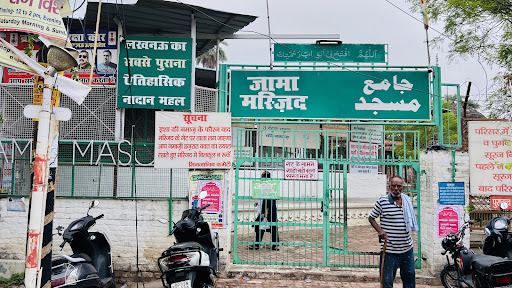
Located in the Yahiyaganj locality of Lucknow, the Nadan Mahal Maqbara is the oldest monument of Lucknow, dating back to the Mughal era. But finding it can be a bit of a challenge. When we told our auto-driver we wanted to go to there, he took us to a private house on the Nadan Mahal Road which had a cement airplane on top! If you don’t have Google maps when on tour (I didn’t), what you need to do is to get to Nadan Mahal Road, find an octogenarian Muslim (easy to tell them apart from the attire, fine flowing beards, and exquisite skull caps), and ask for the “Chishti sahib ka dargah”.
Mausoleum of Sheikh Ibrahim Chishti Currently located within a well maintained park, there are four structures inside the Nadan Mahal complex. The one immediately to left of the gate, to the East of the complex, is the tomb of Sheikh Ibrahim Chishti, a Sufi saint of the Chishti order. It is a domed structure, raised on a low plinth. The outer walls are constructed of stone “kankar” blocks, which were originally covered with lime plaster, which is now mostly gone. The arched entrances however, are built of brick and lime plaster. Over the southern entrance is a green coloured tablet, with a few couplets written in the Nastaʿlīq script. Roughly translated, the tablet says the following – “Sheikh Ibrahim Chishti who was special and just one of many in history. He went from this mortal world to the immortal world. If someone asks about his death, tell him that he was the centre of his era”. The tablet puts down the date of death as 961 Hijri which corresponds to 1553-54 in the Gregorian calendar. The interior of the chamber is octagonal, with the tomb of Sheikh Ibrahim Chishti in the centre. There are arched openings on all four sides for purposes of ventilation, 3 of which are now closed. The exterior of the dome has recently been repaired and whitewashed, although no attempt has been made to re-plaster the walls. The original name of Nadan Mahal may have been Nidan Mahal, since Sheikh Ibrahim Chishti’s followers prayed for “nidan” or deliverance at his tomb. Sheikh Ibrahim Chishti’s tomb is still used for worship, and shoes must be removed before approaching it.
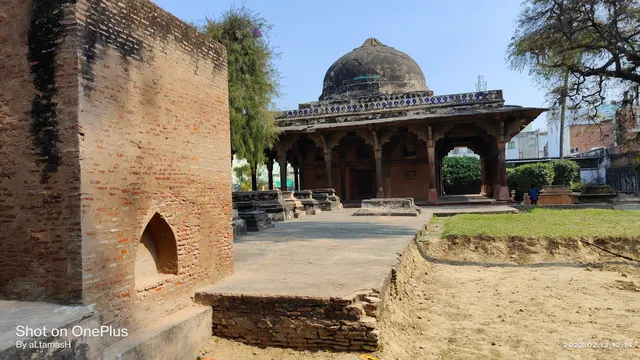
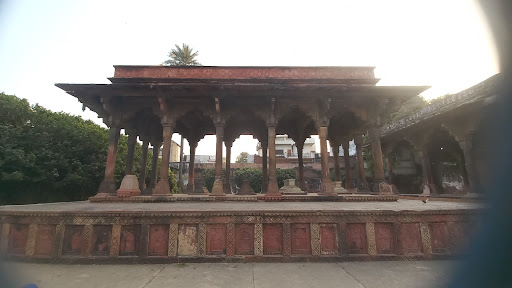
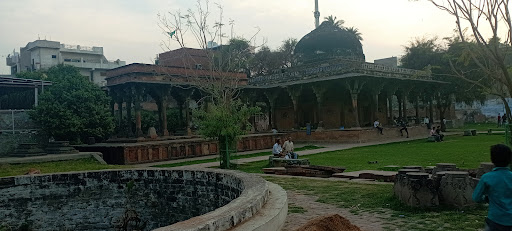
The "Solah Khamba" There are two other structures in the Nadan Mahal complex, which are located to the South, and the one you approach first is called a “Solah Khamba”. The open pavilion derives its name from the sixteen (solah) fluted pillars (khamba) which hold up the roof. Brick and stone are used for construction, and the pillars have exquisitely ornamented bases and brackets. Among the brackets, there may be seen the form of an elephant’s head, or “gaja mukha”. While this is not strictly in keeping with Islamic tradition of not depicting anything living, this structure was probably built in the Mughal style which fused Hindu and Islamic elements. On the raised platform of the “Solah Khamba” are five graves, which are said to be of the descendants of Sheikh Abdur Rahim, the first Governor of Lucknow during the reign of Mughal Emperor Akbar.
Nadan Mahal with the Solah Khamba in the foreground Immediately West of the “Solah Khamba” is the Nadan Mahal tomb, from which the complex gets its name. This is the tomb of Sheikh Abdur Rahim. According to Sheikh Mohammed Azmat Ali Naami Kakorvi’s historical account in Muraqqa-e-Khusravi written in 1282 Hijri (1866), Akbar had been warned by his astrologers that two particular days were inauspicious for him as emperor. To tide over the period of the curse, Akbar nominated Sheikh Abdur Rahim to be emperor for two days. As the period was about to end, the eunuch carrying the emperor’s clothes suddenly dropped dead! There was a cobra inside the emperor’s clothes! The relieved Akbar gave Sheikh Abdur Rahim the Lucknow “pargana” and some parts of Behraich (North-East of Lucknow in the modern day state of Uttar Pradesh). It seems the Sheikh had begun construction of the...
Read moreNadan Mahal Lucknow
Adding a charm in the rich history of Lucknow is another mausoleum - Nadan Mahal - that dates back to the time of Mughal era. Dedicated to Shaikh Ibrahim Chishti, Nadan Mahal is one of the oldest surviving historical monuments in Lucknow. During the reign of the great Mughal emperor, Akbar, Sheikh Ibrahim Chishti was the first governor of Lucknow. Though the mausoleum is less-known amongst tourists, yet, it is one of the most tranquil tourist sites to visit in Lucknow. It is located in a park complex in the old city of Lucknow. There are three structures in the park; two of them are enclosed tombs. One of the tombs contains the remains of Ibrahim Chishti. Once it was a prominent place for Sheikh’s followers used to pray for Nadan (deliverance), and hence, the name of the mausoleum came.
Architecture
The tomb is built in the usual Mughal architectural design. The monument includes enclosed bays that are recessed and panelled. Besides, the architecture of this historical site in Lucknow also includes lattice screens that cover the openings on the north, west and east sides. On the south side is the main entrance to the chamber which is adorned with a large stone tablet. The tablet includes three Persian couplets in Nastaliq style. The dome of the mausoleum is adorned by a lotus leaf finial. Whereas, the octagonal drum of the dome boasts blue and green tiles.
Location Address
257/94, Shankar Dayal Rd, Khajuha, Kundari Rakabganj, Lucknow, Uttar Pradesh 226004, India.
Opening & Closing Timings
Being located in a public park, Nadan Mahal stays open all days a week, i.e., from Sunday to Saturday. Tourists can visit the monument on any day from 6 in the morning to 10 in the evening.
Entry...
Read moreBuilt in the 16th century during the reign of Mughal Emperor Akbar, this mausoleum (meaning "Tomb of Deliverance" or "Tomb of the Innocent" in Persian, symbolizing piety and simplicity) honors Shaikh Ibrahim Chishti, the first governor of Lucknow under Mughal rule (died around 1543 AD). Chishti's followers gathered here to pray for his soul's deliverance, giving the site its name. It's one of Lucknow's oldest surviving monuments, showcasing pre-Mughal Afghan-style stone architecture with a canopied pavilion (Solah Khamba, or "Sixteen Pillars") housing unmarked graves. The complex also ties into the legacy of Mughal poet and courtier Abdul Rahim Khan-i-Khanan (one of Akbar's "nine gems"), who commissioned his own cenotaph here, linking spiritual devotion with imperial power. This site played a key role in establishing early Islamic authority in Lucknow and influenced later institutions like the Firangi Mahal seminary.
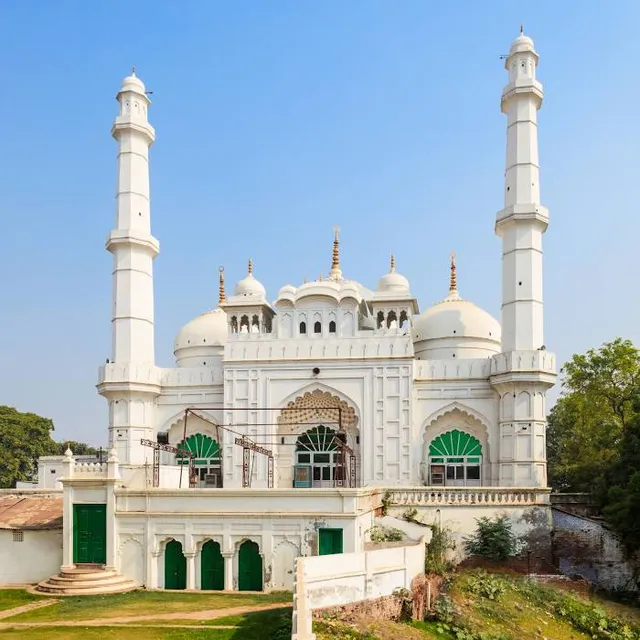
Jama Masjid (in Yahiyaganj, near Nadan Mahal): This is the older mosque adjacent to Nadan Mahal, dating back to the Mughal period and serving as a prayer hub for Chishti's followers. It's distinct from the more famous 19th-century Jama Masjid in Hussainabad (built by Nawab Muhammad Ali Shah in 1839–1845 to rival Delhi's Jama Masjid, using lakhori bricks and lime plaster). The Yahiyaganj Jama Masjid is simpler but integral to the site's spiritual fabric, with Nadan Mahal often described as being "inside" or part of...
Read more