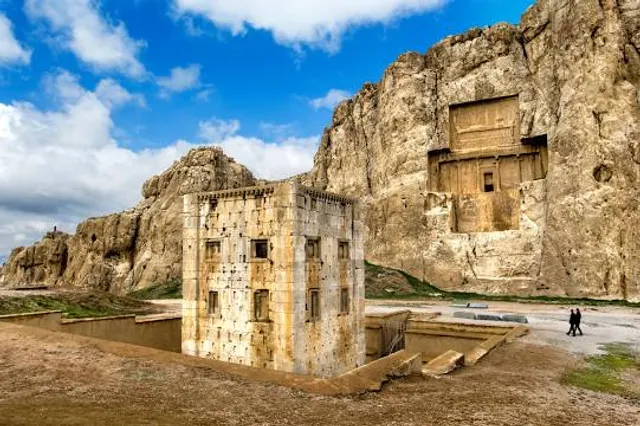
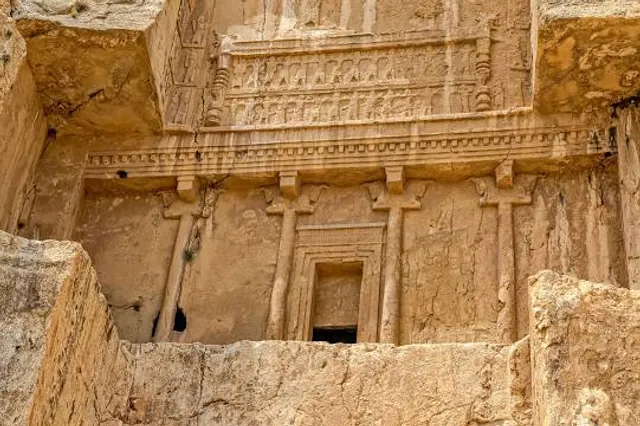
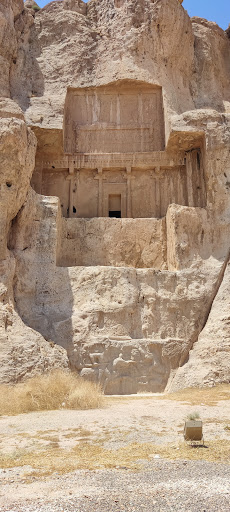
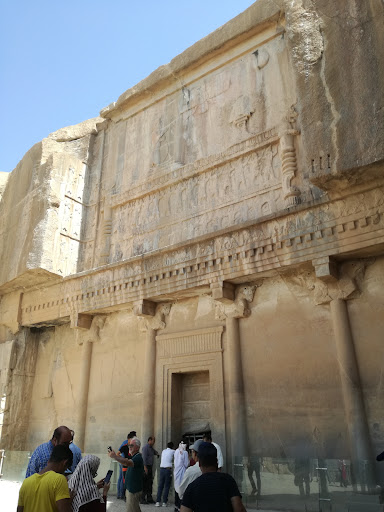
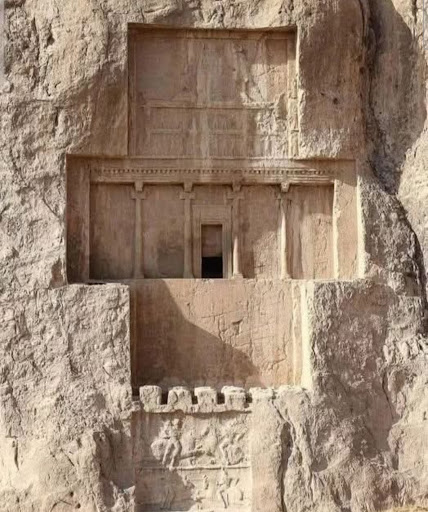
Naqsh-e Rustam is one of the most spectacular and awe-inspiring ancient sites of the Achaemenid Empire, consisting of the colossal tombs of Persian kings dating back to the first millennium BC. It stands as a lasting memory of a once powerful empire that ruled over a significant portion of the ancient world. Naqsh-e Rustam (meaning Throne of Rustam ) is located approximately 5 km (3 miles) to the northwest of Persepolis, the capital of the former Achaemenid (Persian) Empire. Engraved on the façade of a mountain range considered sacred in the Elamite periods are the rock-cut tombs of Achaemenid rulers and their families dating to the 4 th and 5 th centuries BC, as well as richly decorated reliefs carved by the Sasanians in the 3 rd century AD. In addition to being a royal necropolis, Naqsh-e Rustam became a major ceremonial center for the Sasanians until the 7 th century AD. The Naqsh-e Rustam site was already in use prior to the arrival of the Achaemenids, as evidenced in one pre-Achaemenid (possibly Elamite) relief and a number of old graves. Although this relief has been carved over by a Sasanian relief, a portrait of a man with a forward pointing hat and a long dress-like garment (clothing not typical of the Achaemenids and Sasanians) can still be discerned on the extreme right of the later relief. According to some sources, it was this figure that locals associated with the mythical hero of the Shahnameh writings in the “book of the kings”, named Rustam, hence the name of the site. Although there are four tombs, only one of them can be identified with certainty, as it is accompanied by a trilingual inscription. This is the tomb of Darius I, the third ruler of the Achaemenid Empire. Above the cross façade of Darius’ tomb is a panel with a relief. The relief depicts Darius, whose hands are raised in a gesture of worship, standing on a three-stepped pedestal in front of an altar. The king’s piety accords him divine protection, as the winged disc of Ahuramazda (the god of the Zoroastrian faith), is shown floating above his head. The relief also proclaims the might of the Achaemenid Empire, as the entire scene is supported by throne bearers representing the 28 nations under the empire. The other three tombs at Naqsh-e Rustam are thought to belong to Darius’ successors, Xerxes I, Artaxerxes I and Darius II. This is based on the fact that the layout of these tombs is copied from the tomb of Darius. Without any inscriptions or additional evidence, the identities of the tomb owners may remain merely as speculation. Other royal tombs of a similar form can be found in Persepolis. These tombs, cut into the rock face at Kuh-i Rahmat, are thought to belong to the later Achaemenid rulers, and demonstrate of the influence exerted by the tombs at...
Read moreNaqsh-e Rustam (Persian: نقش رستم [ˌnæɣʃeɾosˈtʰæm]) is an ancient necropolis located about 12 km northwest of Persepolis, in Fars Province, Iran. In Naghsh-e Rostam we can see four tombs and one building from Achaemenid dynasty with a group of ancient Iranian rock reliefs cut into the cliff, from Sassanid dynasty; the last important relief is from Elam dynasty and it dates back to 1000 BC.
Naqsh-e Rustam is the necropolis of the Achaemenid dynasty (500–330 BC), with four large tombs cut high into the cliff face. These have mainly architectural decoration, but the facades include large panels over the doorways, each very similar in content, with figures of the king being invested by a god, above a zone with rows of smaller figures bearing tribute, with soldiers and officials. The three classes of figures are sharply differentiated in size. The entrance to each tomb is at the center of each cross, which opens onto a small chamber, where the king lay in a sarcophagus.[1]
Well below the Achaemenid tombs, near ground level, are rock reliefs with large figures of Sassanian kings, some meeting gods, others in combat. The most famous shows the Sassanian king Shapur I on horseback, with the Roman Emperor Valerian bowing to him in submission, and Philip the Arab (an earlier emperor who paid Shapur tribute) holding Shapur's horse, while the dead Emperor Gordian III, killed in battle, lies beneath it (other identifications have been suggested). This commemorates the Battle of Edessa in 260 AD, when Valerian became the only Roman Emperor who was captured as a prisoner of war, a lasting humiliation for the Romans. The placing of these reliefs clearly suggests the Sassanid intention to link themselves with the glories of the earlier...
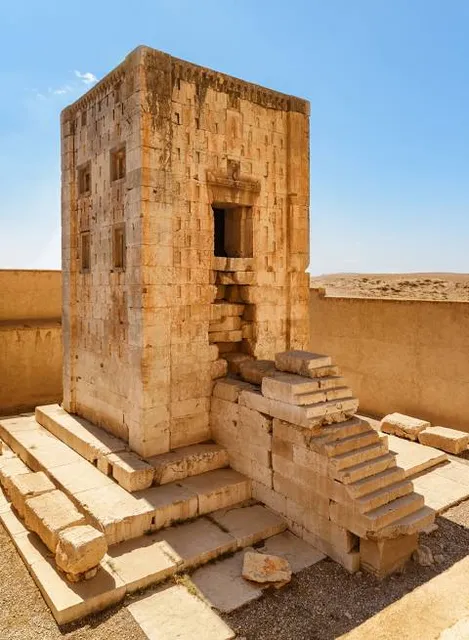
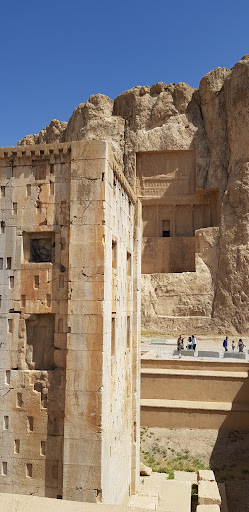
Read moreNaqsh-e Rostam, located near Persepolis in southern Iran, is an ancient necropolis renowned for its rock-cut tombs and monumental reliefs dating from the Achaemenid (550–330 BCE) and Sasanian (224–651 CE) periods. The site features four large cross-shaped tombs carved into a sheer cliff face, traditionally attributed to Achaemenid kings Darius I, Xerxes I, Artaxerxes I, and Darius II. These tombs exhibit similar architectural designs, with façades resembling Achaemenid palaces and inscriptions highlighting royal ideology. Below the tombs, Sasanian reliefs depict triumphant scenes of kings such as Shapur I and Ardashir I, emphasizing their divine legitimacy and military victories over Roman emperors. A notable structure at the site is the Ka'ba-ye Zartosht, a square Achaemenid-era tower whose function remains debated—possibly a fire temple, treasury, or astrological monument. Naqsh-e Rostam served as a dynastic memorial, reinforcing the continuity of Persian kingship from the Achaemenids to the Sasanians. Its strategic placement near Persepolis enhanced its symbolic importance as a sacred and political landscape. Today, the site is a key archaeological and epigraphic resource, offering insights into ancient Persian art, religion, and royal propaganda. Recognized as part of the "Persepolis and Related Sites" UNESCO tentative list, Naqsh-e Rostam remains a testament to Iran’s...
Read more