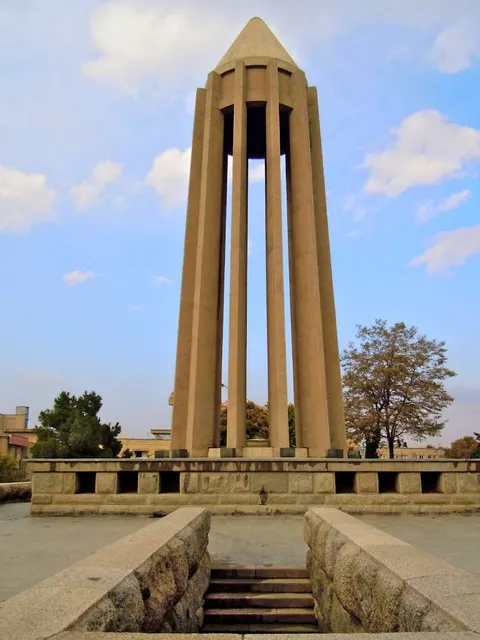
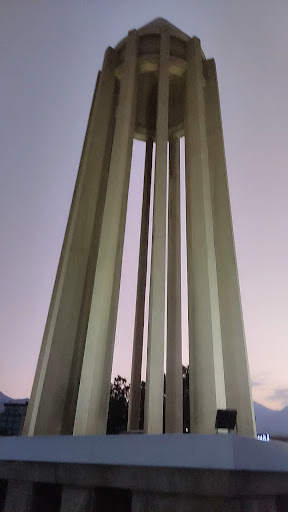
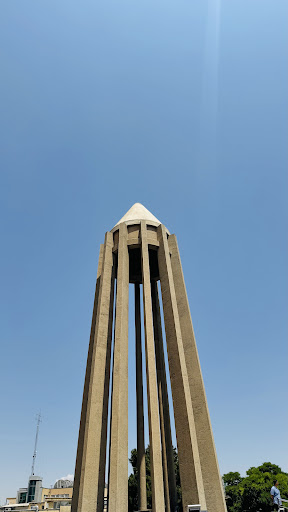
The Mausoleum of Avicenna (Abu Ali Sina) is a complex located at Avicenna Square, Hamadan, Iran. Dedicated to the Iranian polymath Avicenna, the complex includes a library, a small museum, and a spindle-shaped tower inspired by the Ziyarid-era Kavus Tower.
Avicenna (Hojjat-ol-Haq Sheikh-ol-Rais Sharaf-ol-Molk Abu Ali Hossein Ebne Abdollah Ebne Sina) was the great philosopher, scholar, physician of Iran (370-428 AH). His tomb is located in Bu Ali Sq. Hamadan. The present structure was constructed in the years 1946-1951 and since then has been repaired and renovated thrice.
The facade of the tomb is of hard stone. Three wide steps lead to the porch where there are ten stone columns. Each of these columns depict a century from the time of the birth of this great man upto date. The wide wooden doors of the porch, open to reveal the interior with its stone walls and flooring.
The main area is square in shape and the twelve base pillars supporting the tower of the tomb are situated here. The tomb of Avicenna is between the tower and the tomb of his bosom friend 'Abu Saied'. On both these graves are marble tablets and inscriptions with nine lines in the 'Sols' script. On two sides of this vicinity, are two halls, one a conference hall and the other a library.
The tower of the tomb has been constructed with cement and pieces of hard stone. In the midst of the twelve panels of the tower, is a cubical bronze or 'gun metal' chest conical at the top. On the four sides of which are engravings in the 'Sols' script. In the year 1949, a portrait of Bu Ali was drawn by Master Abol Hassan Sadiqi, based on particulars obtained from records. In accordance with this portrait, the statue of Bu Ali Sina was sculptured in white marble and affixed in Bu Ali square of Hamadan.
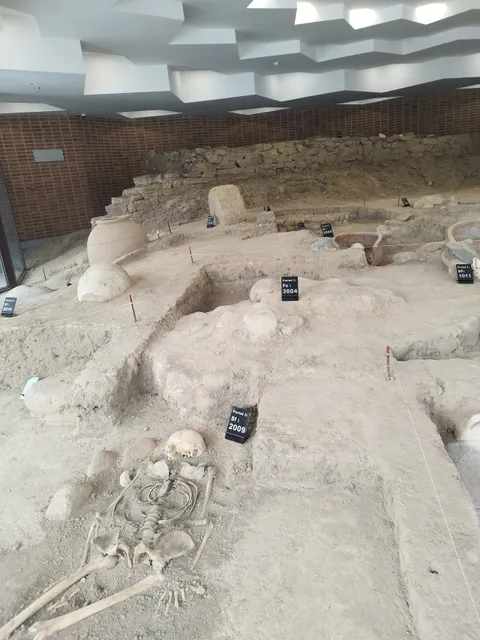
The new memorial structure of the tomb of Avicenna (Bu Ali Sina), was constructed in the year 1941 right in its former location. From the architectural aspect the dome of the said structure is an inspiration from 'The Gonbad-e-Qaboos' in the plains of Gorgan, and 'Persepolis' or Takht-e-Jamshid. In the museum here, ancient relics, an anthropology section and books of Avicenna are on display.
Besides which exhibits such as bronze statues related to the 1st millennium BC., gourd bottles (or canteens), coins, beads and articles of silver related to the Sassanide period. The tomb of the great Gnostic 'Qazvini' is also located in...
Read moreAvicenna (Hojjat-ol-Haq Sheikh-ol-Rais Sharaf-ol-Molk Abu Ali Hossein Ebne Abdollah Ebne Sina) was the great philosopher, scholar, physician of Iran (370-428 AH). itto.org His tomb is located in Bu Ali Sq. Hamadan. The present structure was constructed in the years 1946-1951 and since then has been repaired and renovated thrice. undefined Located in an area of 3,090 sq. undefined m. copyright itto.org the area under foundation is 1,792 sq. m. undefined The facade of the tomb is of hard stone. Three wide steps lead to the porch where there are ten stone columns. Each of these columns depict a century from the time of the birth of this great man upto date. The wide wooden doors of the porch, open to reveal the interior with its stone walls and flooring. The main area is square in shape and the twelve base pillars supporting the tower of the tomb are situated here. read more on itto.org The tomb of Avicenna is between the tower and the tomb of his bosom friend 'Abu Saied'. copyright itto.org On both these graves are marble tablets and inscriptions with nine lines in the 'Sols' script. read more on itto.org On two sides of this vicinity, are two halls, one a conference hall and the other a library. The tower of the tomb has been constructed with cement and pieces of hard stone. In the midst of the twelve panels of the tower, is a cubical bronze or 'gun metal' chest conical at the top. On the four sides of which are engravings in the 'Sols' script. In the year 1949, a portrait of Bu Ali was drawn by Master Abol Hassan Sadiqi, based on particulars obtained from records. read more on itto.org In accordance with this portrait, the statue of Bu Ali Sina was sculptured in white marble and affixed in Bu Ali square of Hamadan. undefined The new memorial structure of the tomb of Avicenna (Bu Ali Sina), was constructed in the year 1941 right in its former location. From the architectural aspect the dome of the said structure is an inspiration from 'The Gonbad-e-Qaboos' in the plains of Gorgan, and 'Persepolis' or Takht-e-Jamshid. In the museum here, ancient relics, an anthropology section and books of Avicenna are on display. Besides which exhibits such as bronze statues related to the 1st millennium BC. , gourd bottles (or canteens), coins, beads and articles of silver related to the Sassanide period. The tomb of the great Gnostic 'Qazvini' is also located in...
Read moreWe often think of the medieval era as a dark age, where science and philosophy were all but forgotten. What this viewpoint forgets is that while medieval Europe had its intellectual difficulties, the medieval Islamic world did not. This was an age of science and philosophy and art and mathematics, an Islamic golden age, and at the heart of it was Avicenna. This Muslim philosopher rose to become amongst the most respected and influential thinkers in the world. It was a medieval world that Avicenna lived in, but it certainly was not a dark age. Avicenna was born near Bukhara (now in Uzbekistan), sometime around 980 CE. His Arabic name was Abu 'Ali al-Husayn ibn 'Abd Allah ibn Sina, often shortened to Ibn Sina (from which we get the Latinized Avicenna). We know little about his early life, except that he showed early intellectual acumen and had memorized the entire Qur'an by the age of 10. He studied under great Islamic scholars, but had surpassed them by the age of 16 when he undertook the study of medicine on his own. After curing the sultan of Bukhara of a mysterious disease, Avicenna was granted access to the royal library, and he devoured it. By the age of 21, Avicenna was a respected scholar and began writing books. He was uninterested in political squabbles of the day and kept on the move to avoid being entangled in them. He finally settled at Esfahan in modern-day Iran, where he was allowed to open his own school for scholars and write without political drama. He ended up writing over 240 books on philosophy, medicine, astronomy, botany, zoology, meteorology,...
Read more