The Ishtar Gate (Arabic: بوابة عشتار) was the eighth gate to the inner city of Babylon. It was constructed in about 575 BCE by order of King Nebuchadnezzar II on the north side of the city. Even though the Ishtar Gate is referred to in cuneiform texts as early as in the late Old Babylonian period, its known material evidence stems from the work projects carried out by Nebuchadnezzar II.
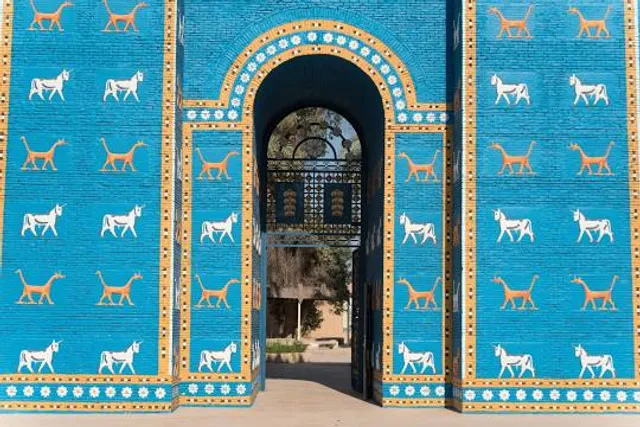
Today only the lower parts of the Ishtar Gate remain in-situ at the site of ancient Babylonian city, known today as Babil. The gate depicted only gods and goddesses with alternating rows of bas-relief mušḫuššu (dragons), aurochs (bulls), and lions, symbolizing the gods Marduk, Adad, and Ishtar respectively. Total length of the ancient gate is about 45 meters from north-south. Parts of the Ishtar Gate and lions from the Processional Way are in various other museums around the world.
Through the gate ran the Processional Street, which was lined with walls showing about 120 lions, bulls, dragons, and flowers on enameled yellow and black glazed bricks, symbolizing the goddess Ishtar. The Processional Way, which has been traced to a length of over half a mile, extended north from the Ishtar Gate. Friezes with sixty ferocious lions representing Ishtar decorated each side of the Processional Way, designed with variations in the color of the fur and the manes. The Processional Way was paved with large stone pieces set in a bed of bitumen and was up to 66 feet wide at some points.
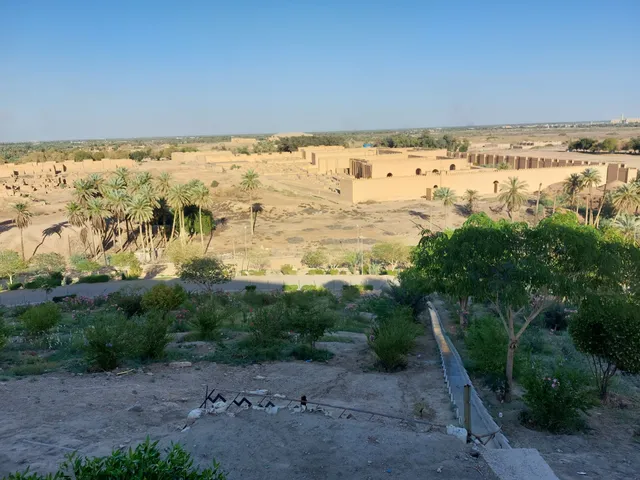
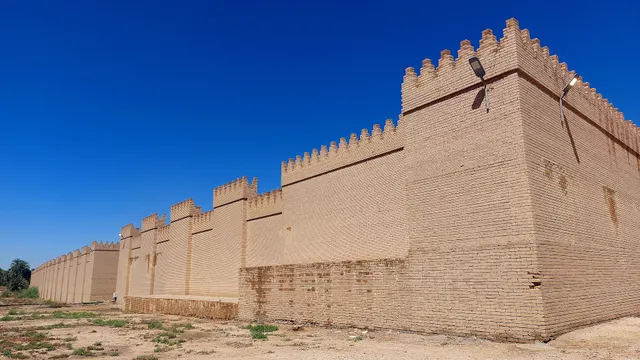
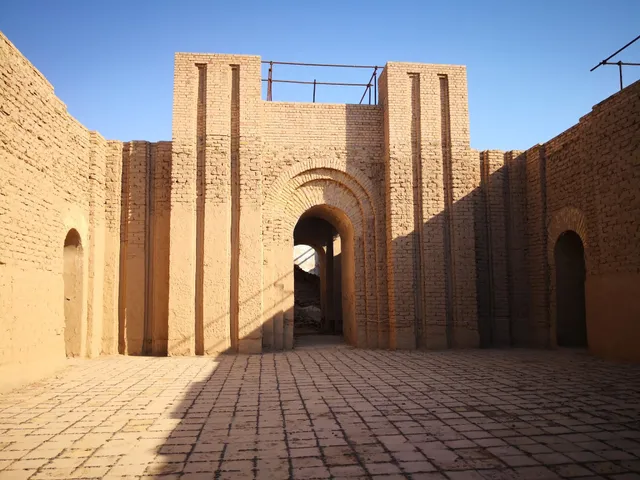
Several important buildings stood around the Ishtar gate, including the Ninmakh Temple to the south-east. The E-mah (great temple of Ninḫursaĝ) as seen from the west, looking over the Ishtar Gate in the bottom foreground. Currently the walls and roofs of the temple are in a very bad condition and no recent renovations have been done. Due to its use as military base by US the site has suffered extensive damage, according to a study by the British Museum, the damage was extensive: some 300,000 sq m (4,000 acres) was covered with gravel.
The Ishtar Gate was only one small part of the design of ancient Babylon that also included the palace, temples, an inner fortress, walls, gardens, processional routes, and other gates. The lavish city was decorated with over fifteen million baked bricks, according to estimates. Most notable of these structures are Street of the Processions, Ninmakh Temple, and the city walls.
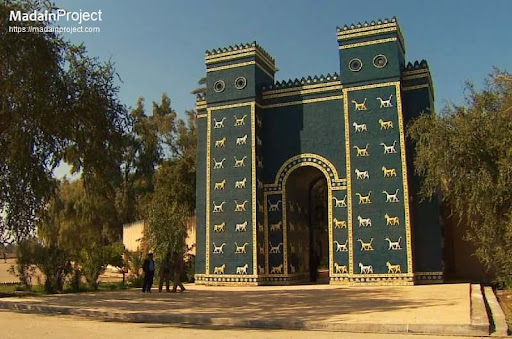
A replica of the Ishtar Gate was installed some 250 meters north of the ancient gateway to the city of Babylon. It is located at the entrance to the Nebuchadnezzar Museum. It is a very simplified model of the original ancient Ishtar Gate, and is not to scale. The construction was meant to emulate the techniques that were used for the original gate. The purpose of the replica's construction was an attempt to reconnect to Iraq's history. Damage to this reproduction has occurred since the US-Iraq War, specially due to the use of this area by the US...
Read moreThis place must be restored to its original glory days! one of the most famous structures possibly in the world, ancient Babylon, was constructed around 575 BCE by order of King Nebuchadnezzar the 2nd. Dedicated to the Babylonian goddess Ishtar, the gate was part of the city's grand processional way, serving as a ceremonial entrance. Adorned with vividly coloured glazed bricks depicting dragons, bulls, and lions, it symbolised the power and grandeur of Nebuchadnezzar's reign. The gate was part of Babylon's extensive fortifications it is one of the Seven Wonders of the Ancient World, underscoring its architectural and cultural significance. Excavated in the early 20th century, sections of the gate were reconstructed and are now displayed in the Pergamon Museum in Berlin, showcasing the splendor of ancient Mesopotamian civilisation.
Will this place see light? Imagine if this place gets restored, it will be number one must visit...
Read moreBabylon is totally worth a visit.. to walk along the same paths as kings from over 4000 years ago .. fragments of pottery and the blue ceramic coated walls still in view in the ruins beside the paths of the Northern palace .. then of course the Lion statue .. the hanging gardens can be imagined in the presumed location (though nothing is visible) all on the banks of the mighty Euphrates river, where water buffalo can be seen bathing .. I'm so pleased further renovation and preservation work is starting through funding from UNESCO.. there is so much more awaiting discovery.. the gardens flanking the banks if the river provide welcome shade from the summer heat .. then there is Saddam Hussein's palace .. and his special (once guarded) date palm ! Then the summer palace ruins and site can be seen in the distance, but I've never been Not sure what to say about Saddam Hussein's influence on the site .. but its all...
Read more