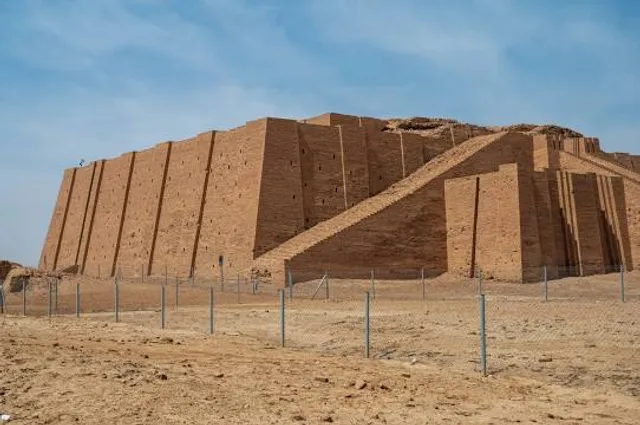
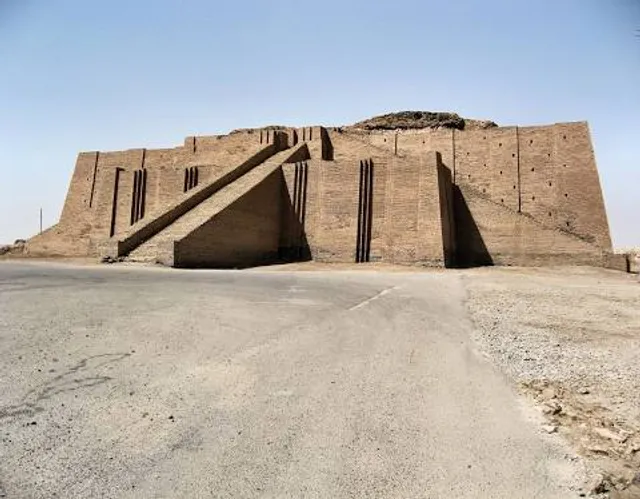
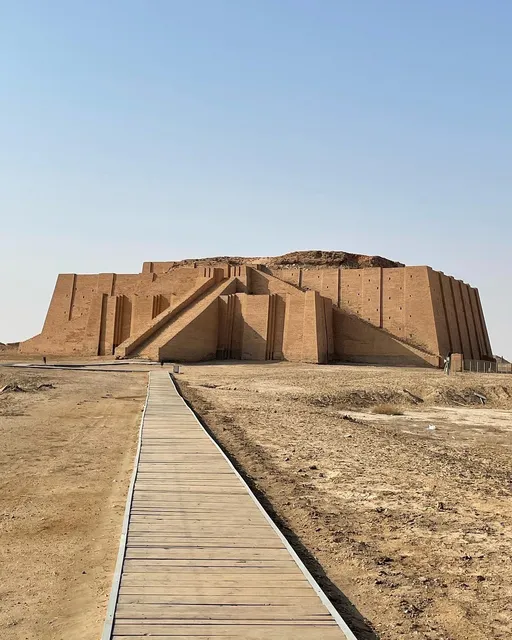
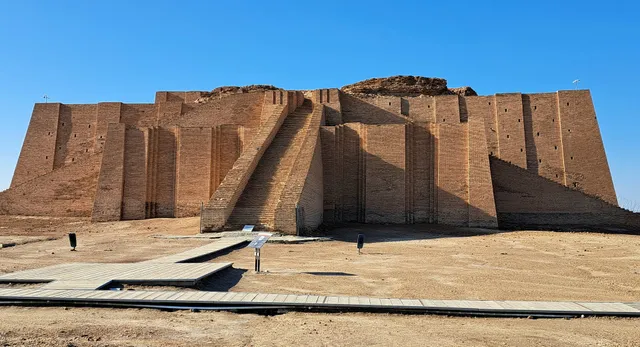
At a distance of several kilometers, visitors can see the ruins of the ziggurat of Ur towering over the horizon, and when approaching it or climbing over it, the visitor will find himself at the threshold of a very accurate urban building, feeling the prestige of the place in which the ziggurat is in between, where the ancient ancient city of Ur is.
The ziggurat - an Akkadian word meaning high place - constitutes the historical and civilizational identity of Dhi Qar Governorate, and people here are associated with the memory of this city, which was once one of the greatest kingdoms on earth, and the most accurate and organized life for the ancient inhabitants of Mesopotamia, according to what archaeological excavations remember.
Amer Abd Al-Razzaq, researcher, archaeologist and director of the Museum of Nasiriyah, confirms to Al-Jazeera Net that "the Ziggurat of Ur is the oldest idea of the listed building in the world, as it was built by King (Ur-Nammu) of the third dynasty of Ur (2100 BC).
Abdul Razzaq adds that it is "older than the Egyptian pyramids and the pyramids of Peru and the Incas in Mexico, as it is located 17 km west of the city of Nasiriyah, and housing appeared there since more than four thousand years BC." على مسافة عدة كيلومترات، بإمكان الزائرين لها، رؤية أطلال زقورة أور شامخة في الأفق، وعند الاقتراب منها أو الصعود فوقها، سيجد الزائر نفسه عند أعتاب بناء عمراني في غاية الدقة، والشعور بهيبة المكان الذي تتوسطه الزقورة، حيث مدينة أور الأثرية الموغلة في القدم. وتشكل الزقورة -وهي كلمة أكدية معناها المكان المرتفع- الهوية التاريخية والحضارية لمحافظة ذي قار، ويرتبط الناس هنا بذاكرة هذه المدينة التي كانت يوما ما واحدة من أعظم الممالك على وجه الأرض، وأكثرها دقة وتنظيما لحياة سكان بلاد الرافدين القدماء، بحسب ما تذكره التنقيبات الآثارية. ويؤكد الباحث والآثاري ومدير متحف الناصرية الحضاري عامر عبد الرزاق للجزيرة نت أن "زقورة أور تعد أقدم فكرة للبناء المدرج في العالم، حيث بناها الملك (أور نمو) من سلالة أور الثالثة (2100 قبل الميلاد). ويضيف عبد الرزاق أنها "أقدم من الأهرامات المصرية وأهرامات بيرو والأنكا في المكسيك، حيث تقع غرب مدينة الناصرية بـ 17 كلم، وظهر السكن فيها منذ أكثر من أربعة آلاف عام...
Read more(Sumerian: 𒂍𒋼𒅎𒅍 é-temen-ní-gùru "Etemenniguru", meaning "temple whose foundation creates aura") is a Neo-Sumerian ziggurat in what was the city of Ur near Nasiriyah, in present-day Dhi Qar Province, Iraq. The structure was built during the Early Bronze Age (21st century BCE) but had crumbled to ruins by the 6th century BCE of the Neo-Babylonian period, when it was restored by King Nabonidus.
The ziggurat was built by King Ur-Nammu who dedicated the great ziggurat of Ur in honour of Nanna/Sîn, in approximately the 21st century BCE (short chronology) during the Third Dynasty of Ur. The massive step pyramid measured 64 m (210 ft) in length, 45 m (148 ft) in width and over 30 m (98 ft) in height. The height is speculative, as only the foundations of the Sumerian ziggurat have survived.
The ziggurat was a piece in a temple complex that served as an administrative center for the city, and which was a shrine of the moon god Nanna, the patron deity of Ur.
The construction of the ziggurat was finished in the 21st century BCE by King Shulgi, who, in order to win the allegiance of cities, proclaimed himself a god. During his 48-year reign, the city of Ur grew to be the capital of a state controlling much of Mesopotamia. Many ziggurats were made by stacking mud-bricks up and using mud to seal them together.
The remains of the ziggurat consist of a three-layered solid mass of mud brick faced with burnt bricks set in bitumen. The lowest layer corresponds to the original construction of Ur-Nammu, while the two upper layers are part of the Neo-Babylonian restorations.The façade of the lowest level and the monumental staircase were rebuilt under the orders of Saddam Hussain.
The ziggurat was damaged in the Gulf War in 1991 by small arms fire and the structure was shaken by explosions. Four bomb craters can be seen nearby and the walls of the ziggurat are marred by over 400...
Read moreThe Ziggurat is a stepped tower built of mudbrick with reeds and bitumen used as mortar. The word ziqquratu in Akkadian means height or 'pinnacle' referring to "Hill of Heaven or the Mountain of God' Its upper temple was dedicated to the worship of Nanna, the Moon God and main deity of Ur. its four corners are aligned with the cardinal points of the qompass. The construction was undertaken by the founder of the 37d Dynasty, UR.NAMMA (2112. 2095 BO) and was completed by his son shulgi (20%5-2047 BC) It is situated in the northwest corner of the sacred temenos area, and consisted of an upper temple and three stages; two of the stages are still standing. Ziggurats were built in many cities and became characteristic of the architecture of Mesopotamia The measurement of the first stage of the Ur Ziggurat is 62.5 x 43m, with a height of 11 m, while the second stage measurec 36 x 26 m, and rises 5.35 m above the first stage. The estimated dimension of the third stage is 11x 20 m, and its estimated height is 2.80 m. The preserved portion of the ziggurat stands more than 16 meters in height today, but originally would have been around 26 meters high The Ziggurat illustrates the engineering phenomenon of inward slanting walls known as Al-Sabt. This has the effect of making the building seem taller and therefore more splendid and prestigious The external and internal walls had decorative buttresses; both were means of strengthening the architecture and adding to its aesthetic appeal. Rectangular holes in the ziggurat act as drainage to counteract water-seepage into the structure. The Ziggurat has three staircases; the middle one leading directly to the higher temple. The two lateral ones lead up to the first stage, at which Point they meet...
Read more