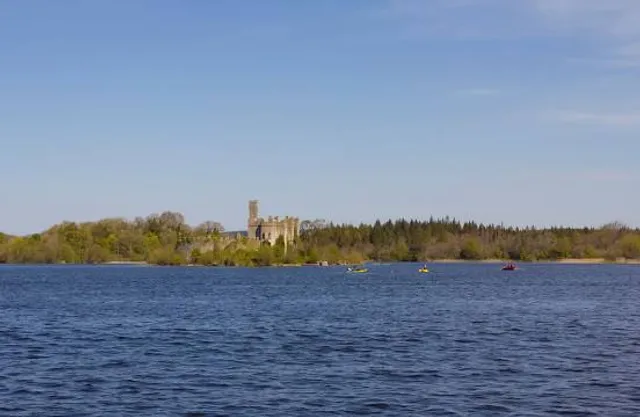
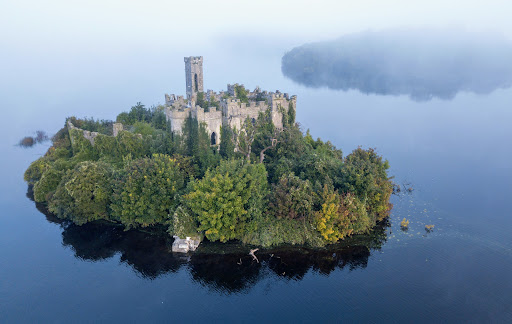
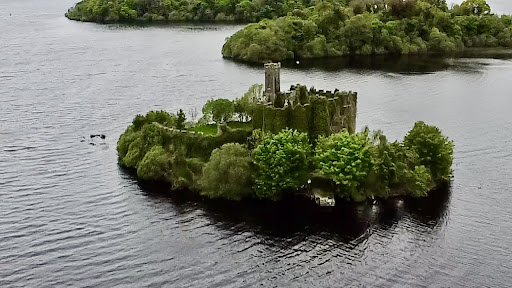
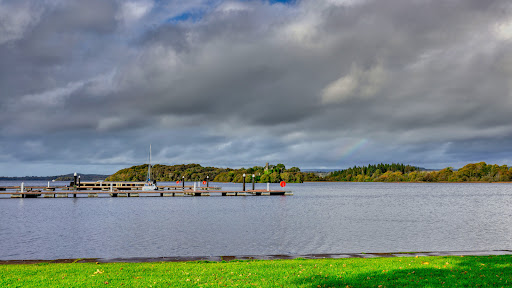
Lough Key Forest Park (in County Roscommon, province of Connacht) is home to over thirty wooded islands. The stunning McDermott’s Castle is on Castle Island, a small island the size of about 2,300 square meters. Located just about 3 km northeast of the town of Boyle, in recent years, it has been open to the public.
The McDermott clan (in Irish Mac Diarmada) was the ruling dynasty in this area from the 10th to the 16th century and a castle has stood on the island since the early 12th century. In 1184, the Annals of Loch Cé reported that a lightning bolt caused a fire over the Castle.
The McDermotts lost the island in 1586 and the current castle is a folly built in the late 1700s by the King family who owned the land at the time. It was burned down during the Second World War and although most of the castle is in ruins, some beautiful features are still intact.
While there is so much history about this Roscommon castle and island, there is a tragic story surrounding them: the legend of Úna Bhán.
Úna was the daughter of the Chieftain, McDermott, whose name gives rise to the castle.
Úna fell in love with a boy who her father believed wasn’t good enough for her. As such, they had a relationship in secret.
The boy would swim across the lake to meet Úna, but unfortunately, on one occasion, he didn’t make it and subsequently drowned.
The story goes that Úna died of a broken heart and that two trees grew up over their graves, intertwining to form a lover’s knot.
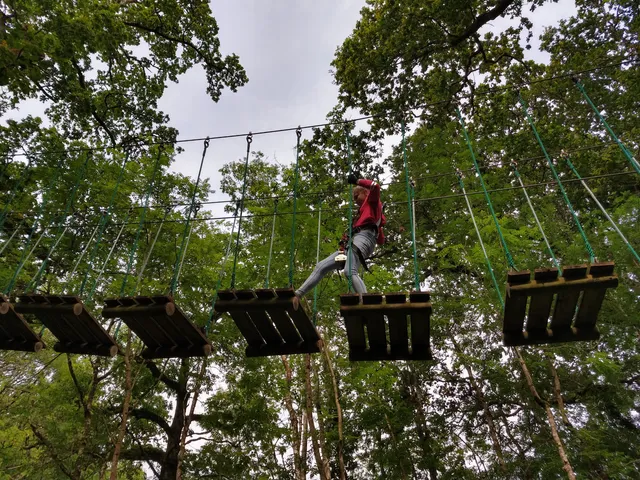
The Lough Key Park and Estate are open all year round for the public to explore, and daily boat tours operate year-round throughout Lough Key. Parking is also available in Lough Key Forest Park.
Admire the sand-coloured stone walls, turrets, and empty windows that once overlooked the chilly Lough Key waters.
Much of the island is completely overgrown with ivy, but you can still get a sense of the grandeur present during the years the castle was lived in.
The neighbouring islands have ruins of churches, towers, and priories, and it is also believed that there are many unmarked or lost graves scattered across them.
Be sure to explore these as well – they really add to the beauty and magic of the area. Head to the nearby Trinity Island, which is where the tomb of Úna Bhán is said to be.
Castle Island was up for sale in 2018 for just €90,000 but was taken off the market.
While the castle is described as being in a “perilous state”, we can only imagine how beautiful McDermott’s Castle would be if it got restored to its former glory!
McDermott's Castle (Castle Island) is also on the list of The National Monument of Ireland.
Ireland is considered as one of the countries with most castles in the world, beside Germany and Wales, with more than 20,000 castles here.
Photos courtesy of Internet and...
Read moreLocation
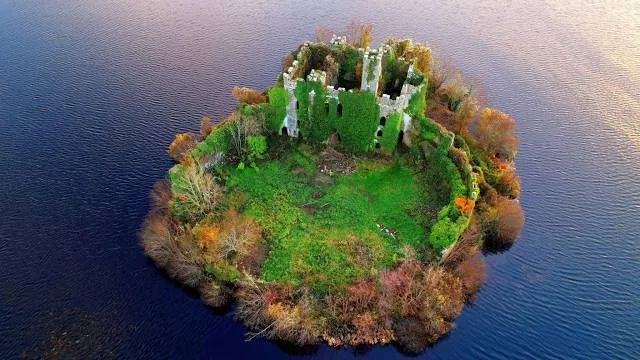
McDermott's Castle is located on Castle Island, an island of 0.23 ha (0.57 ac) in the southeast corner of Lough Key.
History
The Mac Diarmada were the ruling dynasty of Magh Luirg (Moylurg; northeast Connacht) from the 10th to 16th centuries. A castle stood on this island from the 12th century: in 1184, the Annals of Loch Cé report that a lightning bolt caused a fire:
The Rock of Loch-Cé was burned by lightning, i.e. the very magnificent, kingly residence of the descendents of Máel Ruanaid where neither goods nor people of all that were there found protection; where six score, or seven score, of distinguished persons were destroyed, along with fifteen men of the race of kings and chieftains, with the wife of Mac Diarmada, i.e. the daughter of Ó hEidhin, and his son's wife, i.e. the daughter of Domhnall O'Conchobhair, and the daughter of Ó Dubhda, and the son of Donnchadh O'Maelbhrenuinn, and the son of Donn O'Mannachain, and the two daughters of O'Mannachain, and Mac Maenaigh, chieftain of Cenél-Builg, and the priest O'Maelbealtaine, and Gillachiarain Ó Connachtain, (i.e. a son of chastity and lamp of piety), and a countless destruction besides of good men; and every one of them who was not burned was drowned in this tumultuous consternation, in the entrance of the place; so that there escaped not alive therefrom but Conchobar mac Diarmatawith a very small number of the multitude of his people.
A rebuilt castle featured in the final part of the 1235 conquest of Connacht by Richard Mór de Burgh, 1st Baron of Connaught. The castle came under siege, first by a raft-mounted catapult, and then by fire ships. Cormac MacDermott, King of Moylurg, was forced to surrender.
A poem addressed to Tomaltach an Einigh mac Diarmata (King of Moylurg 1421–58) tells the story of the Hag of Lough Key who used (or abused) Cormac MacDermott's (king 1218–44) hospitality by staying on the Rock for a full year, and laid upon the McDermotts the obligation of perpetual hospitality.
The McDermotts lost the island in 1586. Eochaidh Ó hÉoghusa wrote a poem lamenting the castle's emptiness.
In 2014 the island and castle featured in an episode of sitcom Moone Boy, as the residence of the mysterious "Island Joe."
Building
Isaac Weld, writing in 1832, describes as part of "the castle proper" two rooms, one above the other, each 36 × 22 feet (11 × 7 m), with walls 7½ feet (2.2 m) thick. It is not clear whether this refers to part of the original castle, or the later construction.
Currently a folly castle built c. 1800 by the King family stands on the island. It was built as a summer house and burned down during the Second World War
(Copy...
Read moreNice to know, Wikipedia text: " In 2019, archaeological excavations were also undertaken on the island.[11] The excavations concluded that the island itself is essentially a multi-period fortification, with the earliest elements dating to the early medieval era. An earlier, two to three meter thick enclosure wall pre-dating the standing enclosure wall was excavated at a depth of a meter and a half. Medieval buildings dating to the thirteenth century were excavated on the northern side of the island above the earlier fortification, but were not found to be connected to the standing enclosure wall. High-status Gaelic artifacts were discovered, including silver pins, a gaming piece, and large collections of butchered cattle, boar, and sheep. The research on the island was featured in Archaeology Magazine.[12]"
By the way, Tinh's claiming of the castle's destruction by the 2nd WW...
Read more