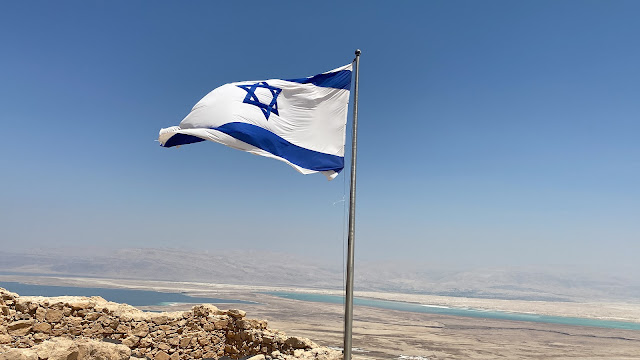
One of the highlights of our Israel Road Trip, for me at least, was the sunrise climb to Masada. I woke at 3 for a wee then it seemed like 30 seconds later Deb was telling me it was 4.45 and the alarm had gone off! It certainly took me a while to get in gear. We left the hotel and drove to Masada and started the path around 5.50, a bit later than intended. Luckily there was enough light that we didn’t need a torch and enough other people around anyway. It was also a lot warmer than I expected, 20 degrees when we started the climb!
A bit of background information: Masada was built by Herod the Great as both a winter residence and a bolt hole. He built massive cisterns and storehouses so he could live in accustomed luxury at this remote desert site and also have a fortified base if he was driven out of Jerusalem. I’m not sure of the sites use after his death (4BC?) but at the time of the Jewish Revolt against Rome in 67AD some Jewish rebels (a mix of fanatics and refugees) took the complex and fortified it. After the Romans retook Jerusalem in a bit of a bloodbath they mopped up all other resistance and then marched on Masada.
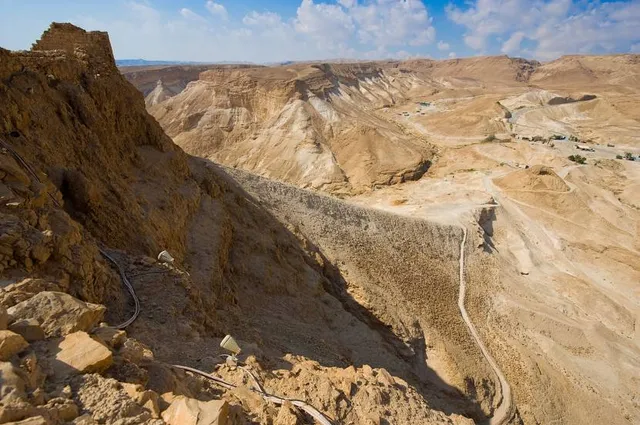
The Romans, with their usual methodical efficiency, built a wall around the site and then built camps for the legionaries around the base of the hill. There were 8000 Romans and maybe a tenth of that number of defenders, although these included women, children and the elderly. The Romans spent 3 years (!) building a ramp to reach the top of the walls and then built a huge siege tower with a battering ram to smash through the wall after they had dragged it to the top. Like Theoden at Helms Deep the Jews thought “What can man do against such reckless hate?” and unlike Theoden, they had no hope of a Gandalf rescuing them.
The solution was mass suicide so when the Romans broke into the fort the next day all they found were dead bodies along with 2 women and 5 children who had hidden in the cisterns and told the Romans what had happened. The site was then abandoned until Byzantine monks occupied it in the 5th century but they in turn abandoned it after the Islamic conquests. The story of Masada is kinda like the Jewish version of the Dunkirk, resistance against hopeless odds and glory in defeat.
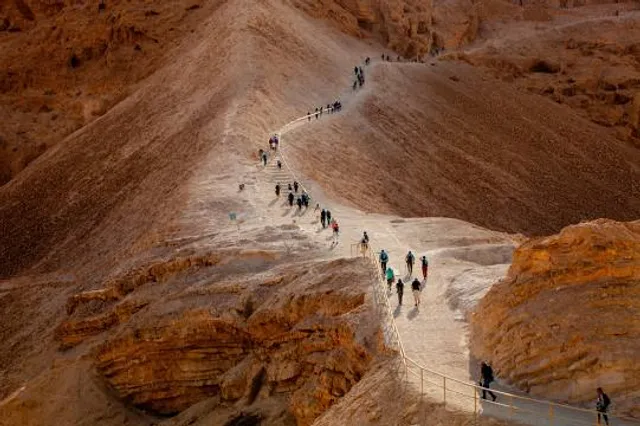
The climb was hard work, it was lucky it was a snake path so you couldn’t see the total climb in one go as that may have been disheartening. Every time I got to the top of one bit I’d look up and see another couple of sections. We gradually ground away at the trek, pausing occasionally for a photo stop and breather.
I got to the top after 45 minutes with a very sweaty head! the sun had probably risen but a bank of cloud blocked it from view for about 10 minutes longer so I ambled around the entrance structures and viewpoints while waiting for Deb. She arrived a little later and was not going to win happy bunny of the year award but at least the climb was done and achieved.
Most of the site is just desert and low walls with viewpoints over more desert and hills as well as various Roman siege camps. It wasn’t until we got to the western edge that we really saw anything. The Roman siege ramp was an incredible feat of engineering and that was also where Herod’s palace buildings started. Of these, by far the most impressive was the Northern Palace.
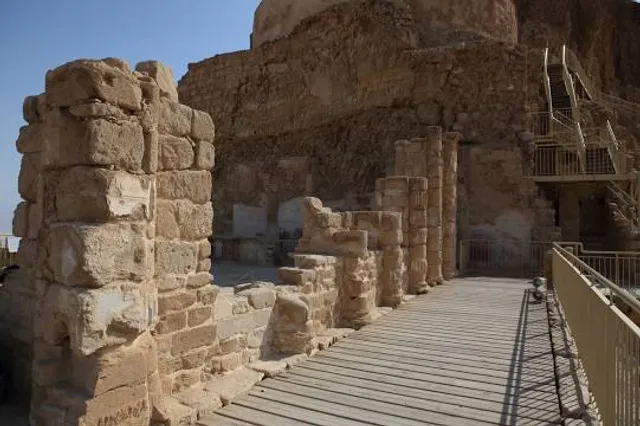
The northern palace was built on 3 levels with pools and terraces to take advantage of the surreal views over the desert of Moab. It seemed the most complete of all the buildings onsite and there were some collonaded areas but Deb waited at the top so didn’t see any of it as she didn’t fancy the thought of climbing back up 100 plus more steps! I joined her at the top and she carried on navigating us round the attractions, seeing the Byzantine church with its mosaics, the decorated guard commander’s rooms, the largest cistern and some of the huge number of store rooms built at the site.
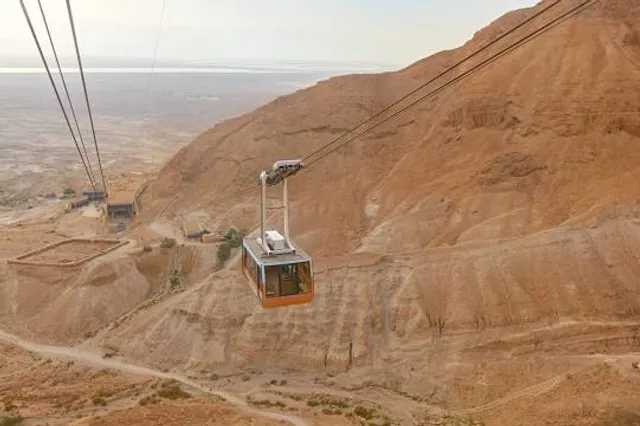
We then caught the cable down at just after 9AM, what an incredible start to the day – both sweaty, achey and tired but also elated about the...
Read moreMasada is the cleared off top of a mountain, originally set up by Jonathan the high priest (ruled from 103 to 76 BC). Herod the Great took it over and expanded it. Herod built a wall around the entire top of the hill. On the wall he erected 38 towers, each 50 cubits high. He made the top of the hill arable for growing crops. Herod built a palace on the western side, within and beneath the walls of the citadel with a great bath house. He created many cisterns for water. The snake path didn't need anyone to guard it. In the back on the western side of the mountain, Herod put a great tower at the narrowest place to protect the mountain. There was enough armor and arms for 10,000 men in the fortress, Herod built it because he was scared of a Jewish revolt and the threat from Cleopatra who wanted him deposed by Marc Antony.
In AD 66 Eleazar led the Sicarii, a group of Jewish zealots who refused to pay taxes to Rome, attacked and plundered any Jews who submitted to Rome, murdered Romans, and rejected Jewish purification laws. Eleazar took Masada by treachery.
In AD 72 Roman general Silva led his army against Eleazar and the Sicarii Zealots. Silva built a wall around Masada so that no one could escape and set up Roman camps. Jewish slaves brought food out to the desert for the Romans. Silva built a seige ramp in the back bringing up a great battering ram to smash in the door. The Zealots rebuilt the door and made it more flexible so that the battering ram couldn't bring it down. Silva decided to set fire to the wall. "Now at the very beginning of this fire, a north wind that then blew proved terrible to the Romans; for by bringing the flame downward, it drive it upon them, and they were almost in despair of success, as fearing their machines would be burned. But after this, on a sudden the wind changed into the south, as if it were done by divine providence, and blew strongly the against way, and carried the flame, and drove it against the wall, which was now on fire through its entire thickness." The Romans retired for the night, ready to conquer the Zealots the next day (April 15, AD73).
Seeing that all was lost, Josephus records Eleazar's speech to the people of Masada: "Why consider how God has convinced us that our hopes were in vain, by bringing such distress upon us in the desperate state we are now in, and which is beyond all our expectations; for the nature of this fortress which was in itself unconquerable, has not proved a means of our deliverance; and even while we have still great abundance of food, and a great quantity of arms, and other necessities more than we want, we are openly deprived by God himself of all hope of deliverance; for that fire which was driven upon our enemies did not of its own accord turn back upon the wall which we had built; this was the effect of God's anger against us for our manifold sins, which we have been guilty of in a most insolent and extravagant manner with regard to our own countrymen; the punishments of which let us not receive from the Romans, but from God himself, as executed by our hands, for these will be more moderate than the other. Let our wives die before they are abused, and our children before they have tasted slavery; and after we have killed them, let us bestow that glorious benefit upon one another mutually, and preserve ourselves in freedom, as an excellent funeral monument to us."
So the men murdered their wives and children, piled them in a heap and burned their bodies. They cast lots for ten men and these ten men then killed all the remaining men, the last of the ten killed the remaining nine and then committed suicide. 960 people died. 2 older women and 5 children escaped by hiding themselves in the cistern. The two women told the Romans what had happened and what had been said.
Josephus, The Jewish War Chapters 8-9....
Read moreMarvelous place! Definitely worth visiting while in Jerusalem! 1h 30m drive from Jerusalem, you can climb on top using the car cable or by foot! The view is extraordinary, you will spend at least 2h of quality time.
MASADA ATTRACTIONS
In addition to being rich archaeological site that offers a window into the history of the region, Masada is also a beautiful natural wonder in the middle of the desert. Many Israelis and active tourists come just as much for the enchanting morning hike up Masada as they do for the site itself.
GETTING TO THE TOP OF MASADA
Most tourists get to the top of Masada via the cable car. These hi-tech, Israeli-engineered cable cars were upgraded for the expected increase in tourism for the year 2000 and are an attraction on their own.
If you’re up for the hike, it’s essential to get to Masada early in the day – otherwise, blistering temperatures can make the hike difficult and even dangerous. The trails open at 5:30 am, and most people hike up the Snake’s Path, which takes an average 40 minutes, but there are also steps. When you reach the peak of this mountain fortress, you’ll be able to gaze at the pink-orange-yellow horizon over the Dead Sea and Judean Hills, surrounded by dusk’s cool newness in the air. So, if you’re inclined for the hiking challenge, take this rare opportunity to catch a breathtaking sunrise and the amazing views from Masada.
ARCHAEOLOGICAL SITES
Once you reach the top either by cable car or hike, at the entrance you’ll receive a site map, good for both self-guided and organized tours. You’ll walk around, site by site, amidst the remains of daily life of the small – albeit strong – group of zealous Jews who held fast for three years against the conquesting Roman legions. Theirs was the last battle, in 73 CE, three years after the Romans destroyed the Jewish Second Temple, resulting in the Jewish Diaspora, splintering Jews to many corners of the earth, longing all the while to return to their homeland. In modern times, Israeli pioneers took to Masada as inspiration for defending the Jewish nation, saying, “Masada will not fall again.” The twist is that the group of people under Roman threat took their own lives in the end, leaving the question about martyrdom’s value, both two millenia ago and now.
Several sites have been semi-reconstructed by expert archaeologists, with lines painted on the stones to distinguish the interpretive add-ons. From cooking facilities to ritual baths, synagogues to seating areas, you’ll sense what life was like for this sequestered holdout almost 2000 years ago.
Another attraction on Masada is the Torah writer (“sofer”), whom you can see caligraphying letter by sacred letter, day in, day out.
MASADA MUSEUM
The refurbished Masada complex houses the Masada Museum, in tribute to the leading Israeli archaeologist, Yigael Yadin, for his spearheading work on Masada and other contributions to Israeli history. The museum’s displays include engraved names (perhaps as part of a martyrdom lottery), braided hair, and other...
Read more