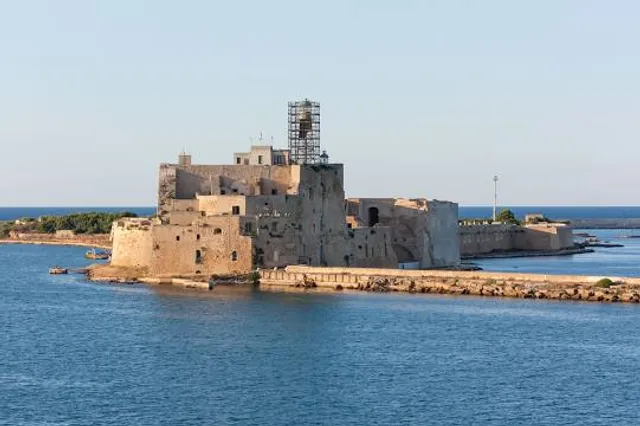
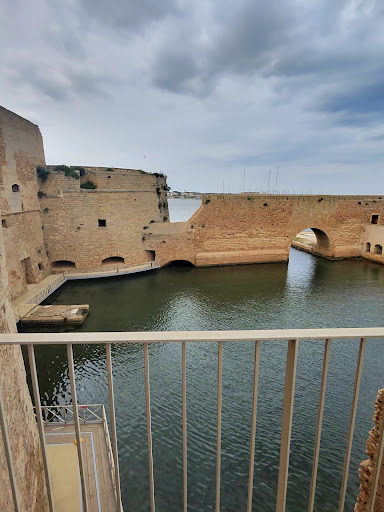
My husband and I visited today and, even if I was born and bred in Brindisi, I never had a chance to visit (castle not being open to the public while I was still living there). I was glad to see that such an important piece of history has been given some consideration. The castle deserved to be restored and made accessible, even if not yet completely. The whole experience was pleasant and informative, and our guide was knowledgeable. Was the tour faultless or perfect? No, it wasn't, but I give the 5 stars anyway as I think it's vital to help such initiatives. The "Ets Le Colonne" is in charge of these tours and the enhancement services, I'm sure they are working hard to make this project a success. I consider the restoring and the opening to the public of this Castle a little but great step towards a recognition of Brindisi's value in history. Please do forgive me for this, but could I suggest something in regards of the guided tours for foreign tourists? The map you give to those who don't speak Italian is not very helpful. I noticed people struggling at working out how to match the map with the audio files. Maybe, instead of the map, you could put the numbers in the very spots they refer to? Like a sign, a plate or something similar? It would be easier to visualise the appropriate number and select the correct audio file. Anyway, I recommend visiting this Castle and enjoy diving into a good page of Italian...
Read moreA first castle was built by Hiero I of Syracuse in 474 BC. At the same time, two towers were built to control enemy fleets' movements. The rock was then occupied by Parthenopeans, the ancient inhabitants of Naples. In 326 BC the fortress was captured by Romans, and then again by the Parthenopeans. In 1441 Alfonso V of Aragon connected the rock to the island with a stone bridge instead of the prior wood bridge, and fortified the walls in order to defend the inhabitants against the raids of pirates. Around 1700, about 2000 families lived on the islet, including a Poor Clares convent, an abbey of Basilian monks (of the Greek Orthodox Church), the bishop and the seminar, the prince with a military garrison. There were also 13 churches. In 1809, the British troops laid siege to the island, then under French command, and shelled it to almost complete destruction. In 1912, the castle was sold to a private owner. Today the castle is the most visited monument...
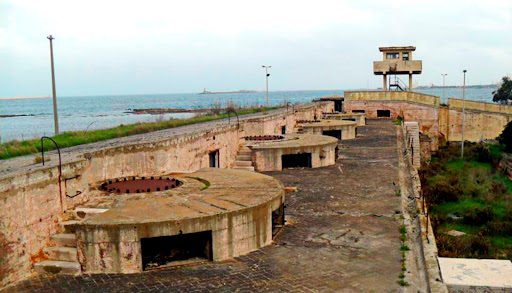
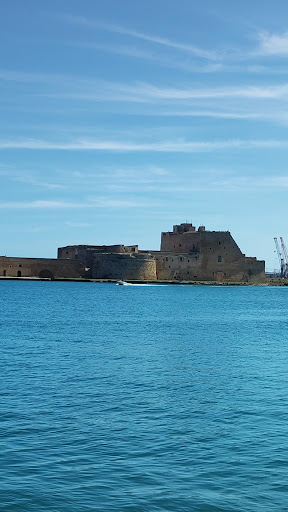
Read moreThe castle has been used for various purposes, including defense, penal bathhouse, quarantine station, and mine depot. Lovely safe place to take a short walk and take in the sea. There is a handful of street bars along the walk . Beautiful castle on a small island across from the historic center of Brindisi. It can be reached by car or bus. The Castello Alfonsino, also known as the Red Castle, is a historic fortress located on Sant'Andrea Island in Brindisi, Italy. It was built in the late 15th century to defend the port against sea attacks. The castle has two distinct parts: the Red Castle, built with distinctive vermilion bricks, and the Forte a Mare, which later served as a barracks. The castle has undergone various uses, including a penal bathhouse, quarantine station, and mine depot, and has been the focus of recent restoration efforts, making it accessible to the public for...
Read more