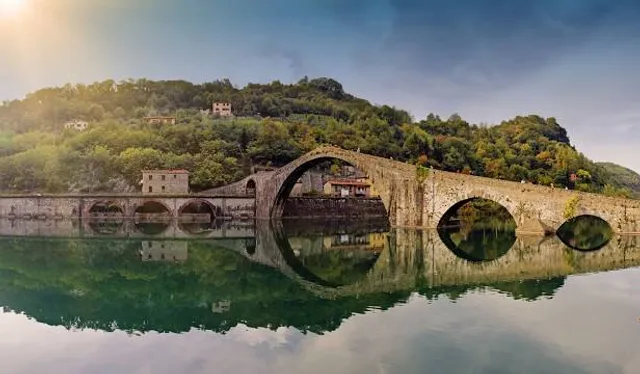
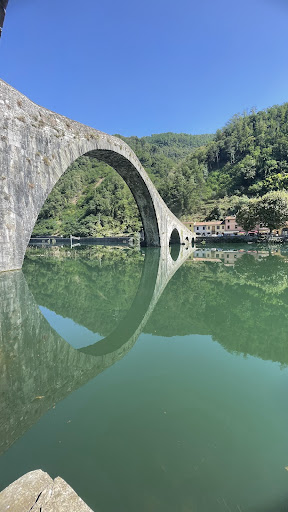
THE BRIDGE OF MARY MAGDALENE ALSO KNOWN AS THE DEVIL'S BRIDGE The bridge was probably erected by Countess Matilda of Canossa in the eleventh century to allow travellers and pilgrims to reach Lucca and the Francigena. It was restored by the government of Castruccio Castracani in the late thirteenth and early fourteenth centuries. The name of the bridge comes from the hermitage that was built at its foot in 1526, which contained a statue of Mary Magdalene. The statue can currently be found in the Church of Saint James the Great (San Jacopo) in Borgo a Mozzano. A masterpiece of medieval engineering, the Devil's Bridge overlooks the River Serchio and has always been the subject of fantasies, myths and legends. In the late 1800s, the bridge was modified to allow the passage of the Lucca-Aulla railway line, with the addition of a new are on the right bank. During the Second World War it was damaged by the Nazis, who were by then abandoning the fortifications of the Gothic Line, but fortunately the bridge was not destroyed. Although nobody knows for sure why the Devil's Bridge was spared by the Germans, it was likely because they deemed it not suitable for the transportation of military equipment and therefore not worth destroying. The bridge has the classic medieval "hunchback" design, but what makes it different is that the arches are asymmetrical and the central one is so high and wide that it seems to defy the laws of gravity. THE LEGEND The Legend: The sinister name of the "Devil's Bridge" is due to a legend of which there are several versions. The best known is the one that takes us back to its construction: it is said that the task of building the bridge was entrusted to Saint Giuliano 1' Ospitaliere. The work proved difficult from the outset. The foreman in charge of the work was in despair because he knew that the bridge could not be completed in time. One evening, as he sat alone on the river bank, thinking of the disgrace he would be in if the bridge was not finished, the Devil appeared to him and proposed a deal. The Devil could make it so that the bridge was completed in a single night, but on one condition: that he could take for himself the first soul to cross the bridge. The pact was signed and in one night the Devil lifted the entire bridge into place with his pitchfork. Filled with remorse, the man confessed the deal to a priest, who told him to respect the pact but to send a pig over the bridge first. The next day the forman...
Read moreBeautiful bridge with an interesting backstory! One version is as follows:
"Legend tells of a skilled chief mason, laboring under the weight of persistent delays during the construction of the bridge. These challenges were exacerbated by the river's unrelenting and forceful floods. One evening, driven to the brink of despair, he uttered sacrilegious words that beckoned forth the presence of Satan himself.
In response to the summons, the devil materialized before the master builder, proposing a dark pact: he would expedite the completion of the bridge in a single night, but in exchange, he demanded the soul of the first being to cross the finished structure. Pressed by the urgency of the situation, the chief mason reluctantly agreed to this ominous bargain, and the construction surged forward under the devil's otherworldly influence.
As the project neared its culmination, an overwhelming sense of dread gripped the master builder. The looming specter of surrendering the first soul to traverse the bridge to the devil weighed heavily on his conscience. Fearing the dire consequences, he turned to the village's parish priest for guidance and salvation.
The priest, moved by the builder's plight, devised a clever strategy to outwit the devil. He orchestrated the crossing of the bridge by an astute surrogate – a dog. As the soulless canine set foot upon the newly erected bridge, the devil's fury erupted in a tempest of anger. With hunched shoulders and a malevolent glare, he raised the very structure he had helped complete, bestowing upon it the distinctive arch that would forever mark its presence.
In a climactic burst of anger, the devil's wrath transformed the bridge, shaping its form and granting it an enduring legacy. The cunning maneuver orchestrated by the parish priest had thwarted the malevolent agreement, sparing the village from the clutches of darkness that had threatened to...
Read moreThe Devil’s Bridge. And yeah, they say he helped build it, which makes sense because no sober architect would’ve signed off on that curve. It looks like someone bent a stone spine over the Serchio River and left it there to confuse tourists and piss off gravity.
You get there and it’s quiet, the kind of quiet that makes you feel like a sinner. No ticket booth, no selfie stations, just a warped miracle of medieval engineering holding itself together out of pure spite. Locals say the builder cut a deal with the devil to finish the thing on time. The usual Faustian clause, soul upon completion. But the builder outsmarted him with a pig or something. Classic Tuscan hustle.
It doesn’t take long to walk across, but it sticks with you. The view upstream feels like a postcard, the view downstream feels like a warning. You feel small in the right way. Like time and stone are in on some joke you weren’t invited to.
Tour buses rarely stop here. It’s mostly old men on bikes, couples pretending not to fight, and the occasional writer trying to outrun a hangover. Which makes it perfect. No gloss. No hype. Just a crooked bridge, a river, and the whisper of hooves you almost hear when the wind...
Read more