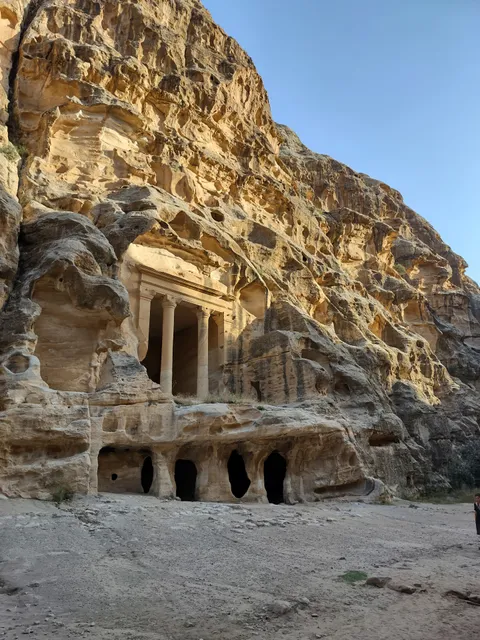
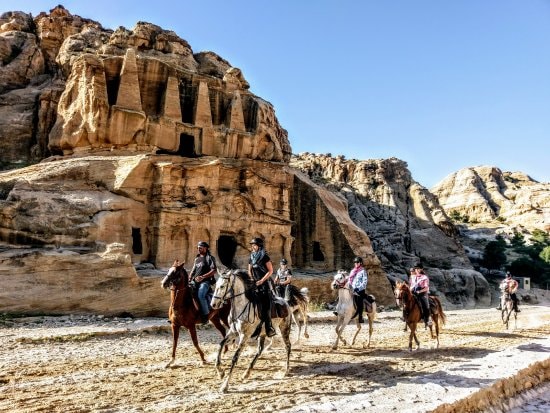
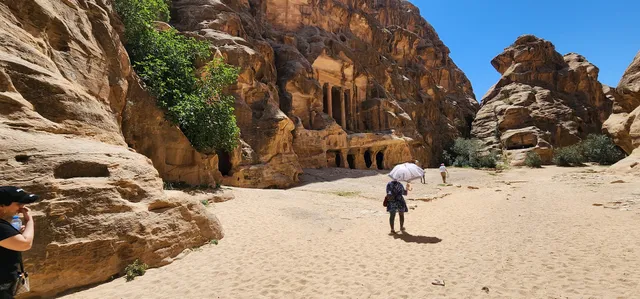
Little Petra is one of the hidden gems when exploring the ancient city of Petra. It is located in the Bayda village around 9 KMs north of the Petra Visitor’s Center. It is considered one of three official entrances into the ancient rose city.
It is said that this place was the “industrial” part of the Nabatean civilization where white wine and currency were made.
The place consists of a small Siq and a small Treasury. The walking path is straight, and is 1 KM long. The place consists mainly of chambers on the ground floor and a lower floor, as well as stairs to go up. Most of the stairs on the right/left side are wiped, and it is recommended not to climb most of them.
You pass through many chambers, pass through a souvenir tent, then climb stairs up to another tent. This second tent; another souvenir store, is the end of this walking trail.
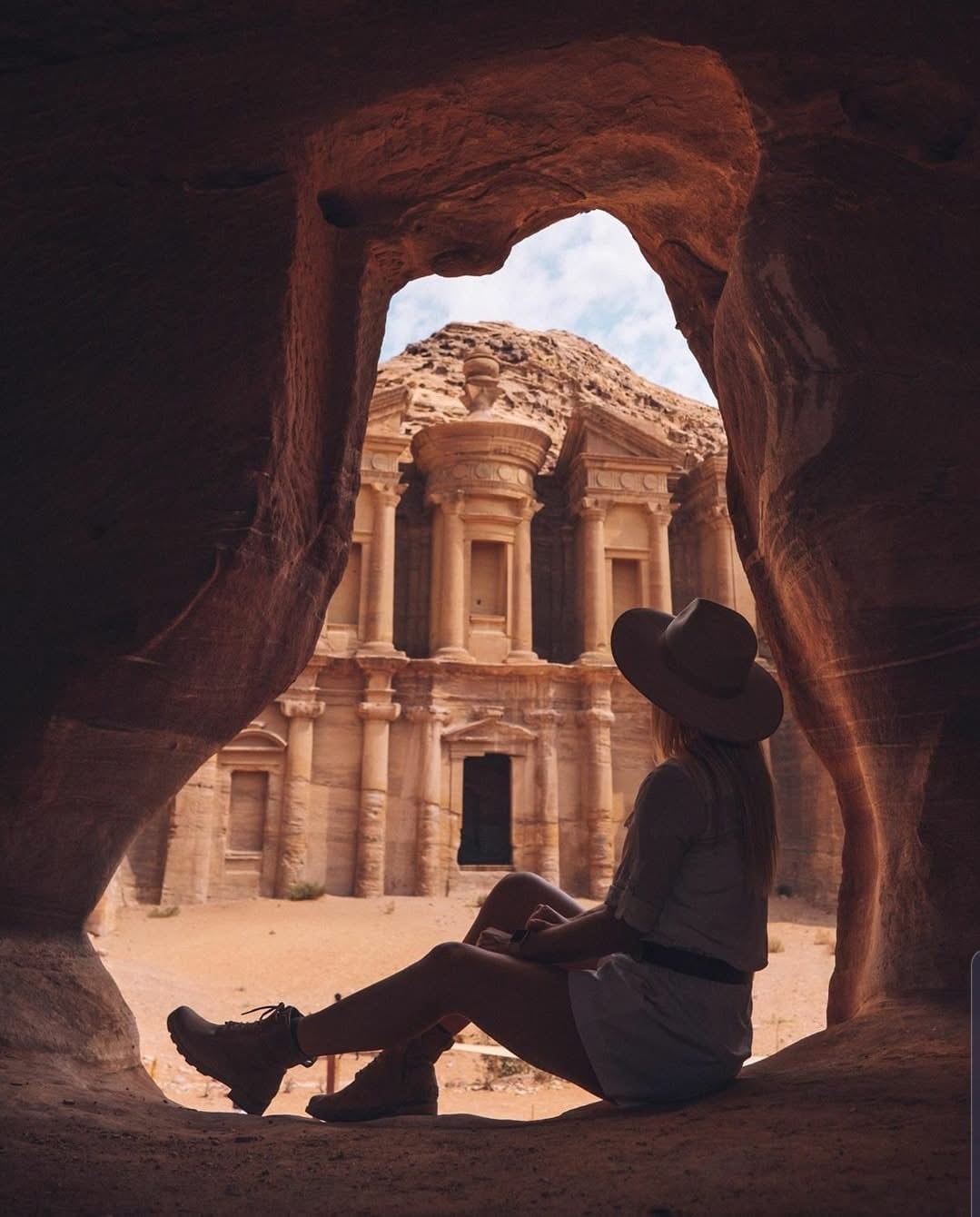
If you are into hiking, Little Petra has a hiking trail that leads to the Monastery. The trail starts by riding a 4x4 (for a fee) to go to the start of this trail. Then, you walk for around 4 KMs before you arrive at the Monastery. The trail involves stairs and muddy terrain, and walking close to cliff edges; thus caution is recommended (mainly if you are hiking with kids).
Once you arrive at the Monastery, you either return back to the drop-off point, or you continue to Qasr Albint in the Petra ancient city (another 3-3.5 KM). If you decide to return back to the drop-off point, ask about the timings of the 4x4 car so that it takes you back to Little Petra.
The hiking trail is quite clear either through stairs, or through a drawn path (using rocks). Thus, having a guide isn’t necessary.
The walking trail is served with small kiosks that sell drinks and snacks. Some folks sell souvenirs, and you may bump into folks who offer donkey rides for a fee. Make sure you have cash on you to pay as most don’t accept credit cards.
Entering Little Petra is free, but riding the 4x4 car to the start of the hiking trail comes with a fee. You can also buy tickets for the Petra ancient city here, and they accept cash or...
Read moreIf you are debating about visiting here, do not do it.
What a complete disappointment! As soon as you arrive, you'll be swarmed by people claiming to be guides who want to follow you for a "good price" which is anything but good. The guy who really tried to get us could barely speak English as well. Little Petra itself has a few kinda cool spots but it's filled with locals trying to sell you a million of the same thing you just declined buying less than 10 seconds before.
If you go inside the caves/rooms, you'll find trash (mostly cigarettes and broken bottles) absolutely everywhere. The caves also reek of bodily fluids (from animals or...). This is how the locals treat their heritage. I can't tell you how disappointing this was to see.
Little kids run around begging for money and don't go away when you try so politely to tell them you don't want their postcards or magnets. They also will forcibly try to take pictures for you for tips.
Maybe the most bizarre is that locals will photobomb you on purpose! If you're trying to get a picture in front of someplace, people will intentionally move themselves (along with whatever they're selling) directly behind you, completely ruining the picture.
If you are considering adding an extra day to your Jordan itinerary to visit this place as well as a few others like Shobak Castle, it isn't worth it. Stay in your hotel and watch a movie on...
Read moreA ten-minutes drive north of Petra is Siq Al-Barid, which is also referred to as 'Little Petra' due to similarities with the main site. It is thought to have been an important suburb of Petra and is entered through a narrow opening, similar to Siq but of a much smaller scale. The site includes tombs, temples, water channels and cisterns carved out of the rock as well as the remains of frescoes on plaster.
This is one of the most important features of Beida and is where many religious activities were held, including the Feast of Drink, when the king of the Nabataeans hosted celebrations and provided drinks for his guests. There is also a cave with the remains of a fresco painted by the Nabataeans that represented grape vines, which confirmed the view that Beida was the area of wine production. In the Siq Al Barid the Nabataean irrigation system, which distributed water through long channels, reservoirs carved into the rock, and dams, is evidence of the greatness...
Read more