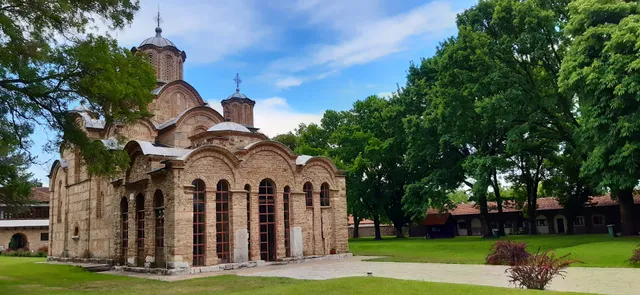
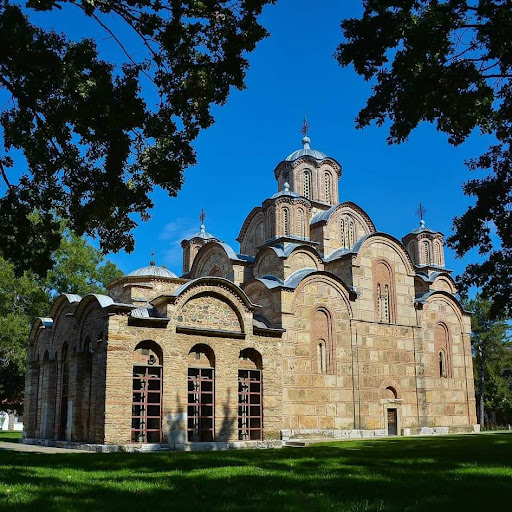
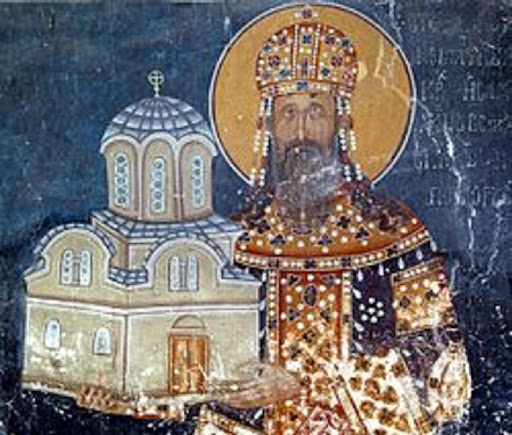
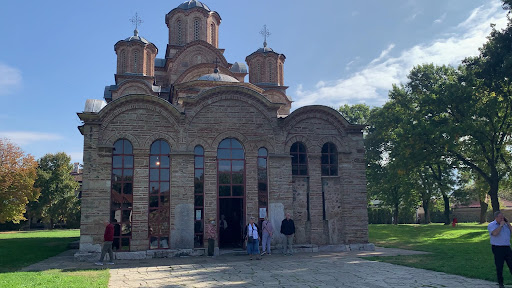
The Gračanica Monastery is a Serbian Orthodox monastery located in Kosovo Serbia. It was built by the Serbian king Stefan Milutin in 1321 on the ruins of a 6th-century basilica. The monastery was declared a Monument of Culture of Exceptional Importance in 1990, and on 13 July 2006. it was placed on UNESCO's World Heritage List under the name of Medieval Monuments in Kosovo Serbia as an extension of the Visoki Dečani site which was overall placed on the List of World Heritage in Danger. The Gračanica Monastery is one of King Milutin's last monumental endowments. The monastery is located in Gračanica, a Serbian enclave in the close vicinity of Lipljan, the old residence of Eparchy Lipljan. Gračanica was constructed on the ruins of an older 13th-century church of the Holy Virgin, which itself was built on the ruins of a 6th-century early Christian three-naved basilica. It was located in the centre of the Eparchy of Lipljan. Stefan Milutin's ktetor comment are written on the southern wall, including "I have seen the ruins and the decay of the Holy Virgin's temple of Gračanica, the bishopric of Lipljan, so I have built it from the ground and painted and decorated it both from inside and outside". In 1346, when the Serbian Archbishopric was raised to the rank of Patriarchate, the bishop of Lipljan was granted the honorary title of metropolitan bishop, and since that time they were called metropolitans of Lipljan or Gračanica. Of the former monastic compound, only the church has survived. The narthex and the tower were added a few decades later, in order to protect the frescoes on the west facade. The narthex was heavily damaged by the Ottomans several times between 1379–1383, when the tower was burned and a fire devoured a rich collection of manuscripts and other precious objects. The narthex was reconstructed in 1383. Again, Gračanica suffered damages at the time of the Battle of Kosovo (1389). During Ottoman rule Gračanica became an important cultural center. In the time of Metropolitan Nikanor (1528–1555) several icons were painted on the altarpiece. Also, because of the printing press, Nikanor obtained numerous service books and objects for monastic use. The royal doors were commissioned in 1564 by Metropolitan Dionisije, whose death is represented on a fresco in the narthex. Major restoration took place through efforts of Patriarch Makarije Sokolović. All the openings on the external narthex were walled up and new frescoes were completed in 1570. Thanks to Patriarch Pajsije, the church got its leaden roofing, and in 1620 the large cross with crucifix was made on the iconostasis. The monastery was exposed to new damages toward the end of the 17th century, in the Great Turkish War, after the second siege of Vienna - in which the Serbs took part on the Christian side. Turks removed the leaden cross and pulled out the floor tiles, together with the treasure hidden in the church by Patriarch Arsenije III. After the World War II it was renewed by nuns and has been serving as a convent since. Today there are 24 sisters in the monastery who are active in icon painting, agriculture, sewing and other monastic obediences. In 1999 the monastery was bombed twice by NATO airplanes. After the Kosovo War (1998–99), Bishop of Raška and Prizren Artemije Radosavljević transferred his official seat to this monastery from Prizren and since then the monastery has become not only the most important spiritual but also the national and political center of the Serb community in Kosovo. The monastery was declared a Monument of Culture of Exceptional Importance in 1990, and on 13 July 2006 it was placed on UNESCO's World Heritage List under the name of Medieval Monuments in Kosovo as an extension of the Visoki Dečani site which was overall placed on the List of World...
Read moreMonastery Gracanica-1321, Gracanica - Serbian Kosovo and Metohija Serbian King Milutin - Stefan Urosh II (1253-1321)
UNESCO
The monastery of Gracanica was built by King Milutin in 1321 and dedicated to the Assumption of the Most Holy Theotokos. The monastery is located in the village of Gračanica, 10 km away from Pristina, the administrative center of Kosovo and Metohija-Serbia. The monastery belonged to the Eparchy of the Raska-Prizren Serbian Orthodox Church and represents an immovable cultural asset as a cultural monument of exceptional significance.
The monastery of the Holy Virgin in South Serbia, on the left bank of the Gracanke River, the right tributary of Sitnica, south of Pristina in Kosovo, is the responsibility of Serbian King Milutin (Stefan Urosh II), his wife Simonida and his son Stefan. It was erected in 1321 and endowed with rich gifts, both in the estate and in the privileges. It was erected at the site of the old church where the chair of the Lipljan Diocese was. Right after the monastery Gracanica, this eparchy is sometimes called Gracanica.
The time of the 14th and 15th centuries was a period of great spiritual glory of the monastery. In Gracanica, hundreds of monks who had developed a very intense spiritual and artistic activity came to life. In the second quarter of the 16th century there was also the center of the New Town Metropolitan who brought the first printing house to the monastery. Later, due to the great Turkish zulum, the monastery was abandoned and the church was used for parish needs. After the Second World War, the monastery was rebuilt by the monk and since then it has served as a female monastery. Today, there are 20 sisters who are engaged in iconography, connection, agriculture and other monastic hearings.
After the war in Kosovo and Metohija in 1999, the seat of the bishop of Raska-Prizren, who had to leave Prizren, was transferred to the Gračanica Monastery. The monastery became not only a spiritual but also a national and political center of the Serbian people of this region. It organizes numerous meetings and meetings with international representatives on a daily basis in order to ensure the survival and life of the Serbian people in Kosovo and Metohija.
Monastery church
The Gracanica Monastery is one of the most important monuments of the old Serbian culture. The church is made of tin stone placed in rows of double and triple rows of bricks and has five cubes and three apses. It has been performed in aesthetic and architectural perfection and is very consistent proportions.
The Church of the Gračanica Monastery is a building with five cubits with the base of the inscribed cross, and as such belongs to a group of first-class architectural achievements of its time. Outside was built at the end of the 14th century at the time of...
Read moreMonastery Gracanica is an enchanting destination that left me awestruck from the moment I arrived. Nestled in the picturesque landscapes of Serbia, this historic monastery is a true testament to architectural grandeur and spiritual significance. I cannot recommend it enough, and it deserves every bit of the five-star rating.
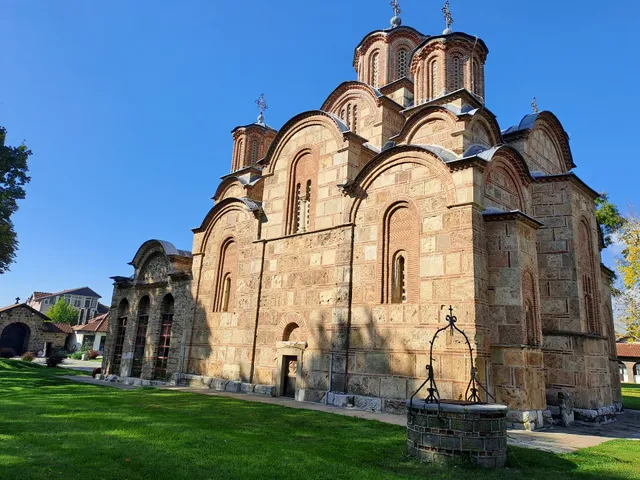
The monastery's exterior is a sight to behold, with its intricate frescoes and remarkable Byzantine style. The craftsmanship and attention to detail are simply breathtaking. As I stepped inside, a profound sense of peace washed over me. The interior is adorned with remarkable paintings and ornate decor, transporting visitors to another era.
The tranquility that permeates every corner of Monastery Gracanica is indescribable. The beautifully maintained gardens provide a peaceful sanctuary where visitors can reflect and find solace amidst nature's beauty. Whether you're seeking spiritual enlightenment or simply a break from the bustling world, this place offers an oasis of serenity.
During my visit, the monastery staff were welcoming and knowledgeable, offering insights into the rich history and cultural significance of the site. Their passion and dedication were evident, adding an extra layer of appreciation to the experience. I was also fortunate enough to witness a divine chant by the resident monks, an ethereal experience that I will cherish forever.
Monastery Gracanica is not just a religious site but also an important cultural heritage that should be preserved and celebrated. It serves as a living testament to the region's history and its enduring faith. Whether you're a history enthusiast, an art lover, or simply seeking a moment of tranquility, a visit to this monastery is an absolute must.
I am truly grateful to have had the opportunity to visit Monastery Gracanica. It is a place that touched my soul and left an indelible mark on my heart. If you find yourself in Kosovo, make sure to prioritize a visit to this remarkable destination. I guarantee that you won't be disappointed.
End your review by signing off with your name or a pseudonym to give it a personal touch.
I hope this helps you craft a wonderful review for...
Read more