Le site 3
Légendes locales
La présence de ces énigmatiques jarres a engendré dans la population locale et au cours des siècles, de nombreuses légendes. Les plus répandues font état d'un peuple de géants qui auraient habité la région en des temps immémoriaux. D'autres parlent d'un ancien roi, Khun Cheung, qui, à l'issue d'une longue et terrible bataille, ordonna la confection des jarres pour faire fermenter et contenir un énorme volume d'alcool de riz, destiné à fêter sa victoire. Les Laotiens sont friands d'alcool de riz. Actuellement, des démarches sont en cours pour classer la Plaine des Jarres dans la liste du Patrimoine mondial de l'UNESCO, et des campagnes de déminage sont menées par des organisations internationales.
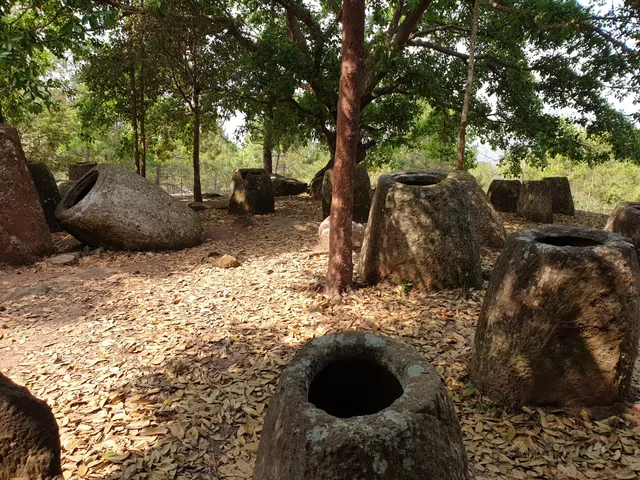
Jarres du site 3. La communauté scientifique ne peut encore donner que des explications conjoncturelles quant à la datation de ces jarres de pierre, sur une période allant de 500 avant J.-C. à 800 après J.-C. ; et plusieurs théories coexistent au sujet de leur destination : urnes funéraires, stockage de nourriture ou d'eau, cuves à fermentation pour la production d'alcool... Le mystère entoure encore cette civilisation encore inconnue, et le peuple qui réalisa et utilisa ces jarres.
Particularités :
Situé à 10km du site 2 et 35km de la ville.
C’est sa situation qui le rend plus impressionnant que les autres : il est situé au sommet d’une belle colline uniquement accessible par une promenade d’une 1/2h au milieu des rizières et à flanc de coteau.
Il abrite +/- 150 jarres.
The site 3
Local legends
The presence of these enigmatic jars spawned in the local population and over the centuries, many legends. The most common reported a people of giants who have inhabited the area in ancient times. Others speak of a former king, Khun Cheung, who, after a long and terrible battle, ordered the making of jars to ferment and contain a huge volume of rice wine, intended to celebrate his victory. Laotians are fond of rice wine. Currently, steps are underway to classify the Plain of Jars in the World Heritage List of UNESCO, and demining campaigns are conducted by international organizations.
Jars Site 3. The scientific community can not yet give than cyclical explanations regarding the dating of these stone jars, over a period from 500 BC to 800 AD; and several theories coexist regarding their destination: funeral urns, storing food or water, fermentation vats for the production of alcohol ... The mystery still surrounds this civilization still unknown, and the people who made and used these jars.
Special features:
Located 10km of the site 2 and 35km from the city.
This is the location that makes it more impressive than the others: it is situated atop a beautiful hill accessible only by a promenade with a 1/2 hours in the middle of rice fields and hillsides.
It has...
Read more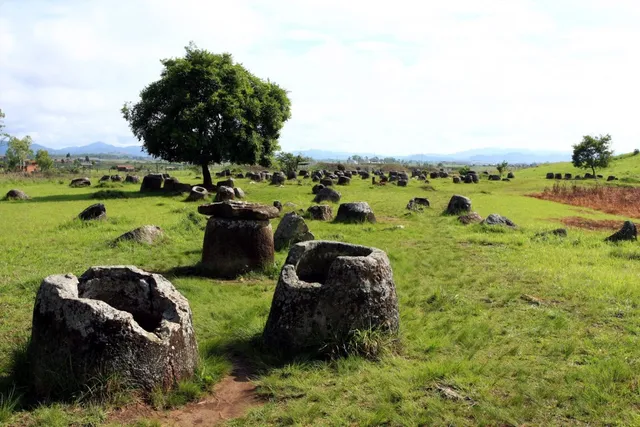
 Learn more insights from Wanderboat AI.