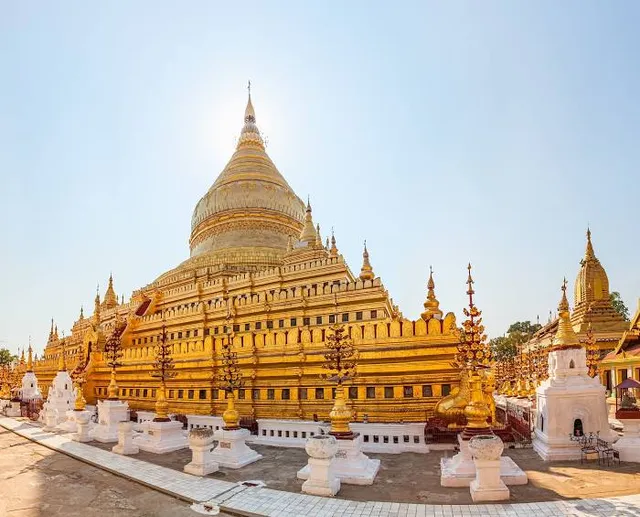
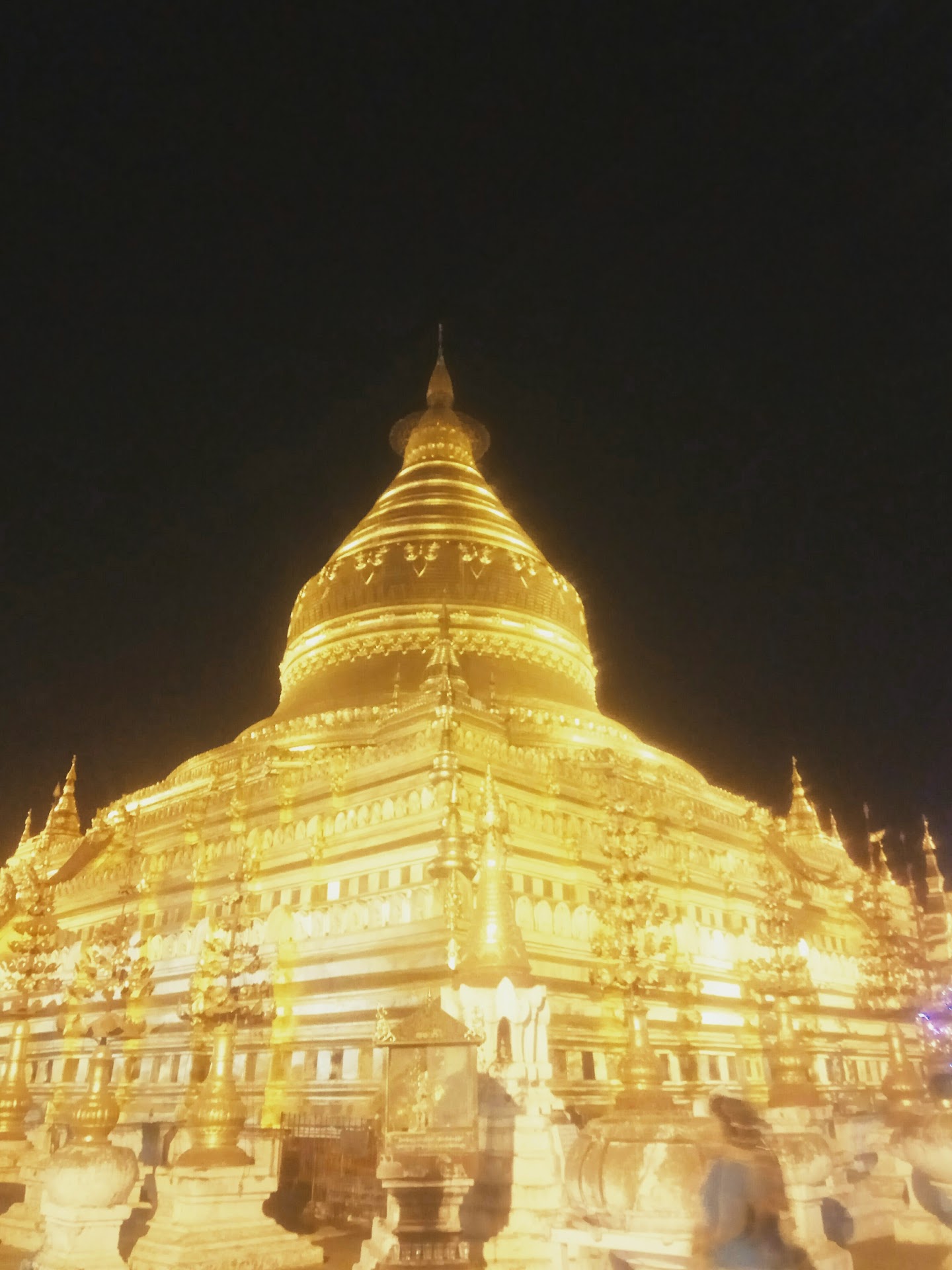
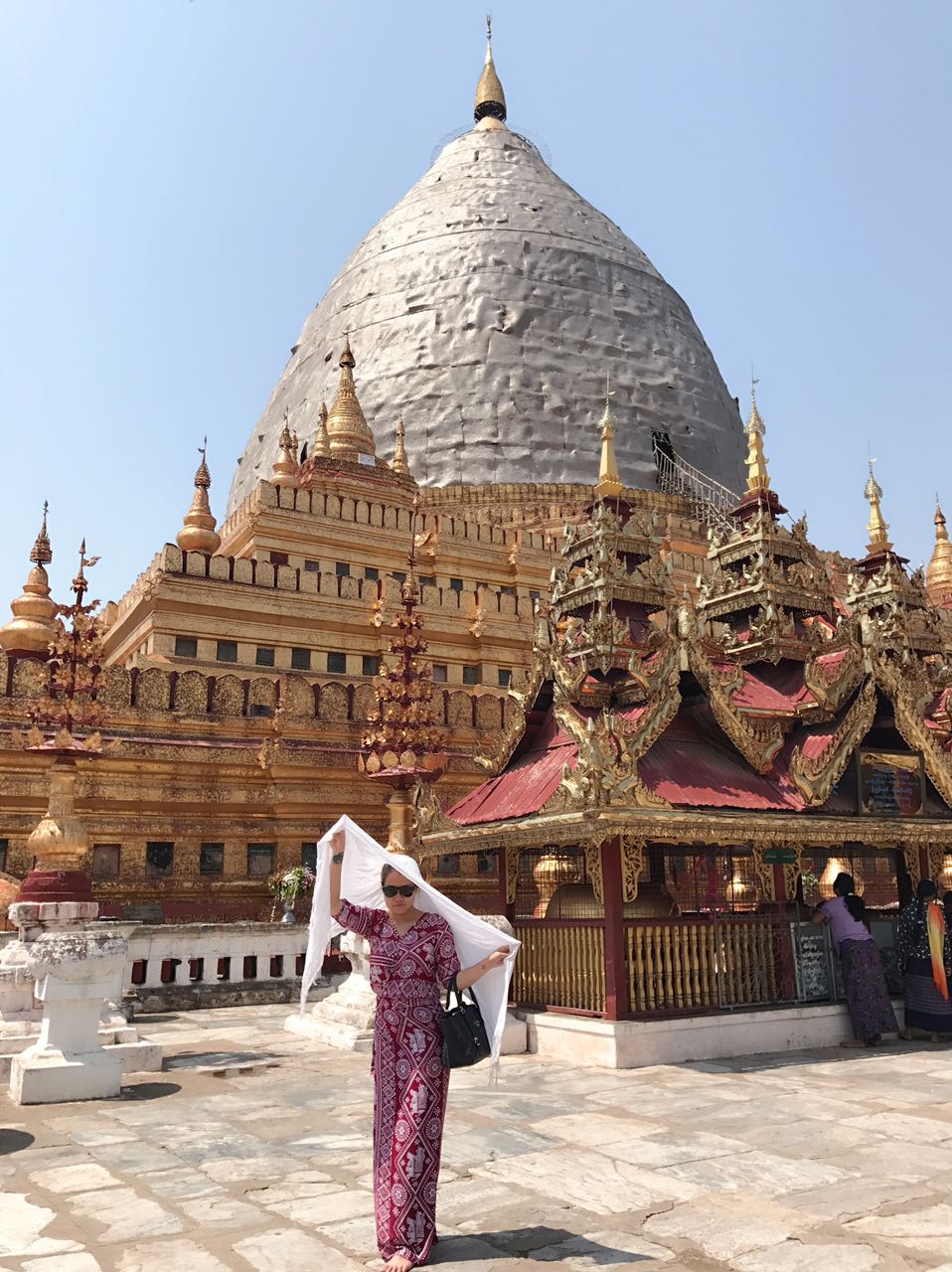
The Shwezigon Pagoda or Shwezigon Paya (ရွှေစည်းခုံဘုရား [ɕwèzíɡòʊɰ̃ pʰəjá]) is a Buddhist stupa located in Nyaung-U, Myanmar. A prototype of Burmese stupas, it consists of a circular gold leaf-gilded stupa surrounded by smaller temples and shrines. Construction of the Shwezigon Pagoda began during the reign of King Anawrahta (r. 1044–1077), the founder of the Pagan Empire, in 1059–1060 and was completed in 1102, during the reign of his son King Kyansittha. Over the centuries the pagoda had been damaged by many earthquakes and other natural calamities, and has been refurbished several times. In recent renovations it has been covered by more than 30,000 copper plates. However, the lowest level terraces have remained as they were.
This pagoda, a sacred Buddhist religious place, is believed to enshrine a bone and tooth of Gautama Buddha. The pagoda is in the form of a cone formed by five square terraces with a central solid core. There are footprints below the four standing Buddha statues here. Jataka legends are depicted on glazed terra-cotta tiles set into three rectangular terraces. At the entrance of the pagoda there are large statues of guardians of the temple. There are also four bronze standing statues of Buddha which are stated to be of the current age Buddha. At the outer limits of the pagoda there are 37 nats deified along with an intricately carved wooden sculpture of Thagyamin, Burmese version of Indian god Indra. Within the compound of the Shwezigon Pagoda there is a stone pillar containing Mon language inscriptions dedicated by Kyansittha.
According to legend, Anawrahta selected the site for building this pagoda by sending a white elephant mounted with a frontal bone relic of the Buddha to roam freely with the declaration that wherever the elephant stopped would be the site for building the pagoda. The elephant finally stopped over a dune which was chosen as the site for erecting the pagoda, and hence the name Shwezigon pagoda meaning "golden pagoda on a dune" in Burmese. Pagoda means "stupa" or "zedi.
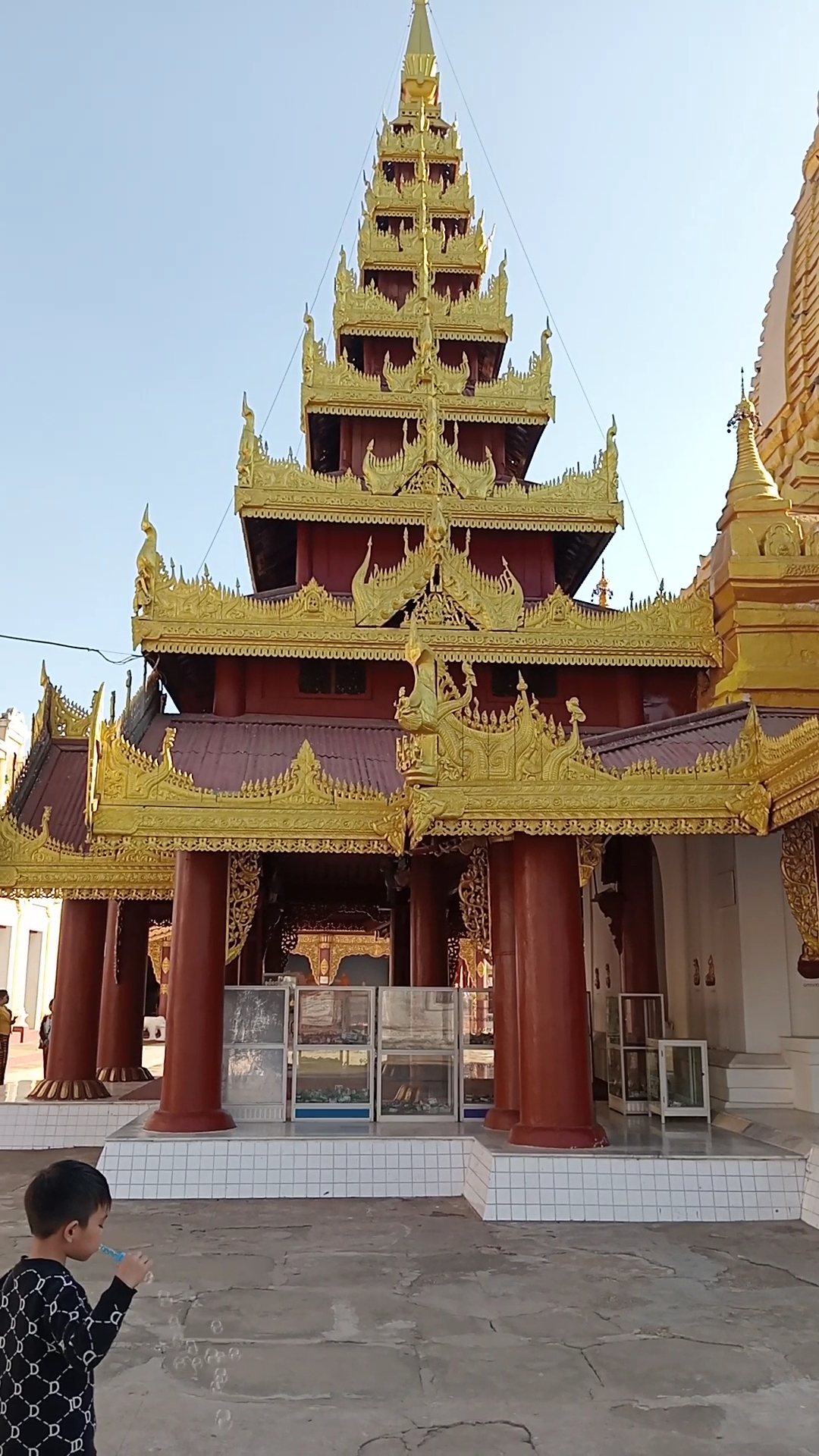
At the entrance to the pagoda there are huge statues of guardians of the temple, known as chinthes which are leogryphs (lion shaped gryphs). Out of the four entrances to the pagoda only the southern and western ones are in use. There are 550 glazed terra-cotta tiles inscribed with the Jataka tales fixed on three of the five terraces of the pagoda; the earlier count was 584 tiles of which some are not found now. The four flights of steps which provide access to the terraces leading to an octagonal platform over which the gilded stupa has been built. At the four corners of the top most terrace, smaller replicas of the main pagoda are affixed at their back side, fitted with four gilded kalashas or vases; similar replicas are also fixed at the corners in the lower terraces. At the base of the pagoda there are containers fitted closely and set in series, which have gilded bronze castings of plants and flowers, with alms bowls carved in stone in between. Around the exterior periphery of the pagoda there are several temples and wooden pavilions decorated with the pyatthat (multi-tiered and...
Read moreIt's located four miles northeast of Old Bagan at the edge of the most important regional town of Nyaung-U. Shwezigon Pagoda is a solid, cylindrical structure resting on three square terraces and a prototype of later stupas all over Myanmar.
It has a bold, waistband around the bell-shaped dome, and a series of concentric mouldings, with finial rises near the top and crowned with an umbrella. It is one of the 55 encased pagodas in Bagan. According to tradition, the inner one was built by King Anawrahta and covered with the stone bricks hewn out of the Tuyin Taung quarries by King Kyanzittha. There are several plaques adorning its terraces.
All four sides of the pagoda have a central stairway, which are guarded by Makaras (sea creatures from Hindu mythology), leading to the top of the terraces. The three terraces contain beautiful glazed terra-cotta plaques depicting the 550 Jataka tales, the stories about the previous lives of Buddha.
On each of the four sides of the pagoda is a small temple which enshrines a standing Buddha. On either side of the east approach to the pagoda is a square stone pillar with Mon inscriptions on all four sides.
Glimmering in the sun, the huge gold-plated Shwezigon pagoda is one of the oldest and most impressive monuments of Bagan.
According to tradition, it was commenced and completed by the two most famous Kings in Bagan history, Anawrahta, the founder of the Bagan Kingdom, and King Kyanzittha. Construction started around 1059 and completed at the end of the 11th century.
According to a legend, the spot where the pagoda was to be built was chosen by a white elephant carrying the relic on his back. It is believed to enshrine the sacred frontal bone and a tooth relic of Buddha. Thus, the pagoda is held in great veneration by the Buddhists of the...
Read moreThe Shwezigon Pagoda or Shwezigon Paya(ရွှေစည်းခုံဘုရား) is a Buddhist temple located in Nyaung-U, a town near Bagan, in Myanmar. A prototype of Burmese stupas, it consists of a circular gold leaf-gilded stupa surrounded by smaller temples and shrines. Construction of the Shwezigon Pagoda began during the reign of King Anawrahta (r. 1044–77), who was the founder of the Pagan Dynasty, in 1059–1060 and was completed in 1102 AD, during the reign of his son King Kyansittha. Over the centuries the pagoda had been damaged by many earthquakes and other natural calamities, and has been refurbished several times. In recent renovations it has been covered by more than 30,000 copper plates. However, the lowest level terraces have remained as they were. This pagoda, a Buddhist religious place, is believed to enshrine a bone and tooth of Gautama Buddha. The pagoda is in the form of a cone formed by five square terraces with a central solid core. There are footprints below the four standing Buddha statues here. Jataka legends are depicted on glazed terra-cotta tiles set into three rectangular terraces. At the entrance of the pagoda there are large statues of guardians of the temple. There are also four bronze standing statues of Buddha which are stated to be of the current age Buddha. At the outer limits of the pagoda there are 37 nats deified along with an intricately carved wooden sculpture of Thagyamin a Burmese version of Hindu god Indra. Within the compound of the Shwezigon Pagoda there is a stone pillar containing Mon language inscriptions dedicated...
Read more