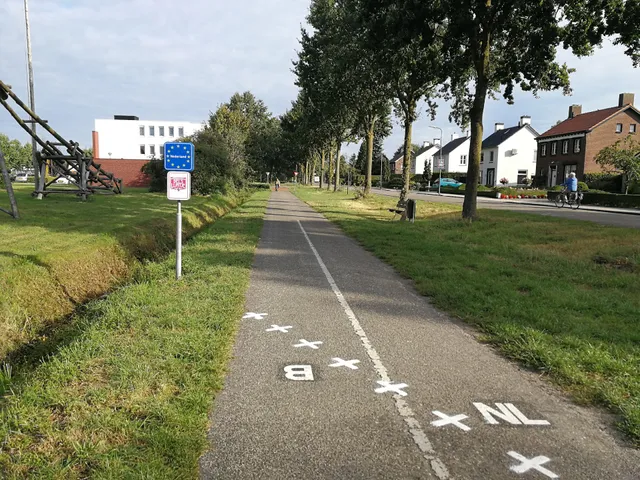
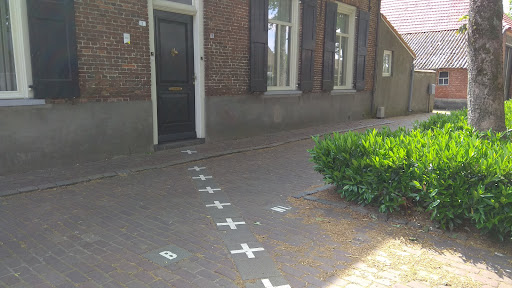
It looks like a typical European town. But here almost everything is two: Two police stations, two large churches, two post offices, two town halls, two mayors. And inside some people's homes, there are even two countries: the kitchen of a house can be in Belgium and the living room in the Netherlands. Baarle: a city divided between two countries in a confusing puzzle. One part of it belongs to the Netherlands, Baarle-Nassau, and another part to Belgium, Baarle-Hertog. The community of 7,000 people is located on the border of both countries. 22 pieces of Belgium are in the Netherlands. And seven Dutch pieces of land in Belgian enclaves. Worldwide, there are 64 enclaves. So almost half of the enclaves of a state in another state in the world are here. The world "capital" of geographical enclaves. In 1198, two dukes agreed to divide the land into pieces, creating this puzzle. But itâs not that hard to figure out where you are if you keep your eyes on the ground. There are stakes in the road and crosses on the sidewalks. In World War I, Belgium was occupied by Germany, while the Netherlands remained neutral. Surrounded â and therefore protected â by Dutch territory, Baarle-Hertog became a site of resistance activity, with the creation of a transmitting and receiving station to monitor German communications and relay them to Belgian forces in France. This took six months to build, with the people of Baarle-Nassau turning a blind eye whenever building supplies were brought in. Here, messages of rebellion from Germany and requests for ceasefire negotiations arrived, thus hastening the end of the war. Residents use the front door rule to know which country they live in. Every house belongs to the country where its front door is. But there are exceptions. And if someone wants to change their country of residence, they just have to move their front door a few meters away. During the coronavirus pandemic, problems arose because the Belgian measures were different from the Dutch ones. Some shops were allowed to remain open during the pandemic, for example, in Belgian establishments, while the corresponding Dutch ones had to close. And so there was polarization and friction between the two communities. Some products are cheaper in the Netherlands and others in Belgium. You pick and choose. But otherwise, regardless of which side of the border they are on, people here live...
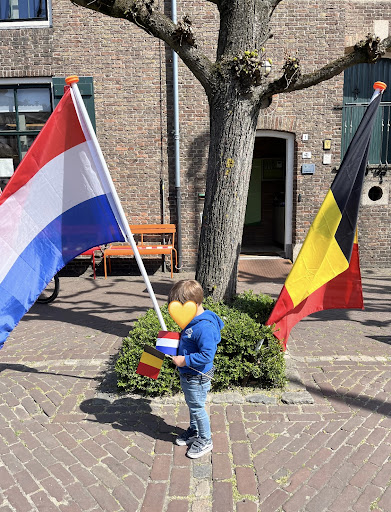
   Read moreOne of the most interesting towns in the world! Where else can you cross the border several times just by walking around? And where else do you get confused, where you are right now? Belgium or Netherlands? Fascinating as well the divided buildings or the fact, that you just can belong to another nation just by swapping your front door. But what nowadays is just funny hasn't been always as easy -- that's documented very well in the little exhibition at the tourist information, which is free to visit. The ladies at the information desk are very, very friendly! We've been twice a week there during our holidays because my little 3-year-old-daughter loved the "Belgium-Netherland-Game" (hopping over the border) and it's been very important to her to visit a second time the tourist information to get two more flags (for free). What would be nice, would be a book (in English) about the history...
   Read moreA tourist office like no other. Representing two villages in two countries that are in fact one siamese twin of a village, but with a chessboard layout where one side of the road is Dutch and the other Belgian; 50m further and they have swapped.
As well as a nicely presented history, there are walking and cycling routes to follow to get the feel of the village(s), including the house with the border through its front door, resulting in both a Belgian and a Dutch house number.
Even the lampposts have stickers to let you know which country you are in.
The tourist office is beautifully represented by the lady answering...
   Read more