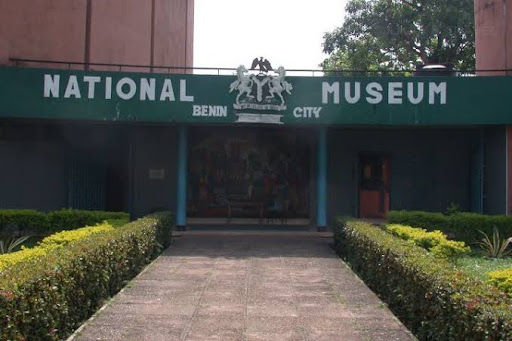
The Benin National Museum is located at King’s Square in the center of the Ring Road, making it quite a traffic hazard to try to walk to the museum entrance.The National Museum Benin City was opened in 1973. Currently, they are working to upgrade the building and redo the exhibits. As part of this effort NMAfA is planning to send Alonge exhibit components to the museum.NATIONAL Museum of Benin City started from the Oba of Benin Palace in 1940’s but the edifice we see today was officially opened to the public on August 10, 1973. The Museum contains priceless objects – of antiquities from Benin Kingdom and other parts of the country. The first known Benin Museum started in the Oba’s Palace. Benin Traditional art was becoming famous and to preserve it, the Oba decided to assemble the artifacts under the custodian of Chief Jacob Eghareba within the palace in the Royal House- of Iwebo.As time went on, people developed more interest in these treasures. There was pressure mounted for these objects to be made public. This collection was relocated to one room in the old tax office Ring Road in Benin. This was later moved to the Benin Divisional Council because of space and through the efforts of one Mr. K.C Murray-a surveyor of antiquities and art teacherIn. 1960, the Federal Department now National Commission for Museums and Monuments took over the custodian of the artifacts. The National Commission for museums and monuments was established under Decree 77 of 1979. Since then, Museum has been growing. The edifices that house the artifacts today, was built during Samuel Ogbemudia regime as the two derma Military Government of Bendel State. This house with the exhibits therein was officially open to the general public in August 1973 with the ground and first floor galleries. While the second or unit gallery - was opened to the public in August 1996 through the efforts of Dr. O.J Eboreime as the Curator then. Truly ancient, historical, beautiful, easily accessible & a must for all visitors, especially first time visitors. The park tells the ancient story of the ancient city of Benin. The Chief Custodian of the Culture and Tradition of the Binis.. HRM Ómó N'Óba N'Èdo Uku Akpólókpóló Óba Éwuare II , The God-King 👑 #benincity . Seeing some cultural artifacts and historical pieces a a must here! . The views around the museum interior are lovely. Seeing art and craft,hundreds and even a thousand years old was a humbling experience. do not leave benin without visiting. the place could use some face-lift but all in all,worth it. is a museum maintained by a state. In many countries it denotes a museum run by the central government, and often is restricted to a few museums, mostly in the capital, while other museums are run by regional or local government, or foundations. In other countries a much larger number of museums are run by the central government, some quite small. Some national museums use the term in their name, but others do not; some museums just adopt the term as a matter of branding.So come one come all ,to the great Benin kingdom to...
Read moreOver 3,000 collections of photographs and images found in the royal court of the Benin king’s Palace were on exhibition yesterday, at the National Museum in Benin, Edo State.
The exhibited photographs were taken by Chief Solomon Alonge, photographer to the royal court of Benin over 50 years ago.
The exhibition was organised by the United States Diplomatic Mission and the Smithsonian National Museum of African Art based in the United States.
It followed a Memorandum of Understanding signed between the National Commission for Museum and Monuments and Smithsonian’s National Museum of African Arts of the United States which has the collections.
A Speaking shortly before the commencement of the exhibition, United States of America Consul-General to Nigeria, F. John Bray, said Art, including photographs, represent freedom of expression in his country’s democracy, adding that the Smithsonian’s National Museum and National Museum of Benin have been working for many years to carry out the exhibition.
Commending the two National Museums and the Edo State Government for their support, Bray said the exhibition was significant because it was the first time in the history, the Smithsonian’s National Museum of African Art, Washington DC was holding an exhibition in Africa.
He said: “I think we are delighted because this first exhibition in Africa is not only in Nigeria, it’s here in Benin City. So, this exhibition of Benin National Museum will go a long way in preserving the essential history of Benin people and exhibition of its leaders. The cultural heritage was a reminder of the contribution and experiences of the people.
“The US Government seeks to show its respect for culture by assisting efforts to preserve cultural heritage around the world, including Nigeria.
In his speech, Director-General of National Commission for museums and Monuments, Dr. Yusuf Usman, said the Commission had series of collaboration with museums around the world, stressing that “what makes this exhibition significant is that it comes with materials that have been taken out of Nigeria.
“The Alonge archival materials left the country many years back and now we have a replica. We have replica and we are going to use this to tell the story of not just the Royal Court of Benin but also Benin City in the 19th century, to help us to understand where we are as a people, where we have been as a people,” said Usman.
Responding to a question on Benin stolen art works in foreign countries, a Director of the Smithsonian’s National Museum, Johnnetta Cole said it was incredibly important in their museum to honour where each and every object has come from.
Cole added: “We have two figures and went to the government of Mali saying we were prepared to send them back. They told us they know where they are and proud that it is in the National Museum of African Art. If every work of African Art is returned to Africa, how will the rest of the world know of your arts, know of your culture, know of...
Read moreIt's a lovely place, gives a glimpse into the past especially in helping one create better mental pictures of what historical texts have tried to communicate.(it's good to know the texts we've been fed with are true😅)

I would however suggest that tour guides should be available. I remember getting a ticket and being told to go ahead and i thought to myself, 'shouldn't there be a tour guide?" It was at the tip of my tongue to ask, but i let it slide seeing that i had an indigene with me who proved helpful. But even at that, having a more enlightened tour guide would have made the whole experience more educative and enjoyable. (While there is a possibility that there indeed may be a tour guide available, I don't think people have to ask before they're provided with one...🤷. I wouldn't mind going back there if that...
Read more