Heraclea Lyncestis
Heraclea Lyncestis is a ancient Macedonian town found by the ancient Macedonian King Phillip 2nd in the middle of the 4th century BC, but most of the remains that can be seen in Heraclea Lyncestis are from the Roman and the early christian period.
Heraclea Lyncestis was an important strategical town during the Hellenistic period as it was at the edge of Macedonia border with Epirus to the west, until the middle of the 2nd century BC, when the Romans conquered Macedon and destroyed its political power. The Romans divided Macedonia into 4 regions and Heraclea was in the fourth region. The main Roman road in the area, Via Egnatia went through Heraclea, and Heraclea was an important stop. The prosperity of the city was maintained mainly due to this road. Objects discovered from the time of Roman rule in Heraclea are: Votive monuments, a portico, thermae (baths), a theatre and town walls. In the early Christian period, Heraclea was an important Episcopal seat. Some of its bishops are mentioned in synods in Serdica and other nearby towns. From this period are the ensembles of the Small and Great (Large, Big) basilica. The Grave (Funeral) basilica with a necropolis is located east of the theatre.
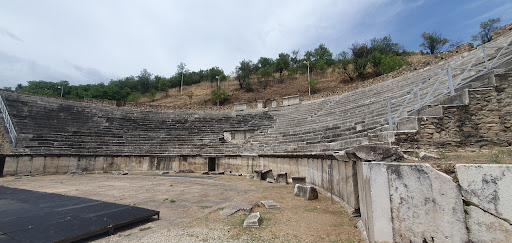
The Roman emperor Hadrian built the theater in the center of the town, on a hill, when many buildings in the roman province of Macedonia were being restored. It began being used during the reign of Antoninus Pius. Discovered in 1931, a small bone ticket for a seat in the 14th (out of 20) row is the earliest known proof of the theater’s existence. The theatre itself wasn’t discovered until 1968. Inside the theater there were three animal cages and in the western part a tunnel. The theater went out of use during the late 4th century AD, when gladiator fights in the Roman Empire were banned, due to the spread of Christianity, the formulation of the Eastern Roman Empire, and the abandonment of, what was then perceived as, pagan rituals and entertainment.
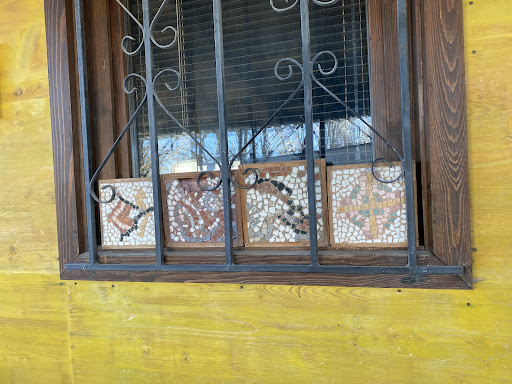
In the early Byzantine period (4th to 6th centuries AD) Heraclea was an important episcopal centre. Some of its bishops have been noted in the acts of the Church Councils as bishop Evagrius of Heraclea in the Acts of the Sardica Council from 343 AD. A Small and a Great (Large) basilica, the bishop's residence, a Funeral (grave) basilica near the necropolis are some of the remains of this period. Three naves in the Great Basilica are covered with mosaics of very rich floral and figurative iconography. There are birds, trees, bushes, a red dog, which is a symbol of paradise, and animals beasts as a domain of the earth. These well preserved mosaics are often regarded as fine examples of the early Christian art period. Other bishops from Heraclea are known between 4th and 6th century AD as bishop Quintilinus mentioned in the Acts of the Second Council of Ephesus, from 449 AD. The city was sacked by Ostrogoth/Visigoth forces, commanded by Theodoric the Great in 472 AD and, despite a large gift to him from the city's bishop, it was sacked again in 479 AD. It was restored in the late 5th and early 6th century.
The Episcopacy Residence was excavated between 1970-1975. The western part was discovered first and the southern side is near the town wall. The luxury rooms are located in the eastern part. The 2nd, 3rd and 4th room all have mosaic floors
In the late 6th century Heraclea Lyncestis suffered successive attacks by Slavic tribes. In place of the deserted theater several houses were built between the 6th century and the 7th century AD, when Slavs settled across the northern regions of the Balkans.
Just small portion of Heraclea Lyncestis has been unearthed, including a theatre, two water fountains, courthouse, baths, bishops palace and two basilicas. There is a small museum on the grounds with few artifacts and a nice scale model of the city...
Read more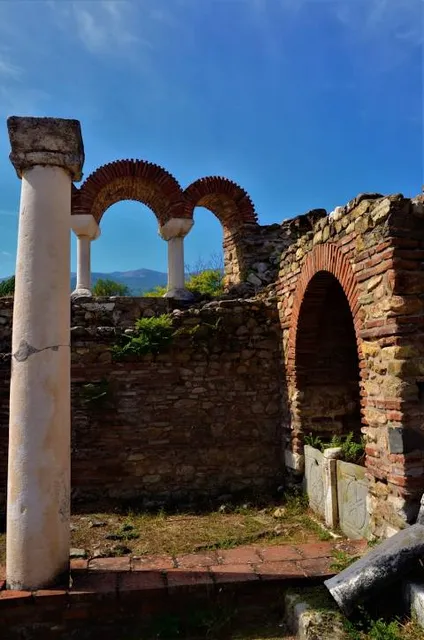
 Learn more insights from Wanderboat AI.