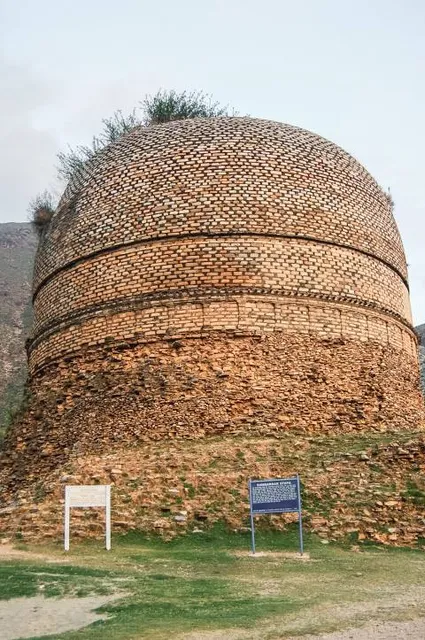
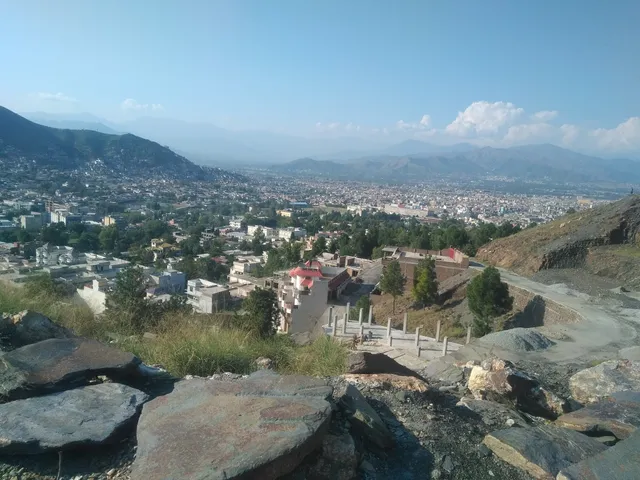
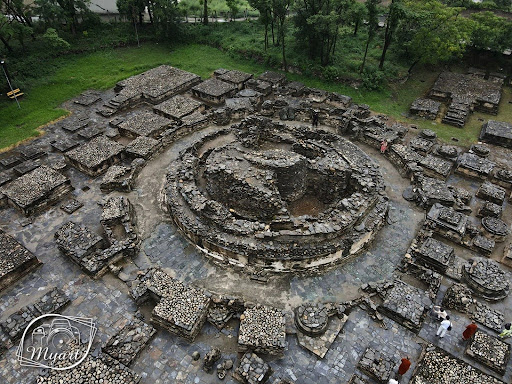
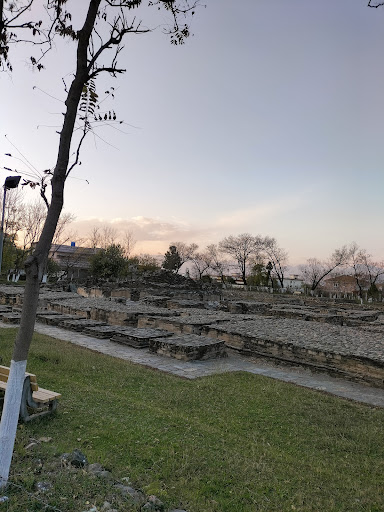
The Buddhist sacred precinct of Butkara ( identified as the monetary of Ta-Lo, mentioned by Sung Yun (520 AD) visited and described by the Chinese Buddhist pilgrims of the 5th, 6th and 7th centuries AC lies at the eastern end of the ancient capital of Udyana Meng-Chich-Li, present Mingora. The main Stupa stand in the middle, around it are crowded monuments Stupas, Viharas and columns, on the Northern side stands a great building and further to the north and west the inhabited area. The Great Stupa under event five reconstruction, each new one incasing the oldery from 3rd century B.C down to 10th century A.D. Butkara is now known as Gulkada. Its just 1 km away from Swat museum.
The stupa was excavated by an Italian mission (IsIOAO: Istituto Italiano per l'Africa e l'Oriente), led by archaeologist Domenico Faccenna from 1956, to clarify the various steps of the construction and enlargements. The mission established that the stupa was "monumentalized" by the addition of Hellenistic architectural decorations during the 2nd century BCE, suggesting a direct involvement of the Indo-Greeks, rulers of northwestern India during that period, in the development of Greco-Buddhist...
Read moreHistorical Place
Archaeologists in the northern area of Swat in Pakistan have discovered a Buddhist monastic and educational complex believed to be between 1,900 and 2,000 years old. The largest known complex in the area, its age puts it in the era of the Kushan empire, which controlled the area as well as much of modern-day Afghanistan, Pakistan, and northern India from 30–375 CE.
There are some 150 Buddhist heritage sites in Pakistan’s Malakand Division of Khyber Pakhtunkhwa Province, which encompasses much of the north and northwest of the country, including the Swat valley, a major center for early Buddhist development. Many in Pakistan hope to protect and develop the sites as part of their cultural heritage and as tourist destinations. Last May, a newly discovered Buddha statue in the nearby Takht Bahi area was destroyed by local villagers at the direction of religious conservatives.* Since then, Pakistan’s government has restored and renovated the statue and is taking careful steps with further developments of Buddhist...
Read moreThe Butkara Stupa is an important Buddhist stupa near Mingora, in the area of Swat, Pakistan. It may have been built by the Mauryan emperor Ashoka, but it is generally dated slightly later to the 2nd century BCE. The in-situ seated Buddha (or Bodhisattva) statue at Butkara is considered one of the earliest, if not the earliest, known iconographical statues of the Buddha in northwestern India. Van Lohuizen-de Leeuw considers that the statue dates to the late 1st century BCE to the early 1st century, as it was discovered in the GSt 3 stratum that contained a coins of Azes II. More conservative estimates date it to the 1st-2nd century CE, roughly at the same time the first known statues of the Buddha were made in the art of Mathura. Probably the earliest known statue of the Buddha in the art of Mathura is the "Isapur Buddha", dated to circa 15 CE. This would make the creation of the Buddha image an approximately simultaneous phenomenon between the two...
Read more