A Guide For A One Day Trip To Mazar-E-Quaid
The City of Lights is known for its ornate and elaborate historical sites, but nothing as significant as Mazar-e-Quaid, nearly 1.5 kilometres from Shahrah-e-Quaideen. Besides being another important landmark in the city, it is a marvelous archeological site in the region. In short, Jinnah Mausoleum is to Karachi what Royal Mausoleum is to Frogmore. Anyone who has seen the tomb can appreciate its beauty and its simplicity, but not everyone knows about its history, its features, or facts about this magnificent site. This blog can serve as your personal guide to Mazar-e-Quaid. Bonus point: we’ll also share some information about Quaid-e-Azam.
History of the National Mausoleum Mazar-e-Quaid also goes by the titles of Jinnah Mausoleum, Mazar-e-Quaid, and the National Mausoleum. These terms are used interchangeably for the same place – the final resting place of the Founder of Pakistan. Quaid-e-Azam Muhammad Ali Jinnah died very shortly after the independence of Pakistan in 1948. A year after his death, the government built the Quaid-e-Azam Memorial Fund (QMF). The department was deemed responsible to establish a memorial in his honor. Soon after the inauguration of the department, the plans to rebuild a memorial, which reflected the founder’s personality were made. Following the plans, an international contest was held in 1957 and many renowned architects submitted their design. All those designs were vetoed by Fatima Jinnah – the sister of Muhammad Ali Jinnah. She selected Yahya Merchant – a Bombay based architect – to design the final resting place of the Quaid or today what we see as Mazar-e-Quaid. The Government of Pakistan decided that the tomb will be built on the highest place in Karachi. The mausoleum was officially inaugurated between 1970-1971.
Significance of the Tomb The thing about visiting Mazar-e-Quaid is that the place holds great significance in the hearts of Pakistanis. Most of us have our sentiments attached to the place. Since Karachi [as a city] is often reflected by the photos of Quaid-e-Azam’s Tomb in the media [press, mass, or social], we can claim that it is a regional symbol. In fact, the place is bustling with architectural wonders that it makes everyone marvel: how pure and simple it looks. Most of us take pride in visiting the final resting place of one of the greatest personalities in the world since Muhammad Ali Jinnah was the driving force behind the great independence movement. Furthermore, visiting the tomb brings a renewed sense of patriotism. Standing near the grave of a man who was a celebrated scholar and renowned lawyer makes you believe that nothing is impossible if you’re passionate about a cause.
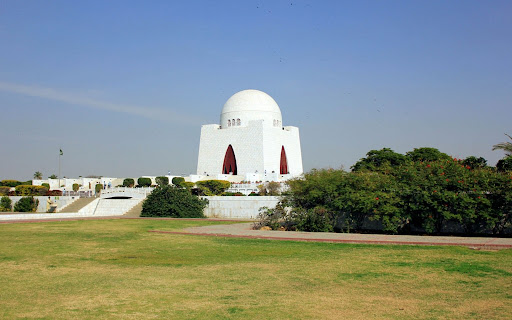
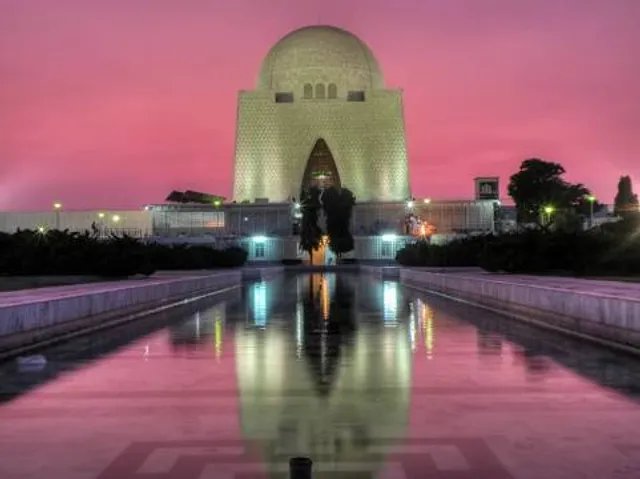
Architecture of the Mazar-e-Quaid Who better to design an individual’s resting place than his friend Yahya Merchant – along with being an excellent architect, he was also a close friend of the Quaid. Merchant’s design consisted of a cuboid structure with a dome on its top and covered in white marble. The cuboid structure reflects the disciplined part of Jinnah’s personality while the white colour symbolises purity and simplicity. The design is deemed as a “traditional monument of a modernist period”. The inside of Quaid-e-Azam mazar consists of five white marbled sarcophagus. The casket is placed in the middle.
Jinnah Mausoleum Location The Tomb of Quaid-e-Azam is located near Numaish Chowrangi on M.A Jinnah Road. It is in close proximity with the Cosmopolitan Society and The Dawood Foundation ghar (TDF). The area is called Jamshed Town and a number of significant neighbourhoods of Karachi such as Sindhi Muslim Society, Tipu Sultan Road, Saddar Town, Shaheed-e-Millat Road, Soldier Bazaar, and Britto Road are nearby.
How to Get to the Tomb of Quaid-e-Azam? Since the final resting place of Muhammad Ali Jinnah is situated in a well-populated neighborhood of Karachi, the roads are well-paved and dotted...
Read moreThe Tomb of Quaid-e-Azam is regrettably an underrated destination, and my recent visit brought to light the reasons behind this disheartening reality. Firstly, the entrance to the tomb is shockingly distant from the revered resting place of Quaid-e-Azam, because administration have allocated the main gates for actual Pakistanis (The VIPs, The Kings and Princess of Pakistan) this creating an initial sense of detachment and inconvenience. Adding to the disappointment is the stark absence of security mechanisms within the tomb premises, leaving visitors concerned and uneasy.
As I explored further, instances of inappropriate behavior by couples became painfully apparent. It's disconcerting that such behavior is not only tolerated but observed by visitors, creating an uncomfortable atmosphere. Additionally, the presence of unattended dogs freely roaming and barking on visitors, within the tomb premises is not only a safety concern but also poses a potential threat, particularly to children. Administration is not even capable of removing stray Dogs from the Great Leaders Mazar.
The experience is further marred by the presence of unruly visitors, including drug addicts and profane individuals, with no evident oversight to maintain order.
The tomb, unfortunately, often transforms into a crowded and chaotic environment, No Pakistani visits the Tomb to actually pay respect to the Quaid, rather they believe the tomb is a picnic spot and visitors do everything in their capacity to desecrate the actual place of grave. Incidents such as political slogeneering and dances by TikTokers, leading to the administration to cordon off the actual grave. This drastic measure is a testament to the inappropriate activities.
Due to these well-educated families don't visit the place and neither they encourage the well-educated, sophisticated and urbane families to go to Quaids Mazar to appreciate this historic site.
In essence, the Tomb of Quaid-e-Azam fails to attract sophisticated and educated individuals due to the lack of safety measures, the observed incidents, and an overall disappointing experience. Urgent and comprehensive action by the administration is imperative to rectify these issues and restore the significance, appeal, and safety of this historically...
Read moreMazar-e-Quaid in Karachi is a significant landmark that holds great historical and cultural importance for the people of Pakistan. Built in honor of the country's founder, Quaid-e-Azam Muhammad Ali Jinnah, this mausoleum is a symbol of national pride.
The renovation efforts undertaken during the time of General Pervez Musharraf have certainly improved the overall appearance of the site. The mausoleum now boasts well-maintained gardens and a cleaner environment. However, there is still room for improvement to fully utilize the potential of this iconic place.
One issue that needs addressing is the increasing number of visitors using the premises as a dating spot. This compromises the peaceful atmosphere and makes it less suitable for families to visit. Authorities should take steps to ensure that Mazar-e-Quaid remains a respectful and serene place for everyone.
To enhance the experience for visitors, it would be beneficial to have more shops offering souvenirs and cultural items. This would not only provide an opportunity for tourists to take home a piece of Pakistani culture but also support local artisans and businesses. Additionally, informative displays or guided tours could be implemented to educate visitors about the life and achievements of Quaid-e-Azam.
Despite these shortcomings, Mazar-e-Quaid still holds immense value as a historical and patriotic site. Families continue to visit to pay their respects and teach their children about the founding father of their nation. The grandeur of the mausoleum and the peacefulness of the surroundings create a sense of reverence and unity among visitors.
In conclusion, Mazar-e-Quaid remains an important landmark in Karachi that represents the pride and identity of Pakistan. While there are areas that require attention and improvement, it continues to attract visitors who seek to connect with their country's history and pay homage to its...
Read more