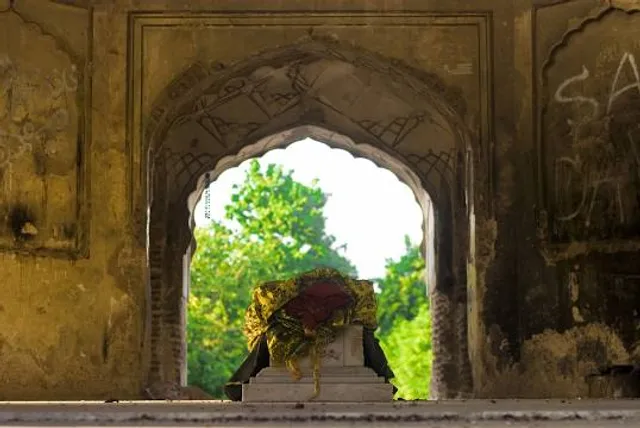
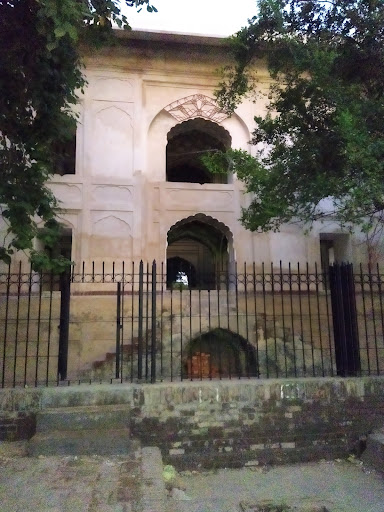
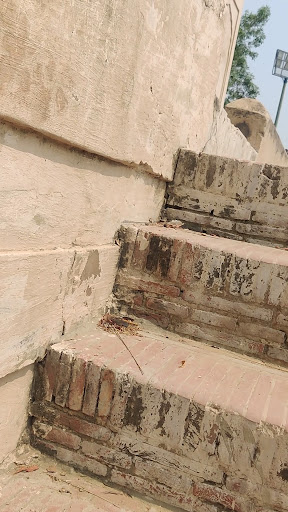
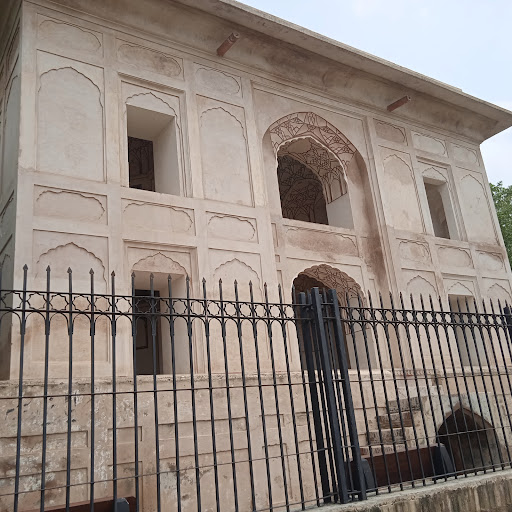
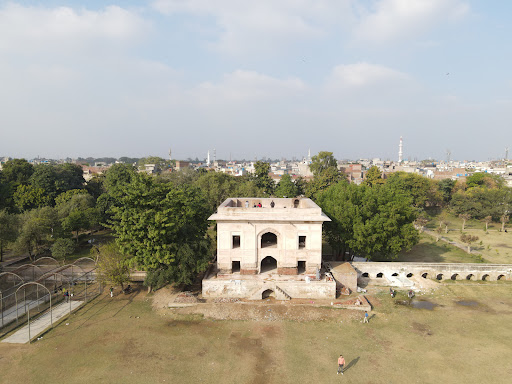
The Tomb of Nadira Begum is a Mughal era tomb in the city of Lahore, Pakistan, which houses the tomb of Mughal princess Nadira Banu Begum, wife of Prince Dara Shikoh.Nadira was the wife of Dara Shikoh, who served as the governor of Lahore in the 1640s. In 1659, Dara was fighting his brother Aurangzeb for the Mughal throne. After Dara's defeat in the Battle of Deorai, he and his wife tried to flee to Iran through the Bolan Pass, but Nadira died of dysentery and exhaustion. Though Dara's troops were depleted, he sent his remaining soldiers to carry his wife's body from the pass to Lahore, to be buried near the shrine of Mian Mir, whom both considered to be their "spiritual guide" The tomb is believed to have been robbed of all costly marbles and semi-precious stones during Ranjit Singh's rule, leaving it in a "dilapidated" state. The tomb is also a prey to "contemporary vandalism" which is evident from the gaudy graffiti on the mausoleum "with the ugly plague of wall chalking".Unlike other Mughal tombs, which are built in gardens, this tomb does not have a dome and was built in a sunken water tank.The tomb stands at the center of the tank on a raised platform .The tank was "200 by 200 Mughal gaz in size" Later, however the tank was converted into a Mughal garden. The corners of the tank were denoted by pavilions and the tomb could be accessed through "lofty gateways" on the north and south through a masonry bridge. The bridge stands on thirty arches. The central chamber is 14 feet wide and is surrounded by an ambulatory. The square tomb measures 44 feet on each side and is 32 ft 6 in tall. The first storey is 13 feet and surrounded by square headed apertures. The stairs for reaching the upper storey are located in the northeast and southeast corners. The grave is 6 ft 10 in long, 2 ft 10 in wide and 1 ft 8 in high. Quranic verses are inscribed in Nastaliq script on a marble slab on the northern face...
Read moreNadira Banu Begum (14 March 1618 – 6 June 1659) was a Mughal princess and the wife of Crown prince Dara Shikoh , [1] the eldest son and heir-apparent of the Mughal emperor Shah Jahan . [2] After Aurangzeb 's rise to power, Dara Shikoh's immediate family and all of his supporters were in grave danger. Nadira died in 1659, few months before her husband's execution, and was survived by two sons and a daughter. Nadira Begum died on 6 June 1659 of dysentery while she was accompanying her husband and family in Bolan Pass , Pakistan . She had been faithful and devoted to her husband during the hardships in his life and had shared in all his wanderings. Her death drew Dara into such a frantic state of grief that his own fate appeared a matter of indifference to him. [12] Nadira's last wish was to be buried in India , and without considering the consequences of her request, Dara sent his deceased wife's corpse to Lahore in charge of his soldiers to be buried there. [13] The princess' tomb was built next to Mian Mir 's tomb in Lahore, Pakistan, who had been the spiritual instructor of...
Read moreNadira Begum was the wife of Dara Shikoh, the crown prince , the eldest son of Emperor Shah Jahan. This poet-prince remained the Governor of Punjab during 1640s. Nadira Begum is buried in a square shaped tomb near the shrine of Hazrat Mian Mir r.a to whom the princely couple was spiritually attached. Constructed with massive brick masonry, the two-story structure of the tomb was originally built as a Baradari, surrounded by an enormous water tank.
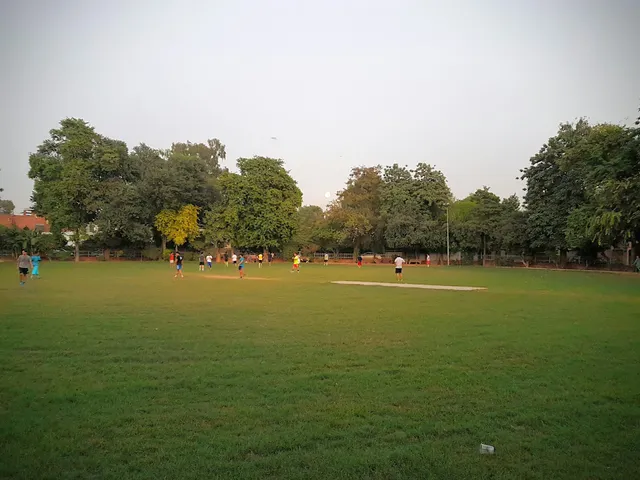
Unlike other Mughal tombs which have normally been constructed in the midst of gardens, Nadira Begum’s tomb is built amidst a water tank without a dome, which bears the flat parapet on all its four sides. These distinguished architectural features have made it look rather like a pavilion than a tomb. The tomb stands on a raised platform in the centre of a water tank, which was large enough to accommodate a lake. Encroachments have eaten away most of the tomb’s area during the course of history.
During the British period, the tank was dismantled by Muhammad Sultan and its bricks used in building the...
Read more