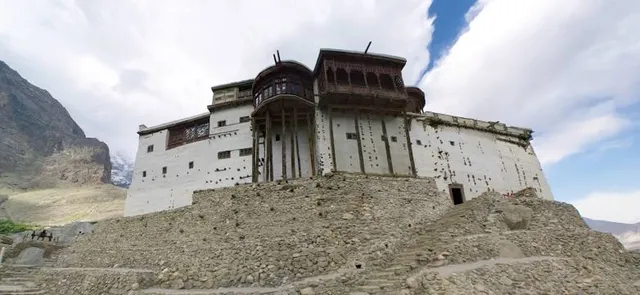
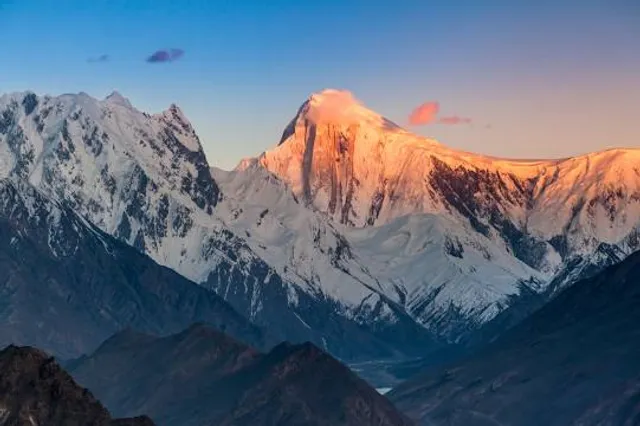
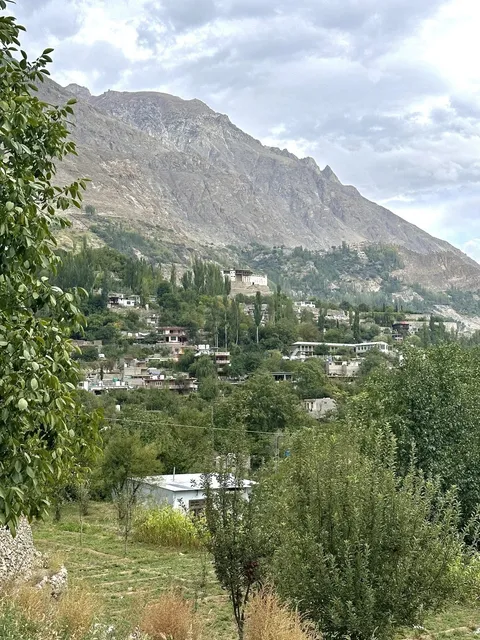
The Baltit Fort stands on moraines of Ultar glacier in the central Hunza valley, among the Karakorum range, in the Gilgit-Baltistan region of Pakistan. Entry fee of Rs 600/- per person is charged. The amount collected is utilised for repair and maintenance of the fort. The rich beauty of Baltit Fort can be traced back 700 years, to Ayasho II, Tham/Mir (ruler) of Hunza. The Hunza rulers initially resided in the Altit Fort, but later, as a result of a conflict between the two sons of the ruler (Sultan), Shah Abbas (Shάboos) and Ali Khan (Aliqhάn), Shaboos shifted to the Baltit Fort, making it the capital of Hunza. The power struggle between the two brothers eventually resulted in the death of younger one, and Baltit Fort established itself as the seat of power in the Hunza state This fort is the first ever to be restored (1990-96) by the Aga Khan Trust for Culture, as a pilot project of currently on-going conservation of a number of monuments of northern Pakistan. One of the biggest changes in the structure of Baltit Fort came with the invasion of British in December 1891, which resulted in Tham/Mir Safdarali Khan, ruler of Hunza, his wazir Dadu (Thara Baig III), fleeing to Kashgar (China) for political asylum with their companions and families.The fortified wall and watch towers of the old Baltit village and watch towers of the Fort on its north-western end were demolished on the directions of the British authorities. The British installed Tham/Mir Sir Muhammad Nazim Khan K.C.I.E, as the ruler of Hunza State in September 1892. The Fort remains open all year round and seven days a week, with the idea of being a self-sustaining cultural centre supported by the sale of entry tickets, souvenirs and generous donations of individuals and organizations interested for the promotion and preservation of cultural and historical heritage of this part of world. The Baltit Fort is a wood and stone structure with mud plaster. It is a three story building, with granaries and some stores in the basement on a glacier moraine hill with man-made narrow terraces for the stability of its ancient foundations. The the area is surrounded by mountains like Rakaposhi (7788m), Diran Peak (7257m), Golden Peak (7027m), Ultar (7388m), and Bubulimoting ('Lady...
Read moreThe rich beauty of Baltit Fort can be traced back 700 years, to Ayasho II, Tham/Mir (ruler) of Hunza, who married Princess Shah Khatoon (Sha Qhatun) from Baltistan in the early 15th Century. The Fort remains open all year round and seven days a week, with the idea of being a self-sustaining cultural centre supported by the sale of entry tickets, souvenirs and generous donations of individuals and organizations interested for the promotion and preservation of cultural and historical heritage of this part of world. In olden times a number of small independent states existed in the Northern Areas of Pakistan. Among them, Hunza and Nagar were the traditional rival states, situated on opposite sides of the Hunza (kanjut) river. The rulers of these two states, known as Tham, built various strongholds as expressions of their power.
The Hunza rulers initially resided in the Altit Fort, but later, as a result of a conflict between the two sons of the ruler (Sultan), Shah Abbas (Shάboos) and Ali Khan (Aliqhάn), Shaboos shifted to the Baltit Fort, making it the capital of Hunza. The power struggle between the two brothers eventually resulted in the death of younger one, and Baltit Fort established itself as the seat of power in the Hunza state.
Ayasho II, Tham was the first to modify the face of Altit and, subsequently Baltit Fort. Baltistan - the land of Balti people - had a strong cultural and ethnic relationship with the Ladakh region of undivided India.
Consequently, the structure of Baltit Fort was influenced by the Ladakhi/Tibetan architecture, with some resemblance to the Potala palace in Lhasa. Additions, renovations and changes to the building were made through the centuries by the long line of rulers of the Hunza region, which was on the historic Silk Route.
One of the biggest changes in the structure of Baltit Fort came with the invasion of British in December 1891, which resulted in Tham/Mir Safdarali Khan, ruler of Hunza, his wazir Dadu (Thara Baig III), fleeing to Kashgar (China) for political asylum with their companions...
Read moreBaltit Fort Museum, Karimabad.
My visit to the Baltit Fort Museum in Karimabad was an unforgettable journey through time and culture. Nestled amidst the majestic mountains of the Hunza Valley, this museum offers a captivating glimpse into the rich heritage of the region.
As you ascend the ancient steps leading to the fort, you're immediately struck by the grandeur of its architecture and the breathtaking views of the surrounding landscape. The fort itself is a marvel of traditional craftsmanship, with intricately carved wooden beams and sturdy stone walls that have withstood the test of time.
Upon entering the museum, I was greeted by a treasure trove of artifacts and exhibits that showcase the history, culture, and traditions of the Hunza Valley. From ancient pottery and tools to intricate textiles and jewelry, each item offers insight into the daily lives of the people who once called this region home.
One of the highlights of my visit was exploring the various rooms and chambers of the fort, each filled with artifacts and relics that transport you to a bygone era. The exhibits are thoughtfully curated, providing context and understanding of the region's rich cultural heritage.
In addition to its historical significance, the Baltit Fort Museum also offers stunning panoramic views of the surrounding valley and mountains. It's the perfect spot to soak in the beauty of nature while immersing yourself in the history and culture of the Hunza Valley.
Overall, my experience at the Baltit Fort Museum was truly enriching and memorable. Whether you're a history buff, a culture enthusiast, or simply someone who appreciates stunning architecture and breathtaking views, a visit to this museum is a must when exploring Karimabad and the...
Read more