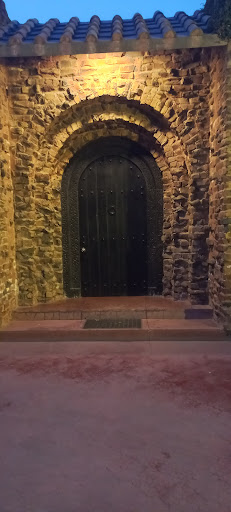
Good location. Easy to find. Street parking is available. Very interesting place.
There are many unusual places to visit in Lahore and one of them is the Shakir Ali Museum.
I am going to make an effort to give you an overall picture but I will refrain from giving you every chapter and verse because I believe you will be better off in seeing the place for yourself.
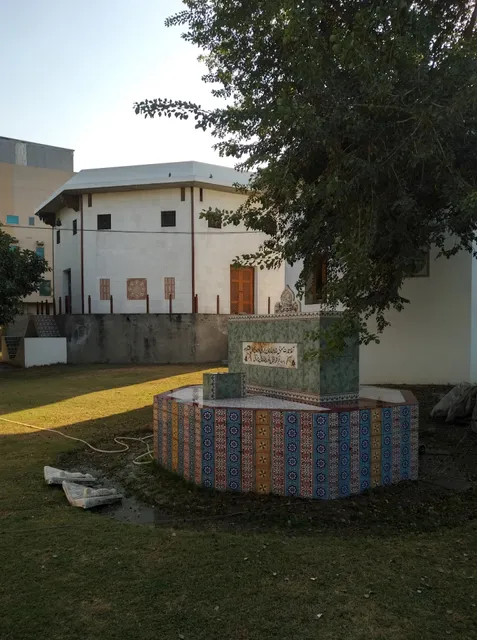
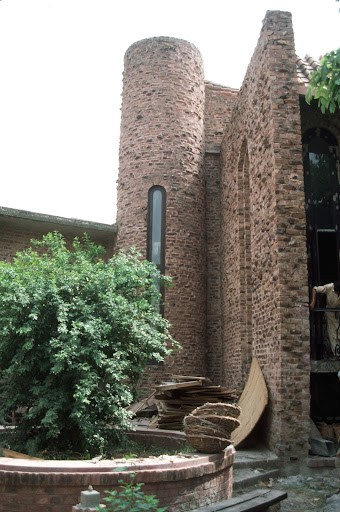
As soon as your glance at the museum from the outside, your immediate thought points to the fact that it looks like a small castle but one without a moat.
It is worthy of note that almost every aspect of this building has a uniqueness to it. Every human has a uniqueness but in an artist, this uniqueness is to a greater level.
Although Shakir Ali has long gone, yet, in his work we see a glimpse of who he was, a complicated man looking to get others to see who he was by putting his feelings and thoughts into painting, pictures, statues, writing and planting his ideas into his students.
There is no doubt there is some artwork in the building which some people will find offensive and I too turned away from these.
As it is often the case, some artists believe there is no RED LINE that they can not cross, and with Shakir Ali, this is the case.
Most certainly, this building has a unique artistic mind behind it.
It is highly unlikely that anyone will come across this type of brick structure in another building.
The building is constructed from a highly unusual red brick where there is no uniformity to the brick structure. The bricks are a deep, rusty colour with black marks.
It is almost as if the black marks were formed when the bricks were placed on a charcoal fire till some parts became black.
If a passerby looks at the assembly of the bricks and how they have been glued together to form the museum, they may be forgiven for thinking a child has put the bricks together.
No doubt it was a labour of love with the building taking almost a decade to complete.
Reliable sources say that almost every brick was chosen by the artist himself.
Of course, there is a uniqueness to Shakir Ali, and this is exactly what we expect from an artist. The whole building is an open plan unlike much of what we saw elsewhere when the building was erected. It is unlikely there is another building similar to this in Pakistan.
I was expecting an unusual and unique sleeping (bedroom) arrangement, but rather, what I found was to my complete surprise.
A very simple Charpai (a traditionally made bed . A wooden frame with interwoven natural-fiber ropes).
It was here that the great controversial artist, Shakir Ali, was born. At one point, he was an art teacher, and he rose to become the principal of the National College of Arts (NCA).
The current museum, named after the man himself, came into being after his death in 1975 when it was purchased by the Pakistan National Council of Arts (PNCA).
If you look carefully at the pictures I took, you will see many of his personal items as well as his works.
Among his works dotted around, there are many paintings and drawings, some sketches, many black and white photographs, some unusual furniture, and sculptures.
Like many other artists/painters, shakir Ali himself has also done some self- portraits.
It can be difficult for an ordinary person to comprehend the reasoning behind the design of a particular piece of art.
When you look carefully at any particular piece of artwork of Shakir Ali, just like other artists, it is difficult to understand the mood of the artist when he began the work and you wonder what it was like when he finished it.
In the basement, you will come across a cupboard with glass doors as well as another unit that houses numerous books. Just by looking at the books, you can tell that the age of the books is most likely to be a hundred or more.
This will lead us automatically to accept the fact that these books are antiques and very rare, hence the reasoning behind being kept under...
Read more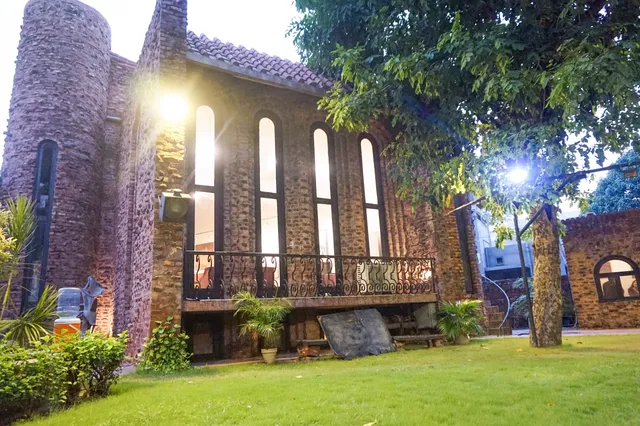
 Learn more insights from Wanderboat AI.