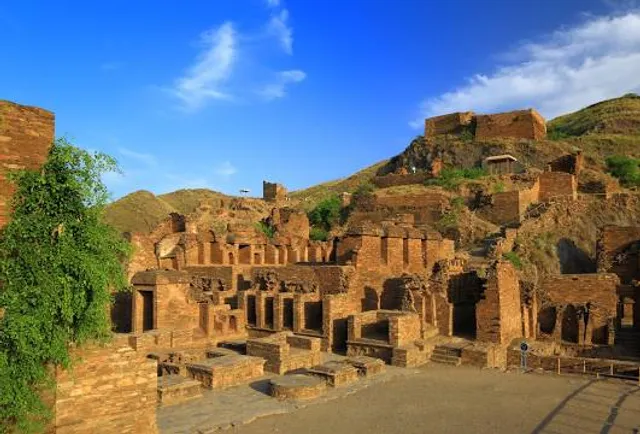
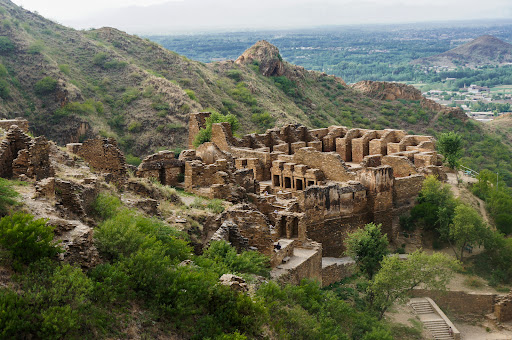
Takht-i-Bahi is an Indo-Parthian archaeological site of an ancient Buddhist monastery in Mardan, Khyber-Pakhtunkhwa, Pakistan. The site is considered among the most important relics of Buddhism in all of what was once Gandhara,and has been "exceptionally well-preserved."
The monastery was founded in the 1st century CE and was in use until the 7th century. The complex is regarded by archaeologists as being particularly representative of the architecture of Buddhist monastic centers from its era. Takht-i-Bahi was listed as a UNESCO World Heritage Site in 1980.
Etymology A monastery under the domain of Purusapura which was also a center for Buddhist learning, the origin of the name Takht-i-Bahi is uncertain. Local belief postulates that site got its name from two wells on the hill, or the springs nearby. In Persian, Takht means 'top' or 'throne' while bahi means 'spring' or 'water'. When combined, its meaning is 'spring from the top' or 'high spring', and there were two springs on the top of mountains. Another meaning suggested is 'throne of origin'.
Location The ruins are located about 15 kilometres (9.3 mi) from Mardan in Pakistan's Khyber-Pakhtunkhwa Province. A small, fortified city, dating from the same era, sits nearby. The ruins also sit near a modern village known by the same name. It is located around 150 metres (500 ft) atop the small hill and around 2 km (1.2 mi) from the village bazar. The surrounding area is known for sugar cane, wheat, maize, vegetable, and orchard cultivation. Once remote and little visited, the site now has a road and car park, set below the ruins, and has become popular with visitors.
Structure Aerial view of the ruins of the monastery There are four main areas of the Takht Bahi complex:
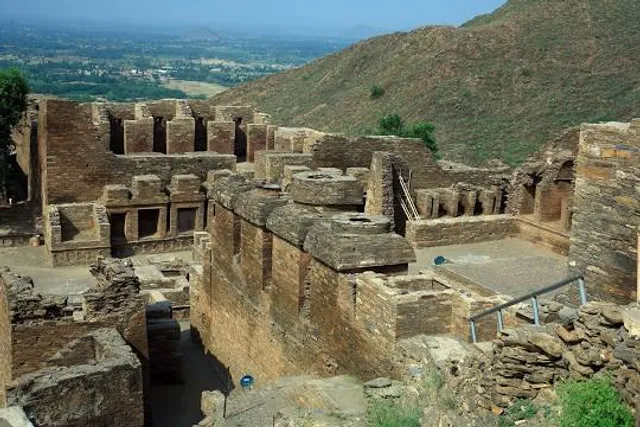
The Stupa Court, a cluster of stupas located in a central courtyard. The monastic chambers, consisting of individual cells arranged around a courtyard, assembly halls, and a dining area. A temple complex, consisting of stupas and similar to the Stupa Court, but of later construction. The Tantric monastic complex, which consists of small, dark cells with low openings, which may have been used for certain forms of Tantric meditation. Additional structures on the site may have served as residences or meeting halls, or for secular purposes. All of the buildings on the site are constructed from local stone and are mortared with lime and mud.
History Archaeologists have divided the history of the complex into four periods, beginning in the 1st century BCE. The monastic complex was likely founded in the early 1st century CE. It is proven by an inscription found bearing the name of Gondophares (20–46 CE). After Gondophares, the area fell under control of Kujula Kadphises, the first Kushan king. This first era continued until the 2nd century CE, and is associated with another Kushan king Kanishka, as well as early Parthian and subsequent Kushan kings. The second construction period, which included the creation of the Stupa Court and assembly hall, took place during the 3rd and 4th centuries CE. A third construction period, associated with the later Kushan dynasty and the Kidara Kushana rulers, occurred during the 4th and 5th centuries.
The region was subjugated by Huns in middle of fifth century CE which ended the Kushan rule. The Hun Toramana and then his son Mihirakula slaughtered the inhabitants of the Gandhara region and destroyed most if not all Buddhist monasteries. Evidence suggests that Takht-i-Bahi was destroyed in the same period of destruction by the Huns, however the complex appears to have been in use until 7th century CE. The first modern historical reference to these ruins was made in 1836 by a French officer who referred to the Buddhist remains in a village named Mazdoorabad. Explorations and excavations on the site began in 1864. A significant number of objects can be found in the British Museum. The site underwent a major restoration...
Read morethe Takht-i-Bahi, which translates to throne of the water spring. It is located in Mardan, Khyber Pakhtunkhwa, Pakistan and dates all the way back to the 1st Century CE. By the 1980’s, the Takht-i-Bahi was listed as the UNESCO World Heritage Site.
The Takht-i-Bahi is so well known because it is one of the last surviving Buddhist sites in that region, where it escaped destruction by several Gurjaras and Hun invasions; one of the greatest migrations of of Central Asian nomadic tribes in the history of Pakistan. The Hun invasions extends during the 5th and 6th centuries, and it is the turning point in the history of Pakistan both socially and politically. It was socially a turning point because the majority, if not all, of the tribes of Pakistan and Rajputana trace back to the Huns and Gurjaras. Research by scholars has been done to find evidence of earlier dynasties, but that has been completely lost. The Afghan-Pathan tribes and most of Rajput, Jat clans of the Punjab, and Sind are descended from the Huns. The Hun invasions broke the historical chain because these clans do not go back beyond the 8th century. Existing clans were formed sometime in the 6th century.
View of one of the Monastery Complex
The Hun and Gurjara invasions were also a political turning point for the people of Pakistan because they were the ruling class of Pakistan and northern India. During this time, Pakistan and India were entering the Medieval Period. The hordes of foreigners that had invaded were absorbed into the Hindu body politic and new grouping of states began to evolve. This period is also called the Rajput period, because the Medival Period was marked by the development of the Rajput clans and they began to play a permanent role after the death of Harsha, until the Muslims arrived. During the 5th and 6th centuries, when the Gurjaras and Hun expanded into Pakistan, they destroyed Buddha sites by the hundreds. Some monasteries and temples were able to escape this destruction, such as the Takht-i-Bahi monastery, because it was located in a remote location. It is one of the most preserved Buddhist sites in that region.
The history of the Takht-i-Bahi is divided into four different periods by archeologists, beginning in the 1st Century BCE. During the 1st century BCE, the monastery was built as a small stone monastery with inscriptions by Gondophares, who was king at the time. After the ruling of Gondophares, KujulaKadphises, the first Kushan king, took over. The 2nd century CE rolled in with another Kushan king, known as king Kanishka, then Parthian rulers took over, and then more Kushan kings.
Statues inside the Meditation Room
It wasn’t until the 3rd and 4th centuries CE that the second construction period of the Takht-i-Bahi began; this construction included the Stupa Court and assembly hall. A third construction was done to the Takht-i-Bahi in the 3rd and 4th centuries under Kushan dynasty and KidaraKushanrulers. The 6th and 7th centuries CE saw the final construction of the monastery under Hun rulers when they invaded. This final creation was the Tantric complex.
There were several invasions that wreaked havoc around the Takht-i-Bahi, yet despite that, it remained protected from destruction because of its hilltop location. During the 7th century, the monastery saw a decline, because Buddhist influences and monastery donations were dwindling. The monks abandoned the site, but it was later rediscovered in the second half of the 19th century. Chinese monk-pilgrim Xuanzang, traveled through India and Pakistan in search of Buddhists texts, when he first identified this monastery. However, the first to mention anything about the Takht-i-Bahi was French officer named General Court in the service of Maharaja Ranjit Singh in 1836. The monastery was also explored by Indian-born British officer Dr. Henry Walter...
Read moreTakht-i-Bahi: A Glimpse into Gandhara's Buddhist Past Takht-i-Bahi, nestled in the Mardan District of Khyber Pakhtunkhwa, Pakistan, stands as a testament to the rich Buddhist heritage of the Gandhara civilization. This ancient Buddhist monastery, dating back to the 1st century CE, offers a captivating glimpse into the past, showcasing the architectural and artistic brilliance of its time. A Well-Preserved Gem One of the most remarkable aspects of Takht-i-Bahi is its exceptional state of preservation. Perched atop a hill, the monastery complex escaped the ravages of time and invaders, allowing its intricate details to remain intact. The site's strategic location, combined with its robust construction, contributed to its enduring legacy. Key Features of Takht-i-Bahi Stupa Court: The central courtyard houses a magnificent stupa, a dome-shaped monument symbolizing the Buddha's enlightenment. Surrounding the stupa are smaller votive stupas, each bearing intricate carvings and sculptures.
Monastic Quadrangle: This area comprises a network of interconnected cells, halls, and passageways, providing a glimpse into the daily life of Buddhist monks. The quadrangle showcases the architectural sophistication of the Gandhara period.
Tantric Monastic Complex: A unique feature of Takht-i-Bahi is this complex, which reflects the influence of Tantric Buddhism, a mystical and esoteric branch of the religion.
Panoramic Views: The elevated position of the monastery offers breathtaking panoramic views of the surrounding landscape, including the ruins of Sahr-i-Bahlol, an ancient city. UNESCO World Heritage Site Recognizing its outstanding universal value, UNESCO inscribed Takht-i-Bahi as a World Heritage Site in 1980. The site's exceptional preservation, architectural significance, and cultural importance contribute to its global recognition. A Journey Through Time Visiting Takht-i-Bahi is like stepping back in time. As you wander through the ruins, you can almost imagine the monks meditating in their cells, the devotees circumambulating the stupa, and the vibrant life that once pulsated within these ancient walls. It is a journey that offers a profound connection to the rich Buddhist heritage of Gandhara and a testament to the enduring power of faith and...
Read more