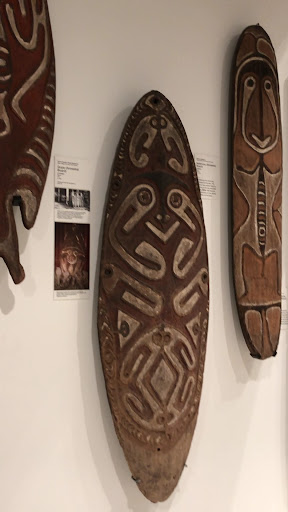
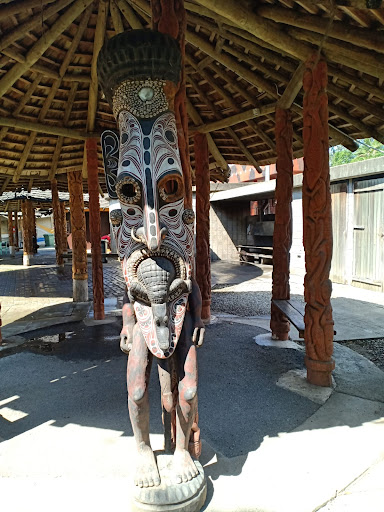
This is my personal favorite address in Port Moresby. When people say Papua New Guinea has over 800 tribes, each with its own distinct language, this museum is the living proof.
Unfortunately, it’s poorly managed. For starters, visitors are often left guessing whether it’s even open. The sign outside says it opens on Sundays from 1–3 PM, but on many Sundays I’ve visited, it’s been closed during those hours. I understand PNG is a Christian country, which may explain the closures, but Sunday is often the only day families are free to visit! A Monday closure, like many museums around the world do would make more sense.
I’ve heard that overseas visitors can sometimes arrange a private visit through their hotel when the museum is closed, though I haven’t confirmed this myself.
Another issue is the lack of recent publications. The last known collaboration was over a decade ago. For a museum that only displays a small portion of its full collection, publishing research or catalogues would be a great way to preserve and share PNG’s cultural knowledge, especially considering the country’s most prestigious university (UPNG) has a dedicated anthropology and archaeology department.
On my most recent visit, only half the museum was open. Entry was through the back door, tickets were inconsistently charged with no receipts, even parking was charged “per person”, not per car, again with no receipt. It all felt very opaque.
The displays themselves need attention too. Some labels are inaccurate, for example, a bilum described as having seeds is clearly decorated with cowrie shells and other seashells. It is also unmistakably from the sepik region, but the origin isn’t mentioned on the label card. With PNG’s vast cultural richness, these details should be better provided.
Other practical issues include broken air conditioning, understaffing, and a lack of supervision, parents often let young kids run around the artifacts unchecked.
Despite all this, I love this museum. It’s a treasure trove of PNG’s cultural heritage and identity, and a rare space where so many of its diverse traditions are brought together under one roof. Not to be missed by any POM residents...
Read moreThe Papua New Guinea National Museum and Art Gallery (NMAG) in Port Moresby is generally well-regarded, with reviews praising its diverse collection of artifacts and art, including musical instruments, masks, and weaponry from various regions of PNG. Some reviews suggest that the museum is a good introduction to PNG's cultural heritage. However, some visitors have noted a decline in the museum's condition and funding. Here's a more detailed breakdown of the reviews: Positive Aspects: Rich and diverse collection: The museum boasts a wide array of artifacts and art, offering a glimpse into PNG's varied cultural traditions. Educational and informative: Exhibits provide context and interpretations of the artifacts, making the museum an educational experience. Well-organized and thematic: The museum is organized by theme, making it easy to navigate and learn about different aspects of PNG's culture. Remodeled and well-presented: Lonely Planet notes that the museum was beautifully remodeled for PNG's 40th anniversary of independence. Variety of artifacts: Visitors can find examples of musical instruments, body adornments, ceremonial drums, seafaring equipment, masks, and totem poles from various regions. Negative Aspects: Potential for decline: Some reviewers have observed a decline in the museum's condition and funding, with some suggesting that it may not be well-maintained. Limited refreshments: There is no cafe or food/drink options within the museum, so visitors are advised to bring their own snacks and water. Potential for disappointment: Some reviews caution that the museum might be underwhelming despite its efforts, especially given the vastness of...
Read moreThe National Museum and Art Gallery is a perfect place where you get to see the history and modern history of our beautiful country. The area is packed with artefacts including the famous lakatoi boat, the door of the airplane where Yamamoto had flown. They also have a wide collection of Natural history, world war 2 remains (with voice recorded history, narrated (with translation) either in one of the 800 local languages or in English.
There's also an Australian boot in the museum. This boot contains Japanese bones. Go for yourself and see how a Japanese bone ended up in an Australian boot.
Many of the carvings there signifies events and customs of our country. Birds, mammals and all you need to know is there.
I suggest you take a look around and see for yourself. There's always someone around at every turn to help you whenever you need...
Read more